Call CA Tally HelpDesk
+91 9205471661,
7428779101
Why Smarter Business Operations Matter More Than Ever
Running a successful business requires more than selling products, managing customers and recording financial transactions. Every growing organization must coordinate accounting, inventory, purchasing, sales, payments and financial reporting while maintaining accuracy and operational efficiency.
For many Indian businesses, managing these activities through spreadsheets, handwritten records and disconnected software applications creates unnecessary complications. Duplicate entries, inventory shortages, delayed customer payments and inaccurate financial reports can affect profitability.
This is where Tally Prime helps businesses simplify everyday operations through integrated accounting, inventory management, GST compliance and financial reporting.
Whether you operate a wholesale business, manufacturing unit, retail store, distribution company or professional services organization, Tally Prime provides practical features to improve visibility and control.
Its advanced business operations capabilities help organizations manage transactions efficiently, monitor stock movements, track outstanding payments and make informed financial decisions.
By connecting important business activities within a structured accounting environment, companies can reduce repetitive work and focus on customer satisfaction, operational improvement and sustainable growth.
1. Understanding Advanced Business Operations Management
Business operations management involves planning, organizing and monitoring the activities required to deliver products or services successfully.
These activities generally include:
-
Managing sales orders and customer invoices.
-
Recording purchases and supplier payments.
-
Maintaining accurate financial accounts.
-
Monitoring inventory quantities and stock movements.
-
Tracking receivables and payables.
-
Managing GST-related transactions.
-
Evaluating business profitability.
-
Generating operational and financial reports.
When these activities operate independently, employees may need to enter the same information into multiple systems.
For example, a wholesale distributor might maintain inventory in Excel, generate invoices through separate billing software and record accounting transactions manually.
This arrangement increases administrative effort and makes reconciliation difficult.
An integrated solution such as Tally Prime connects accounting and inventory transactions, helping businesses maintain consistent records and improve operational coordination.
2. Faster Accounting with Integrated Financial Management
Accounting is the foundation of effective business management. Accurate financial records help organizations understand income, expenditure, liabilities, assets and overall financial performance.
Tally Prime simplifies accounting by supporting systematic transaction recording and comprehensive financial reporting.
Automated Accounting Through Business Transactions
When properly configured, sales and purchase vouchers can update relevant accounting ledgers automatically.
For example, recording a credit sales invoice can update the customer's outstanding balance, sales account and applicable tax ledgers.
This reduces the need for separate journal entries for routine transactions.
Ledger and Voucher Management
Businesses can maintain ledgers for customers, suppliers, expenses, income, banks and other financial accounts.
Common voucher types include:
-
Sales and purchase vouchers.
-
Payment and receipt vouchers.
-
Contra vouchers.
-
Journal vouchers.
-
Debit notes and credit notes.
These records help maintain an organized audit trail and support financial reconciliation.
Financial Statements
Tally Prime provides reports such as Balance Sheet, Profit and Loss Account, Trial Balance, Cash Flow and other accounting statements.
Business owners can use these reports to evaluate financial performance without waiting until the end of the financial year.
Business Benefit: Faster accounting reduces administrative effort, improves accuracy and provides better financial visibility.
3. Smarter Sales Management and Professional Invoicing
Sales management directly influences customer satisfaction, revenue generation and business profitability.
Businesses handling numerous daily transactions require a reliable system for generating invoices, maintaining customer records and monitoring sales performance.
Tally Prime supports sales invoicing with configurable invoice formats, tax details, item information and customer-specific transactions.
Key Sales Management Features
GST-Ready Invoicing
Businesses can generate GST invoices with relevant tax classifications, GSTIN details, HSN or SAC information and applicable tax calculations.
Sales Order Management
Sales orders help businesses record customer requirements before preparing invoices.
Delivery Note Management
Where applicable, delivery notes support the movement of goods and can be linked to subsequent sales transactions.
Credit Sales Tracking
Customer outstanding reports help identify unpaid invoices and overdue balances.
Sales Analysis
Sales reports allow businesses to review transaction values, customer performance and item-wise sales.
For example, an electrical goods distributor can examine which products generate higher sales and which customers have pending payments.
This information supports better pricing, customer service and credit management.
4. Advanced Inventory Control for Better Stock Visibility
Inventory is one of the most valuable assets for trading, retail, distribution and manufacturing businesses.
Poor inventory management can create two serious problems: excessive stock that blocks working capital and insufficient stock that causes lost sales.
Tally Prime provides inventory management capabilities that help businesses maintain accurate stock records.
Stock Groups and Stock Categories
Businesses can organize products into meaningful classifications.
For example, an electronics distributor may create stock groups for laptops, printers, accessories and networking equipment.
Stock categories can provide an additional classification across different stock groups.
Multiple Units of Measurement
Businesses can maintain suitable units such as pieces, boxes, kilograms, litres and metres.
Godown and Location Management
Organizations operating multiple warehouses can track inventory across different storage locations.
This helps identify where stock is available and supports better distribution planning.
Batch-Wise Inventory Tracking
Businesses dealing with suitable batch-controlled products can maintain batch details and, where configured, expiry information.
This is particularly useful for selected pharmaceutical, food and other inventory-sensitive operations.
Reorder Levels
Reorder levels help identify stock items that require replenishment.
Instead of waiting for inventory to become unavailable, businesses can monitor stock requirements and plan purchases.
Stock Reports
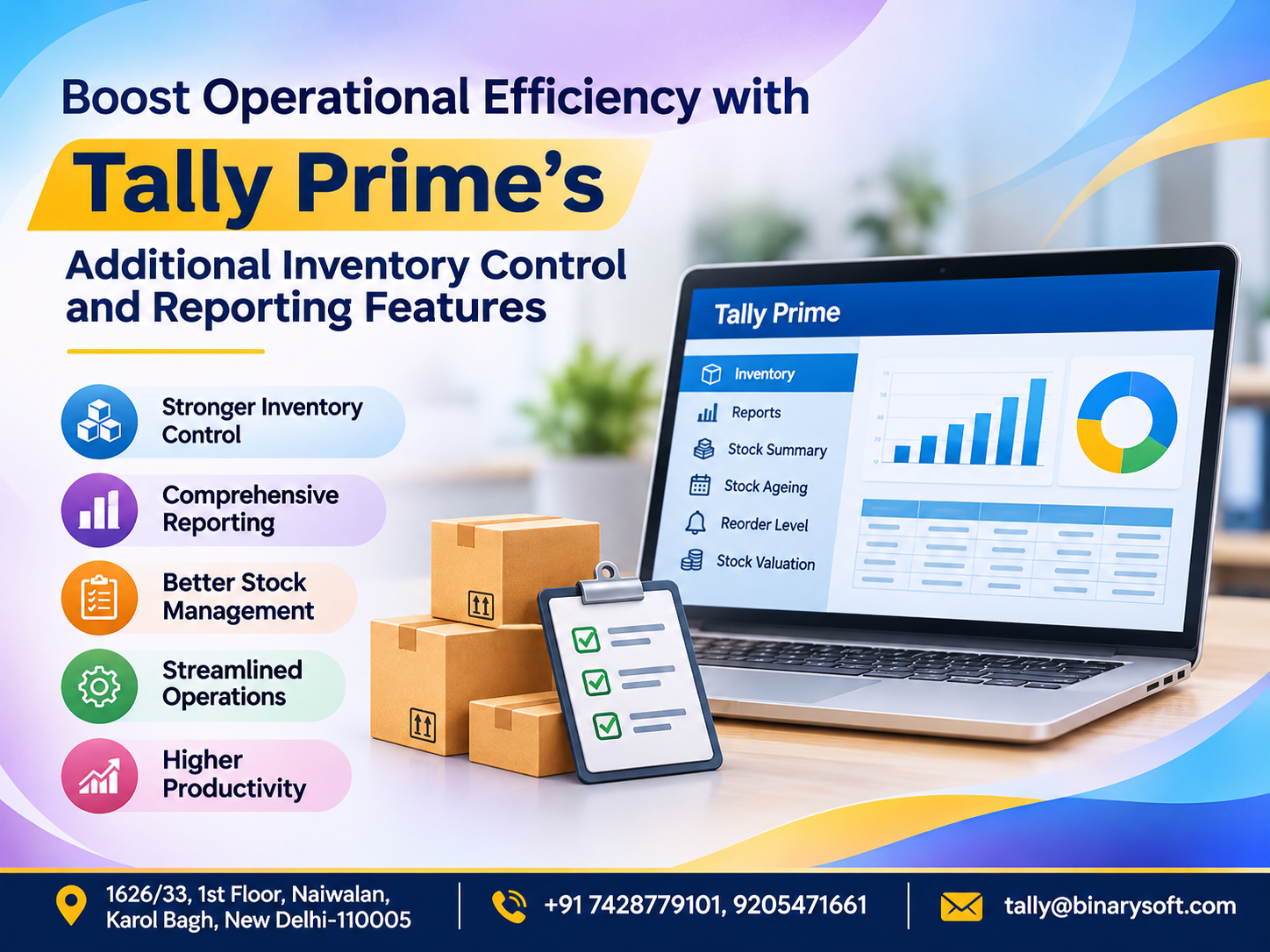
Stock Summary, movement reports and other inventory views help management review stock quantities and values.
Business Benefit: Better inventory visibility reduces stock discrepancies, improves purchasing decisions and supports more efficient working capital management.
5. Efficient Purchase Management and Supplier Coordination
Purchasing plays an important role in maintaining product availability and controlling operating costs.
Unplanned purchases can increase expenses, while delayed procurement can interrupt business activities.
Tally Prime helps organizations manage purchasing transactions through structured records.
Purchase Orders
Purchase orders allow businesses to document intended purchases, including product details, quantities and agreed rates.
Receipt Notes
Receipt notes can record goods received before the corresponding purchase invoice is entered.
Purchase Invoices
Businesses can record supplier invoices and maintain associated accounting and inventory information.
Supplier Outstanding Reports
Outstanding payable reports help management understand payment obligations and plan supplier settlements.
Purchase Analysis
Purchase-related reports help businesses review procurement values and purchasing patterns.
For example, a furniture manufacturer can compare material purchases, monitor supplier balances and coordinate procurement with production requirements.
This reduces dependence on scattered paperwork and improves purchasing transparency.
6. Better Cash Flow Management and Payment Tracking
A profitable business can still experience financial difficulties when customer payments are delayed or working capital is poorly managed.
Cash flow management helps organizations maintain sufficient funds for salaries, supplier payments, rent and daily expenses.
Tally Prime provides financial reports and outstanding management features that support better cash planning.
Receivables Management
Businesses can review customer-wise outstanding balances and identify overdue invoices.
Bill-wise accounting helps maintain references for individual transactions.
Payables Management
Supplier outstanding reports help businesses plan payments and monitor financial obligations.
Cash and Bank Reports
Cash Book and Bank Book reports provide visibility into recorded transactions.
Bank Reconciliation
Bank reconciliation features help businesses match accounting records with bank transactions and identify differences.
Supported bank-related capabilities may vary depending on the bank, configuration and software release.
Cash Flow Reporting
Cash Flow reports help management evaluate recorded cash movements and understand financial requirements.
By regularly reviewing receivables, payables and cash balances, businesses can make better decisions about spending, purchasing and customer credit.
7. GST Management and Accurate Tax Records
GST compliance is an important responsibility for registered Indian businesses.
Errors in tax classification, invoice information or transaction recording can create reconciliation difficulties and compliance risks.
Tally Prime supports GST-related accounting and reporting through structured transaction records.
GST Features for Business Operations
Businesses can maintain GST registration information, tax classifications, applicable rates and transaction details.
GST-enabled invoices help capture the information required for relevant business transactions.
GST reports assist in reviewing outward supplies, inward supplies and tax-related records.
Depending on the applicable release, subscription, configuration and eligibility, connected GST capabilities may also support selected return preparation, reconciliation and related activities.
However, businesses should always verify tax data, applicable rules and filing requirements before submitting returns.
Why GST Integration Matters
When accounting and GST information are maintained together, businesses can reduce duplicate data entry and improve transaction consistency.
For example, a distributor processing hundreds of invoices can review sales records and tax information from the same accounting environment.
This improves efficiency during monthly compliance reviews.
8. Business Workflow Management Through Connected Processes
One of the most valuable aspects of Tally Prime is its ability to connect related business activities.
Consider a typical sales workflow.
A customer places an order. The business records the sales order, checks available inventory, prepares a delivery note where required and generates the sales invoice.
The invoice updates relevant accounting records, while inventory movement is reflected according to the voucher configuration.
When the customer makes payment, the receipt can be recorded against the outstanding invoice.
This creates a structured flow from customer order to payment collection.
Similarly, a purchase workflow may involve a purchase order, receipt note, supplier invoice and payment entry.
These connected processes improve record consistency and reduce repeated administrative work.
Although Tally Prime is not a complete project-management or enterprise workflow automation platform, its transaction-linked features can substantially improve everyday operational coordination.
9. Management Reports for Better Business Decisions
Successful business owners need reliable information rather than assumptions.
Tally Prime provides reports that help management understand business performance and identify areas requiring attention.
Important reports include:
Profit and Loss Account: Evaluates income, expenses and profitability.
Balance Sheet: Presents assets, liabilities and financial position.
Stock Summary: Displays inventory quantities and values.
Outstanding Reports: Identifies receivables and payables.
Sales Register: Provides detailed sales transaction information.
Purchase Register: Helps review procurement transactions.
Cash Flow Report: Supports cash movement analysis.
Cost Centre Reports: Help analyze allocated income and expenses where cost centres are configured.
For example, a company operating three branches can use appropriate accounting structures and cost centres to evaluate financial performance across business units.
Management can identify profitable activities, monitor expenditure and improve resource allocation.
10. User Access, Data Security and Operational Control
As businesses grow, multiple employees may need access to accounting information.
However, unrestricted access can increase the risk of unauthorized changes and operational mistakes.
Tally Prime provides user and security controls that can help businesses manage access according to responsibilities, subject to the edition and configuration used.
Organizations can define suitable permissions for employees handling sales, purchases, accounting and administration.
Regular data backups are also essential for protecting business information.
Businesses should maintain a documented backup schedule, verify restoration procedures and protect backup files against unauthorized access.
For organizations requiring remote access, a properly configured cloud-hosted Tally environment can support access from different locations, subject to network availability, hosting arrangements, licensing and security controls.
These practices help organizations maintain business continuity and improve accountability.
11. How Tally Prime Supports Business Growth
Business growth creates additional operational complexity.
A company processing twenty invoices daily may eventually process hundreds. Inventory may expand from fifty products to thousands, while customer and supplier relationships become more demanding.
Without organized systems, this growth can overwhelm employees.
Tally Prime helps businesses establish a structured accounting and inventory foundation.
As transaction volumes increase, organizations can maintain consistent records, monitor outstanding balances and review operational reports.
Businesses can also use suitable configurations for multiple companies, inventory locations, cost centres and different reporting requirements.
The result is better financial visibility and improved operational discipline.
Software alone does not guarantee growth, but accurate information and efficient processes can help management make stronger decisions.
12. Real-Life Inspired Story: The Business Owner Who Almost Lost His Dream
The following is an illustrative story based on common challenges faced by growing Indian businesses.
For fifteen years, Rajesh operated a small electrical wholesale business in Delhi.
He started with a modest investment, a rented shop and a dream of building a financially secure future for his family.
Over time, his business expanded. More customers arrived, suppliers increased and daily sales became difficult to manage.
Yet Rajesh continued relying on notebooks and spreadsheets.
One afternoon, an important customer requested a large quantity of electrical switches.
Rajesh confidently accepted the order, believing sufficient stock was available.
When his employees checked the warehouse, they discovered that the actual inventory was much lower than the recorded quantity.
The order was delayed, and the customer decided to purchase elsewhere.
That evening, Rajesh sat silently in his shop, surrounded by unpaid invoices and inventory registers.
He had worked tirelessly for years, yet he felt that his business was slipping beyond his control.
His daughter noticed his frustration and asked, "Papa, why do you work so hard if you still cannot come home peacefully?"
The question stayed with him.
Rajesh decided to reorganize his business using Tally Prime.
He created proper stock records, organized customer ledgers, configured inventory locations and started reviewing outstanding payments regularly.
Gradually, his employees developed a more disciplined system for recording transactions.
Rajesh could identify stock shortages earlier, review customer balances and understand financial performance more clearly.
The greatest change was not simply faster accounting.
It was the confidence of knowing what was happening inside his business.
One evening, he closed his shop on time and returned home to have dinner with his family.
For Rajesh, better business management meant something more valuable than reports and numbers.
It meant peace of mind.
13. Case Study One: Wholesale Distributor Improves Inventory and Billing
Illustrative case study with hypothetical business figures.
Business Background
A Delhi-based electrical products distributor handled approximately 1,500 inventory items and served retailers across several markets.
The business relied on spreadsheets for inventory management and separate records for customer payments.
Challenges
Stock discrepancies were common, invoice preparation was time-consuming and customer outstanding balances were difficult to review.
Tally Prime Implementation
The company introduced structured stock groups, inventory locations, GST invoicing and bill-wise outstanding tracking.
Employees were trained to record sales, purchases and receipts consistently.
Illustrative Results
After three months, the business estimated that routine invoice preparation time had fallen from approximately eight minutes to four minutes per invoice.
Management also gained more reliable stock information and improved visibility into overdue customer payments.
Key Learning
Integrated accounting and inventory records can improve efficiency when supported by accurate opening balances, employee training and disciplined transaction entry.
14. Case Study Two: Manufacturing Business Strengthens Purchase and Cost Control
Illustrative case study with hypothetical business figures.
Business Background
A small furniture manufacturing company in Jaipur purchased timber, hardware and finishing materials from multiple suppliers.
The company faced difficulties monitoring material consumption and evaluating production-related expenditure.
Challenges
Purchasing decisions were often made without reviewing available inventory. Supplier balances were maintained separately, and management lacked timely cost information.
Tally Prime Implementation
The company configured inventory items, purchase orders, stock locations and suitable manufacturing-related inventory vouchers.
Cost centres were introduced for selected expense tracking requirements.
Supplier invoices and payments were recorded through structured accounting processes.
Illustrative Results
Within six months, management reported improved visibility into material availability and supplier obligations.
Illustrative internal estimates suggested a reduction in avoidable emergency purchases and better coordination between purchasing and production teams.
Key Learning
A structured inventory and accounting system helps manufacturing businesses improve material planning, financial reporting and operational control.
15. Practical Steps to Implement Tally Prime Successfully
Businesses planning to improve operations should follow a structured implementation process.
Step 1: Review Existing Processes
Identify problems in accounting, inventory, invoicing, purchasing and payment tracking.
Step 2: Prepare Accurate Master Data
Create customer and supplier ledgers, stock items, tax classifications and other required records.
Step 3: Configure Business Features
Enable appropriate accounting, inventory, GST and security features according to operational requirements.
Step 4: Establish Opening Balances
Verify opening financial balances, inventory quantities and outstanding bill references.
Step 5: Train Employees
Provide practical training on vouchers, invoices, stock movements and reports.
Step 6: Review Reports Regularly
Monitor stock summaries, outstanding payments, profitability and cash flow.
Step 7: Maintain Backups and Controls
Introduce periodic backups, access restrictions and data verification procedures.
A carefully planned implementation can help businesses achieve more consistent and dependable results.
Conclusion: Build a Smarter and More Profitable Business with Tally Prime
Efficient business operations are essential for long-term profitability and sustainable growth.
Organizations that maintain accurate accounting records, monitor inventory carefully and manage payments systematically are better positioned to respond to market changes.
Tally Prime brings together important business management capabilities, including accounting, GST invoicing, inventory control, purchase management, outstanding tracking and financial reporting.
Its integrated approach helps reduce repetitive work, improve transaction visibility and support informed decisions.
Whether a business is beginning its digital transformation or improving an existing accounting system, Tally Prime can provide a practical foundation for operational efficiency.
The real objective is not merely to maintain accounts faster. It is to build a business where owners understand their finances, employees follow reliable processes and customers receive dependable service.
With proper implementation, training and ongoing support, businesses can transform everyday operations into a stronger foundation for future growth.
Powered by Binarysoft Technologies
Authorized Tally Partner
Location: 1626/33, 1st Floor, Naiwalan, Karol Bagh, New Delhi – 110005, INDIA
Contact Us: +91 7428779101, 9205471661
Email: tally@binarysoft.com
Business Hours: 10:00 AM – 6:00 PM, Monday to Friday
Frequently Asked Questions
What are advanced business operations features in Tally Prime?
Advanced business operations features include integrated accounting, inventory management, sales invoicing, purchase tracking, GST reporting, outstanding management and financial analysis. These capabilities help businesses maintain organized records and improve operational efficiency.
How does Tally Prime improve accounting speed?
Tally Prime links relevant business vouchers with accounting ledgers, reducing the need for duplicate entries. It also provides financial statements and transaction reports that help accountants review records more efficiently.
Can Tally Prime manage inventory across multiple warehouses?
Yes. Businesses can configure multiple godowns or inventory locations to track stock across different warehouses and storage facilities.
Is Tally Prime suitable for small businesses?
Yes. Tally Prime can be used by small retailers, wholesalers, service providers and other businesses that require structured accounting, invoicing and financial reporting.
CA. Reyansh Kulkarni has expertise in GST advisory, accounting compliance, and financial planning. He frequently contributes articles on digital accounting, inventory management, and modern financial practices for businesses.