Call CA Tally HelpDesk
+91 9205471661,
7428779101
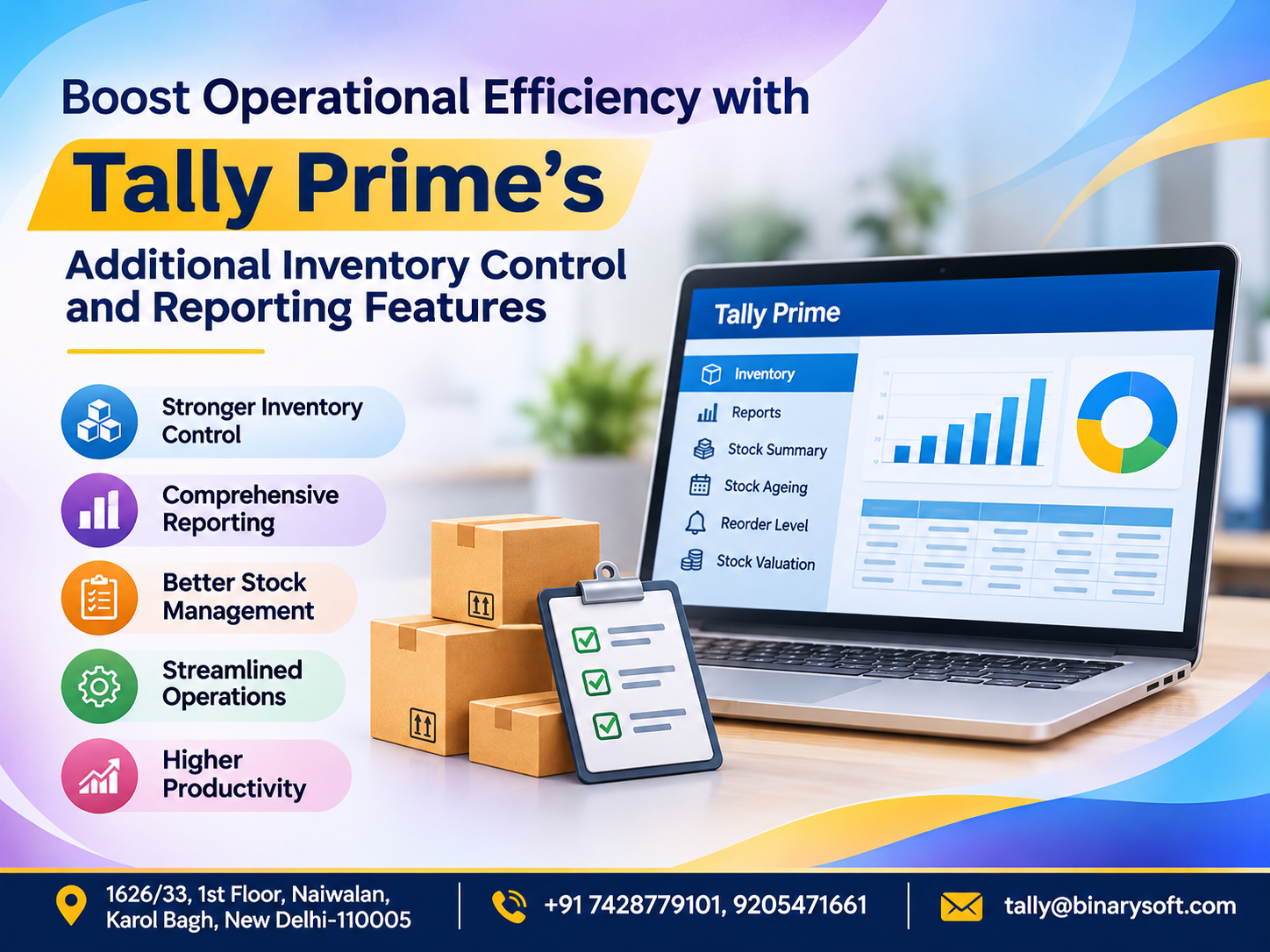
SEO Title: Boost Operational Efficiency with Tally Prime Inventory Control and Reporting Features
Meta Description: Discover how Tally Prime improves inventory management, stock tracking, warehouse control, reorder planning, batch management, inventory valuation and business reporting for growing businesses.
Focus Keywords: Tally Prime inventory management, inventory control software, Tally Prime stock reports, inventory tracking, warehouse management, stock ageing analysis, reorder levels, inventory accounting software India.
Introduction: Why Smarter Inventory Management Is Essential for Business Growth
Inventory is one of the most valuable assets of any trading, manufacturing, wholesale, distribution or retail business. However, managing inventory efficiently becomes increasingly challenging as businesses expand their product range, serve more customers and operate across multiple locations.
A business may generate impressive sales but still struggle with profitability because of excess stock, delayed purchases, inaccurate inventory records or inefficient warehouse operations.
Imagine a wholesaler receiving an urgent order for 500 units of a popular product. The accounting records show sufficient stock, but the warehouse team discovers that only 300 units are physically available. The remaining stock was incorrectly recorded or transferred without proper documentation.
Such situations can damage customer relationships, delay deliveries and increase operational expenses.
This is where Tally Prime inventory management features help businesses improve stock visibility, maintain accurate records and make better operational decisions.
Tally Prime combines inventory accounting, stock monitoring, warehouse tracking, purchase management and financial reporting within a structured business management environment.
By using its additional inventory control and reporting capabilities, businesses can reduce manual work, identify stock-related problems earlier and improve overall operational efficiency.
1. Understanding Inventory Control and Its Importance
Inventory control refers to the process of monitoring, organizing and managing goods throughout their movement within a business.
It includes purchasing materials, receiving stock, storing products, transferring inventory, recording sales and maintaining accurate stock balances.
Effective inventory control ensures that businesses maintain appropriate stock quantities without unnecessarily increasing storage expenses.
Major Objectives of Inventory Control
-
Maintain accurate records of available stock.
-
Prevent unnecessary overstocking and shortages.
-
Improve purchasing and replenishment decisions.
-
Reduce inventory carrying costs.
-
Monitor warehouse-wise stock movement.
-
Identify slow-moving and obsolete inventory.
-
Improve order fulfilment and customer satisfaction.
-
Support accurate accounting and profitability analysis.
For businesses handling hundreds or thousands of products, maintaining these records manually can become difficult.
An integrated inventory accounting system reduces repetitive work and helps management access reliable information whenever required.
2. How Tally Prime Improves Inventory Management
Tally Prime provides inventory management capabilities that connect stock transactions with accounting records.
When a business records purchases, sales, stock transfers or manufacturing transactions correctly, the corresponding inventory information can be reflected in relevant reports.
This integration helps reduce inconsistencies between inventory records and financial accounts.
Important Inventory Management Capabilities
Stock Item Management
Businesses can create individual stock items with relevant names, units, classifications and applicable tax details.
Stock Groups
Products can be organized into categories for easier monitoring and reporting.
Stock Categories
Businesses can classify products across different stock groups using additional product characteristics.
Godown Management
Inventory can be monitored across multiple warehouses, branches or storage locations.
Batch-Wise Inventory
Businesses can track products using batch numbers and applicable expiry information.
Reorder Level Monitoring
Management can identify products requiring replenishment based on configured inventory thresholds.
Inventory Reports
Stock summaries, movement reports, ageing analysis and valuation information help businesses understand inventory performance.
These capabilities are particularly useful for wholesalers, distributors, manufacturers and retailers managing large product portfolios.
3. Advanced Stock Classification for Better Inventory Organization
Proper inventory classification is essential for managing large product databases.
Without structured classification, employees may struggle to identify products, generate meaningful reports or understand stock availability.
Tally Prime allows businesses to organize inventory using stock groups, categories and individual stock items.
Stock Groups
Stock groups help businesses organize products based on their nature or business classification.
For example, an electrical goods distributor may create groups such as:
Each group can contain multiple stock items.
Management can review inventory performance at the individual product level or group level.
Stock Categories
Stock categories provide another method of classifying inventory.
For example, a clothing retailer may maintain stock groups for shirts, trousers and jackets while using categories to classify products by brand or other relevant attributes.
This makes it easier to analyze inventory from different business perspectives.
Benefits of Structured Classification
Proper stock classification improves product identification, reporting accuracy, inventory analysis and purchasing decisions.
It also helps employees work more efficiently because products are organized consistently.
4. Multi-Warehouse and Godown Management
Businesses operating from multiple warehouses often experience difficulties tracking stock movement between locations.
A product may be available in one warehouse but unavailable in another.
Without accurate location-wise information, employees may purchase additional inventory even when sufficient stock exists elsewhere.
Tally Prime supports godown management to help businesses monitor inventory across different storage locations.
Example
A wholesale business operates three warehouses:
| Warehouse | Available Stock |
|---|
| Delhi |
1,200 units |
| Noida |
850 units |
| Gurugram |
650 units |
| Total |
2,700 units |
Instead of maintaining separate spreadsheets, the business can record location-wise stock and review consolidated inventory information.
When stock moves from Delhi to Noida, the transfer can be recorded through an appropriate stock journal.
This helps maintain accurate location-wise balances.
Operational Benefits
Multi-location inventory tracking helps businesses reduce unnecessary purchases, improve stock allocation and manage warehouse transfers.
It also supports better customer service because sales teams can identify available inventory at different locations.
5. Batch-Wise Inventory Tracking and Expiry Management
Batch management is especially important for businesses dealing with products that have manufacturing batches, expiry dates or specific quality requirements.
Industries such as food processing, pharmaceuticals, cosmetics and chemical distribution frequently require detailed batch records.
Tally Prime supports batch-wise inventory tracking where the feature is configured and used appropriately.
Businesses can record relevant batch information and monitor stock associated with particular batches.
Example
A food distributor purchases 1,000 packets of packaged products in two batches.
Batch A contains 600 packets with an earlier expiry date.
Batch B contains 400 packets with a later expiry date.
By maintaining accurate batch information, the distributor can identify products requiring priority attention.
This supports better inventory rotation and reduces the risk of unsold expired products.
Why Batch Tracking Matters
Batch tracking improves product traceability, expiry monitoring and stock identification.
It can also support investigations involving damaged goods, quality complaints or product recalls.
However, businesses must establish suitable physical stock rotation procedures alongside software records.
6. Reorder Levels for Preventing Stock Shortages
Stock shortages can interrupt sales and damage customer relationships.
At the same time, excessive purchases can increase storage expenses and block working capital.
Reorder level management helps businesses maintain a balance between stock availability and inventory investment.
Tally Prime allows businesses to configure reorder levels and minimum order quantities for stock items.
Example of Reorder Planning
Consider a hardware distributor selling approximately 20 units of a product daily.
The supplier normally requires five days to deliver new stock.
The business also wants to maintain 30 units as safety stock.
A simple planning calculation is:
Reorder Level = Expected Demand During Lead Time + Safety Stock
Reorder Level = (20 × 5) + 30
Recommended Planning Threshold = 130 Units
This is an illustrative calculation that management can use when deciding an appropriate reorder level.
Once suitable levels are configured, inventory reports can help identify products requiring replenishment.
Business Advantages
Reorder planning can reduce emergency purchases, improve product availability and prevent excessive stock accumulation.
It is particularly beneficial for businesses managing frequently purchased products with predictable demand.
7. Stock Ageing Analysis for Better Working Capital Management
Slow-moving inventory is a common problem among wholesalers, retailers and distributors.
Products that remain unsold for extended periods occupy warehouse space and block money that could otherwise support business growth.
Stock ageing analysis helps businesses identify inventory that has remained in stock for different periods.
Tally Prime provides stock ageing information that can support management decisions.
Example of Inventory Ageing
| Stock Age | Inventory Value |
|---|
| 0–30 Days |
₹4,50,000 |
| 31–60 Days |
₹2,80,000 |
| 61–90 Days |
₹1,60,000 |
| Above 90 Days |
₹3,10,000 |
<em>Illustrative figures.</em>
In this example, ₹3,10,000 is tied up in inventory older than 90 days.
Management can investigate whether these products require promotional offers, revised purchasing policies or better sales planning.
Stock ageing reports are useful for identifying inventory risks, although ageing alone does not prove that a product is obsolete.
8. Inventory Valuation and Financial Accuracy
Inventory valuation directly affects financial reporting and profitability.
Incorrect stock valuation can result in misleading financial statements and poor management decisions.
Tally Prime supports inventory valuation methods that businesses can configure according to their accounting requirements and the nature of their products.
Common approaches include FIFO and average-cost-based valuation, subject to the available configurations and applicable accounting policies.
Why Inventory Valuation Matters
Accurate inventory valuation supports:
-
Cost of goods sold calculations.
-
Gross profit analysis.
-
Closing stock reporting.
-
Financial statement preparation.
-
Inventory investment analysis.
-
Better purchasing decisions.
For example, a distributor purchasing identical products at different prices needs a consistent valuation policy.
Applying appropriate valuation methods helps management understand inventory costs more accurately.
Businesses should select valuation methods in consultation with their accounting professionals and follow applicable financial reporting requirements.
9. Inventory Reporting Features for Better Decision-Making
One of the major advantages of Tally Prime is its ability to provide inventory-related reports based on recorded transactions.
These reports help business owners move beyond guesswork and make decisions using available business information.
Stock Summary Report
The Stock Summary provides an overview of inventory quantities and values.
Businesses can review stock information and drill down into relevant details.
Stock Movement Analysis
Stock movement reports help identify products experiencing frequent or limited movement.
This information supports purchasing and sales planning.
Stock Item-Wise Profitability
Where relevant transaction information is maintained, profitability analysis can help businesses evaluate product performance.
Management can identify products generating stronger margins and those requiring further investigation.
Godown-Wise Stock Reports
Location-wise reporting helps businesses monitor stock distributed across warehouses.
Stock Ageing Reports
These reports help identify inventory held for extended periods.
Inventory Valuation Reports
Valuation information supports accounting review and inventory investment analysis.
Together, these reports improve management visibility and help businesses respond more quickly to operational problems.
10. Connecting Inventory with Purchase and Sales Operations
Inventory management becomes more effective when purchasing and sales activities are recorded systematically.
Tally Prime supports purchase and sales voucher workflows, including order-related processes where configured.
Purchase Management
Businesses can record purchase orders, receipts and supplier invoices using appropriate transaction workflows.
This helps improve documentation and inventory accuracy.
Sales Management
Sales orders, delivery-related records and sales invoices can help businesses maintain a structured order fulfilment process.
Accounting Integration
Inventory-related transactions can be connected with accounting information, reducing the need to maintain completely separate records.
Operational Advantages
Integrated workflows can help reduce duplicate entries, improve transaction visibility and support more accurate financial reporting.
However, businesses must establish suitable approval procedures and ensure employees record transactions consistently.
11. Inventory Control for Manufacturing Businesses
Manufacturing businesses require inventory systems that track raw materials, production consumption and finished goods.
Tally Prime supports manufacturing-related inventory workflows, including stock journals and bill of materials functionality where applicable.
Bill of Materials
A bill of materials identifies the components and quantities required to manufacture a finished product.
For example, a furniture manufacturer producing one office table may require:
| Material | Required Quantity |
|---|
| Wooden Board |
2 Pieces |
| Metal Frame |
1 Set |
| Screws |
16 Pieces |
| Packaging Material |
1 Set |
A properly maintained bill of materials helps standardize material requirements.
Manufacturing Stock Journals
Manufacturing-related stock journals can be used to record the consumption of materials and production of finished goods.
This improves inventory traceability and supports production cost analysis.
For manufacturers, structured inventory records can reduce material discrepancies and improve planning.
12. Case Study One: A Delhi Electrical Distributor Improves Stock Accuracy
<em>Illustrative case study based on common wholesale business challenges.</em>
A medium-sized electrical goods distributor in Delhi managed more than 1,500 stock items across two warehouses.
The company depended on spreadsheets and handwritten records to monitor inventory.
Employees frequently struggled to identify available stock.
Some products were purchased repeatedly despite being available in another warehouse.
Other popular items became unavailable during periods of high demand.
The Challenge
The business faced inaccurate stock balances, delayed order processing and unnecessary inventory investment.
Warehouse employees also spent considerable time checking physical stock.
The Solution
The distributor introduced a structured inventory process using Tally Prime.
The team created stock groups, configured warehouse locations and standardized purchase and sales entries.
Reorder levels were introduced for frequently sold products.
Management began reviewing Stock Summary, godown-wise inventory and stock ageing reports regularly.
Illustrative Outcome
Over the following months, the business experienced fewer stock discrepancies and improved coordination between purchasing and warehouse teams.
Employees could identify inventory locations more quickly, while management gained better visibility into slow-moving products.
The key improvement was not simply adopting software but establishing consistent inventory recording practices.
13. Case Study Two: A Food Processing Business Reduces Inventory Wastage
<em>Illustrative case study.</em>
A food processing company supplied packaged products to retailers and distributors.
The business handled multiple production batches with different expiry dates.
Previously, employees maintained batch information manually.
This occasionally resulted in older stock remaining in storage while newer batches were dispatched.
The Challenge
The company struggled with batch identification, stock rotation and inventory reconciliation.
Management also lacked timely information about products approaching expiry.
The Solution
The company configured batch-wise inventory tracking in Tally Prime and improved its warehouse procedures.
Employees recorded relevant batch details during stock transactions.
Management reviewed batch-related information and stock reports regularly.
Warehouse staff followed a physical stock rotation process based on expiry dates.
Illustrative Outcome
The company improved batch visibility and reduced avoidable stock handling errors.
Purchasing decisions became more disciplined, and employees could identify inventory requiring priority dispatch.
The business also benefited from better coordination between production, storage and sales teams.
This example demonstrates how inventory software and practical warehouse procedures can work together.
14. A Business Owner’s Story: The Order That Almost Broke His Confidence
Rajesh had spent nearly fifteen years building his family’s wholesale distribution business in Delhi.
His father had started the company with a small shop, limited inventory and a reputation for delivering orders on time.
Rajesh wanted to preserve that reputation.
As the business expanded, inventory management became increasingly complicated.
One afternoon, an important customer placed a large order for products required urgently at a construction site.
Rajesh confidently accepted the order because his stock register showed sufficient inventory.
The next morning, his warehouse supervisor informed him that several products were missing.
Some had been transferred to another location without updating the records. Others had already been sold.
The customer was disappointed, and Rajesh had to arrange emergency purchases at higher prices.
That evening, he sat in his office looking at the old handwritten stock registers his father had once maintained.
He realized that the methods that had supported a small shop were no longer sufficient for a growing business.
The problem was not his employees' dedication. It was the absence of a reliable inventory process.
Rajesh decided to improve the company’s stock management using Tally Prime.
His team organized inventory records, introduced warehouse-wise tracking and established regular stock reconciliation.
Gradually, employees gained confidence in the information available to them.
Purchasing became more systematic, and customer orders were handled with greater clarity.
Months later, another urgent order arrived.
This time, Rajesh checked the inventory records, confirmed warehouse availability and coordinated dispatch without the earlier confusion.
For him, the greatest benefit was not merely saving time.
It was restoring the confidence that his father had built the business upon.
<em>This fictional story illustrates a common business experience.</em>
15. Practical Steps to Improve Inventory Efficiency Using Tally Prime
Businesses planning to strengthen inventory control should begin with a structured implementation process.
Step 1: Review Existing Inventory Records
Identify duplicate stock items, missing information and inconsistencies between physical and recorded inventory.
Step 2: Organize Stock Masters
Create meaningful stock groups, categories, units and item names.
Step 3: Configure Warehouse Locations
Set up godowns according to actual storage arrangements.
Step 4: Enable Relevant Inventory Features
Configure batch tracking, reorder levels, order processing and manufacturing functionality according to business requirements.
Step 5: Standardize Transaction Recording
Train employees to record purchases, sales, transfers and adjustments using the appropriate vouchers.
Step 6: Establish Physical Verification
Conduct regular stock counts and investigate discrepancies.
Step 7: Review Inventory Reports
Monitor stock summaries, ageing, movement and valuation reports.
Step 8: Improve Purchasing Decisions
Use inventory information alongside sales demand, supplier lead times and working capital availability.
These steps help businesses gain greater value from their accounting and inventory management systems.
16. How Tally Prime Supports Long-Term Business Growth
As businesses expand, inventory management requirements become more complex.
A small retailer may initially manage a few hundred products, while a growing distributor may eventually handle thousands of stock items across several locations.
Tally Prime provides a structured environment for managing inventory alongside accounting activities.
Its reporting capabilities help management understand product availability, inventory movement and financial implications.
Businesses can also benefit from suitable deployment arrangements, including professionally managed Tally on Cloud environments where remote access is required.
Cloud deployment can help authorized employees access the business system from different locations, depending on the hosting setup, connectivity and access permissions.
However, cloud hosting should include appropriate backup procedures, user access controls, security monitoring and recovery planning.
The greatest long-term benefit comes from combining reliable software with disciplined operational practices.
17. Best Practices for Maintaining Accurate Inventory Records
Businesses should follow practical inventory management principles to maintain reliable information.
Regular physical verification is essential because software records depend on accurate transaction entry.
Employees should use consistent product names and units to avoid duplicate or confusing stock records.
Warehouse transfers should be documented promptly.
Businesses should investigate negative stock situations and unusual inventory adjustments.
Reorder levels should be reviewed when sales demand or supplier lead times change.
Slow-moving inventory should be evaluated periodically.
Management should also review stock valuation and profitability information before making major purchasing decisions.
Finally, employees should receive adequate training so inventory processes remain consistent even when staff responsibilities change.
Conclusion
Efficient inventory management is essential for controlling costs, improving customer satisfaction and supporting sustainable business growth.
Businesses that depend on inaccurate stock registers or disconnected spreadsheets may experience unnecessary purchases, delayed deliveries and reduced profitability.
Tally Prime’s additional inventory control and reporting features help businesses organize stock, monitor warehouse locations, track batches, configure reorder levels and analyze inventory performance.
Its integration with accounting and transaction workflows provides a more complete understanding of business operations.
Whether a company operates in wholesale trading, retail distribution, manufacturing or food processing, structured inventory management can improve operational efficiency.
By combining Tally Prime with accurate data entry, regular reconciliation and informed management decisions, businesses can build more reliable and scalable inventory operations.
Powered by Binarysoft Technologies
Authorized Tally Partner
Binarysoft Technologies helps businesses understand and implement Tally Prime for accounting, inventory management, GST billing, reporting and operational efficiency.
Location: 1626/33, 1st Floor, Naiwalan, Karol Bagh, New Delhi – 110005, INDIA
Contact Us: +91 7428779101, 9205471661
Email: tally@binarysoft.com
Business Hours: 10:00 AM – 6:00 PM, Monday to Friday
Frequently Asked Questions
What is inventory management in Tally Prime?
Inventory management in Tally Prime involves recording and monitoring stock items, purchases, sales, warehouse transfers and related inventory transactions. Businesses can use inventory reports to review quantities, values and stock movement.
Can Tally Prime manage inventory across multiple warehouses?
Yes. Tally Prime supports godown management, allowing businesses to maintain location-wise stock records and monitor inventory across multiple warehouses.
CA. Tanishq Saraf works with traders and service businesses on GST compliance, ledger scrutiny, and accounting automation. His focus is on simplifying financial processes and improving the quality of business accounting records.