Call CA Tally HelpDesk
+91 9205471661,
7428779101
Introduction: Why Logistics Companies Need Smarter Cloud Accounting
India's logistics industry keeps businesses moving. From transporting raw materials to delivering finished products, logistics companies connect manufacturers, wholesalers, retailers and customers across cities and states.
Behind every successful delivery lies a complex financial operation involving freight charges, diesel expenses, toll payments, driver advances, vehicle maintenance, vendor bills, GST compliance and customer collections.
For many logistics businesses, managing these transactions across multiple branches remains a major challenge.
A transport company operating from Delhi, Mumbai and Jaipur may maintain separate accounting records at each location. The head office often depends on emails, spreadsheets and phone calls to understand daily expenses and outstanding payments.
This can result in delayed reporting, duplicate entries, reconciliation problems and limited financial visibility.
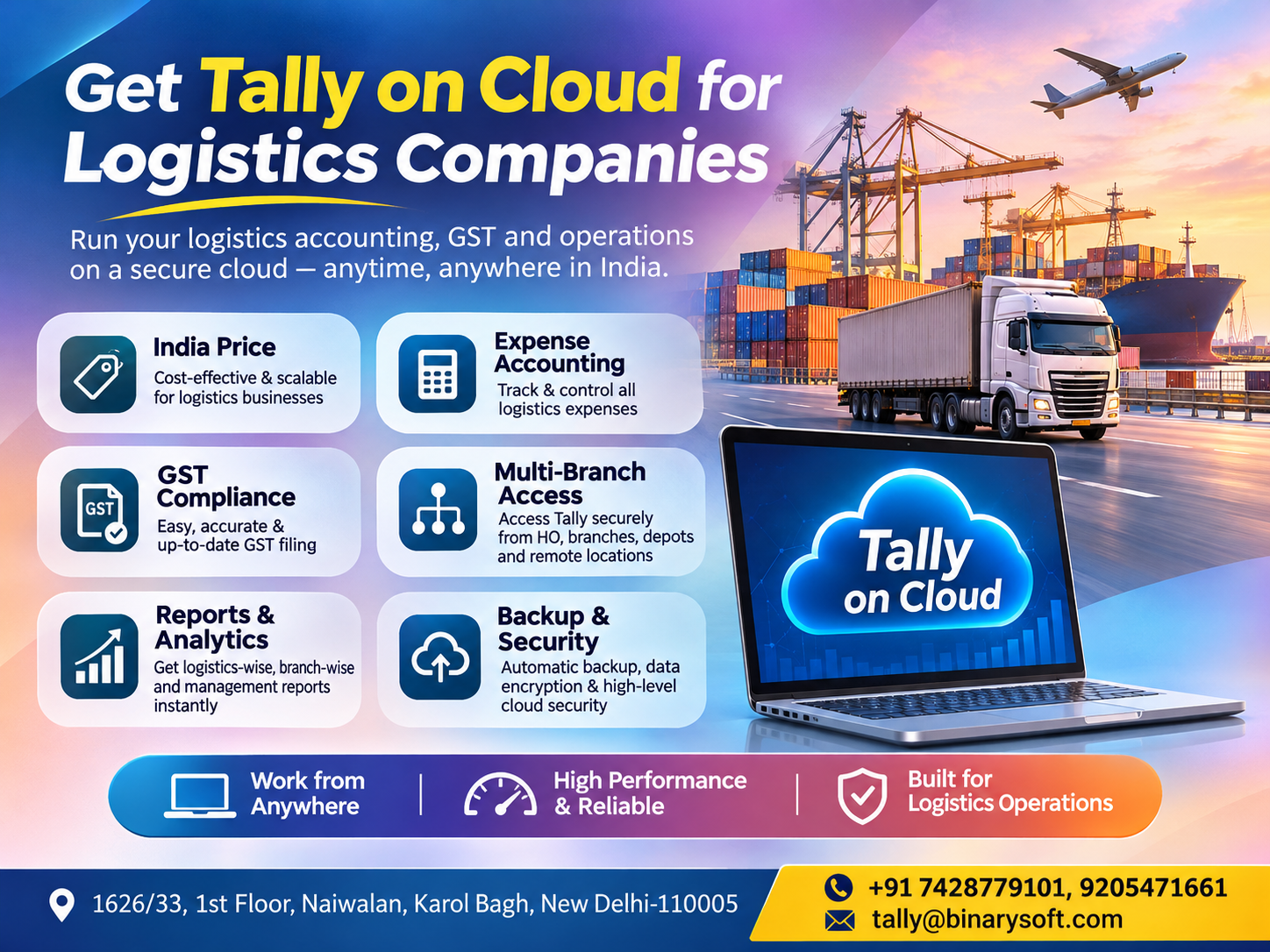
Tally on Cloud for logistics companies offers a practical solution by making Tally Prime accessible through a securely hosted cloud environment.
Instead of depending entirely on an office computer, authorized employees can work with accounting data from different locations, subject to the hosting arrangement, network connectivity and access permissions.
With suitable configuration, Tally Prime supports freight invoicing, expense accounting, GST-related records, customer outstanding tracking and financial reporting.
For growing logistics businesses, cloud-based accounting can improve coordination between branches and help management make better financial decisions.
1. What Is Tally on Cloud for Logistics Companies?
Tally on Cloud refers to an arrangement where licensed Tally Prime software and its company data are hosted on a remotely accessible server.
Authorized users connect to the hosted environment using supported remote-access methods.
This allows employees to work with Tally Prime without requiring the main company data to remain on a single office desktop.
For example, a logistics company with branches in Delhi, Ahmedabad and Pune may use a centrally hosted accounting environment.
Employees can record authorized transactions, while management can review consolidated or branch-specific financial information according to the accounting structure.
How Cloud Accounting Helps Logistics Businesses
Cloud hosting can support:
-
Remote access to accounting data.
-
Centralized financial record management.
-
Coordination between multiple offices.
-
Freight billing and customer accounting.
-
Vehicle-related expense recording.
-
Supplier and transporter payment tracking.
-
GST accounting and reporting.
-
Backup and recovery arrangements.
-
Controlled access for authorized employees.
However, Tally Prime is primarily accounting and business management software. It is not a complete fleet tracking, GPS monitoring or transport management system.
Companies requiring live vehicle tracking, route optimization or automated proof-of-delivery management may need specialized software or suitable integrations.
2. Why Traditional Accounting Creates Problems for Transport Businesses
Logistics companies often operate with high transaction volumes and relatively tight operating margins.
Even small accounting errors can affect profitability.
Consider a transport company managing 40 vehicles across several routes.
Every vehicle may generate expenses for fuel, tolls, repairs, loading, unloading and driver allowances.
If these expenses are recorded manually or submitted several days late, management may struggle to determine the actual cost of each trip.
Common Accounting Challenges
Delayed Expense Reporting
Drivers and branch employees may submit expense details after completing trips, delaying financial updates.
Multiple Branch Records
Different offices may maintain separate spreadsheets, creating reconciliation difficulties.
Unpaid Freight Bills
Customers may take several weeks to settle freight invoices, affecting cash flow.
Fuel Cost Fluctuations
Changes in diesel prices can significantly affect transport margins.
GST Complexity
Freight transactions may involve different GST treatments depending on the service, supplier, recipient and applicable rules.
Data Security Risks
Accounting data stored on individual computers may be exposed to hardware failures, accidental deletion or unauthorized access.
A properly implemented cloud-hosted accounting environment can address several of these operational difficulties.
3. Freight Billing and Customer Invoice Management
Freight billing is one of the most important accounting activities for logistics companies.
Transport businesses may charge customers according to distance, weight, vehicle type, shipment volume or agreed contractual rates.
Tally Prime allows businesses to create appropriate sales and service ledgers for recording freight-related income.
Freight Invoice Management
A logistics company can maintain separate revenue ledgers for different services, such as:
-
Full truckload transportation.
-
Part truckload transportation.
-
Local delivery services.
-
Warehousing services.
-
Loading and unloading services.
-
Freight forwarding services.
-
Additional handling charges.
Businesses can prepare invoices containing customer details, service descriptions, applicable taxes and transaction values.
Where necessary, transport-specific references such as vehicle numbers, consignment numbers or delivery references can be entered using suitable narration fields, configurations or customizations.
Customer Outstanding Tracking
Many logistics companies provide services on credit.
Tally Prime's bill-wise accounting helps businesses monitor customer balances and outstanding invoices.
For example, a transport operator may provide monthly freight services worth ₹8 lakh to a manufacturing customer.
By recording invoices and receipts against bill references, the accounts team can identify unpaid amounts and follow up systematically.
This improves collection planning and reduces dependence on manually maintained payment registers.
4. Transport Expense Accounting with Tally Prime
Expense management is essential for protecting profitability in the logistics industry.
A company may generate substantial freight revenue but still experience financial pressure because of uncontrolled operating expenses.
Tally Prime allows businesses to maintain separate expense ledgers and record transactions systematically.
Fuel and Diesel Expenses
Diesel is often one of the largest operating expenses for road transport companies.
Businesses can create a fuel expense ledger and record fuel purchases through appropriate vouchers.
Where vehicle-wise tracking is required, cost centres or suitable customized fields can help allocate expenses to specific vehicles or operations.
Toll and Highway Charges
Toll payments can be recorded under separate expense ledgers.
Companies may also maintain suitable references for FASTag-related transactions and reconcile recorded expenses against available statements.
Driver Advances and Allowances
Drivers frequently receive advances for fuel, meals, parking and other trip expenses.
Tally Prime can record advances through appropriate ledger accounts.
When supporting bills are submitted, the advance can be adjusted against eligible expenses.
Vehicle Maintenance Expenses
Repairs, servicing, tyres, spare parts and insurance expenses can be recorded separately.
This helps management review maintenance spending and identify unusually high operating costs.
Loading and Unloading Charges
Handling expenses can be allocated to suitable cost centres or business activities.
Business Benefit: Structured expense accounting helps logistics companies understand where money is being spent and identify opportunities to improve margins.
5. Vehicle-Wise and Trip-Wise Profitability Analysis
Knowing total business profit is important, but logistics operators also need to understand profitability at the vehicle, route or trip level.
A transport company may earn ₹75,000 from a particular shipment, but that amount does not represent actual profit.
The company must consider fuel, tolls, driver expenses, vehicle maintenance allocations and other relevant costs.
Illustrative Trip Profitability
| Particulars | Amount |
|---|
| Freight revenue |
₹75,000 |
| Diesel expense |
₹28,000 |
| Toll charges |
₹6,500 |
| Driver allowance |
₹4,000 |
| Loading and unloading |
₹3,500 |
| Other allocated expenses |
₹5,000 |
| Estimated trip contribution |
₹28,000 |
This example excludes additional costs unless included in the allocated expenses, such as depreciation, financing and overheads.
Tally Prime can support such analysis through cost centres, appropriate ledger structures and reporting configurations.
However, automatic trip-wise profitability is not a standard end-to-end transport management workflow. Detailed trip profitability may require disciplined manual allocation, custom reports or integrations.
When properly configured, this approach helps companies compare operating costs and identify less profitable routes.
6. GST Accounting for Logistics and Transport Companies
GST compliance requires particular attention in the transport industry.
Different logistics services may be subject to different tax rules, exemptions and conditions.
Goods Transport Agency services, for example, may involve specific provisions concerning consignment notes, applicable tax rates and reverse charge arrangements.
The correct treatment depends on the nature of the transaction and prevailing GST regulations.
How Tally Prime Helps
Tally Prime supports GST-related transaction recording, tax ledgers, customer and supplier GST details, and relevant accounting reports.
Logistics companies can configure applicable tax information and maintain transaction records for compliance review.
Important GST Considerations
Freight Services
Businesses should identify whether their services qualify under the relevant GST provisions.
Reverse Charge Mechanism
Certain eligible freight transactions may require tax payment by the recipient under applicable rules.
Input Tax Credit
Eligible input tax credit depends on the nature of expenses, supporting documents and statutory conditions.
Interstate Transactions
The place of supply and nature of service determine the appropriate GST treatment.
GST Reconciliation
Accounting records should be checked against relevant portal information and supporting documents.
Tally Prime can assist with recording and reviewing GST information, but businesses should consult qualified tax professionals when determining complex freight tax treatments.
7. Multi-Branch Accounting for Logistics Companies
Many transport businesses operate across several cities.
A company headquartered in Delhi may maintain booking offices in Chandigarh, Jaipur, Lucknow and Ahmedabad.
Managing these branches independently can create delays in financial reporting.
Tally on Cloud allows authorized users to connect to a centrally hosted accounting environment.
Benefits of Multi-Branch Access
Centralized Records
Employees can work with company data according to their assigned permissions.
Faster Transaction Recording
Branch staff can record transactions without waiting to send physical documents to head office.
Improved Management Visibility
Management can review available financial information without requesting separate spreadsheets from every location.
Better Coordination
Accounts teams can work with common records, reducing repeated data transfer.
Important Implementation Considerations
Businesses must choose an appropriate accounting structure.
Where branches operate under different GST registrations, separate company data or suitable configurations may be required.
Multi-user access also depends on the licensed Tally Prime edition and the cloud hosting arrangement.
A properly planned setup can help businesses improve branch coordination while maintaining accounting and tax compliance.
8. Tally on Cloud Price in India for Logistics Companies
Cost is an important consideration when logistics companies evaluate cloud accounting.
The total expense generally depends on the software license, hosting resources, number of users, security requirements and support arrangements.
Indicative Cloud Hosting Budget
| Hosting requirement | Illustrative monthly budget |
|---|
| Basic hosted environment |
₹700–₹1,500 |
| Small multi-user environment |
₹1,500–₹3,500 |
| Growing multi-branch environment |
₹3,500–₹7,000 |
| Customized business environment |
Based on requirements |
These figures are illustrative planning estimates, not verified quotations or guaranteed market prices. GST, software licensing, setup, backups and additional services may be charged separately.
Factors Affecting Pricing
Number of Users: More simultaneous users may require additional server resources and appropriate software licensing.
Server Configuration: CPU, RAM and storage requirements depend on workload and company data size.
Backup Policy: Retention periods, backup frequency and recovery options influence hosting costs.
Security: Additional protection and access management may affect the total price.
Support: Managed hosting, maintenance and technical assistance may be included or billed separately.
Businesses should request a detailed quotation before selecting a cloud hosting plan.
9. Backup and Data Recovery for Transport Businesses
Accounting records contain important information about customers, suppliers, freight invoices, payments and operating expenses.
Losing this information can interrupt business operations and create financial difficulties.
Cloud hosting can provide managed backup options, depending on the selected provider and service agreement.
Recommended Backup Practices
-
Schedule regular backups of company data.
-
Maintain more than one recoverable backup copy.
-
Store backups separately from the main server.
-
Restrict access to backup files.
-
Test restoration procedures periodically.
-
Define recovery time and recovery point requirements.
Businesses should confirm whether backups are automated, how long they are retained and who is responsible for recovery.
Cloud hosting does not automatically guarantee that every deleted or corrupted record can be restored.
A reliable backup policy should be established before moving critical accounting data to the cloud.
10. Data Security and User Access Control
Logistics companies handle commercially sensitive information, including customer rates, supplier contracts, financial balances and payment details.
Protecting these records is essential.
A secure cloud setup should include strong authentication, restricted user permissions, operating system updates and appropriate network protections.
Security Measures to Consider
Role-Based Access
Employees should receive only the permissions necessary for their responsibilities.
Secure Remote Connections
Remote access should use appropriately protected connections and authentication methods.
Multi-Factor Authentication
Where supported by the hosting access system, multi-factor authentication can provide additional protection.
Activity Monitoring
Relevant server access logs can assist with security reviews and troubleshooting.
Regular Maintenance
Security updates and system monitoring help reduce exposure to known vulnerabilities.
Controlled Data Sharing
Sensitive accounting files should not be distributed through unsecured personal channels.
Security depends on the combined effectiveness of software configuration, hosting infrastructure and employee practices.
11. Financial Reports for Logistics Business Decisions
Reliable reporting helps logistics operators understand revenue, expenses, outstanding payments and overall financial performance.
Tally Prime provides accounting reports that support regular management reviews.
Important Reports
Profit and Loss Account: Helps assess business profitability.
Balance Sheet: Shows assets, liabilities and financial position.
Cash Flow Report: Helps review cash movements.
Customer Outstanding Report: Identifies unpaid freight invoices.
Supplier Outstanding Report: Shows amounts payable to vendors and transport contractors.
Expense Ledger Reports: Help analyze fuel, toll, repair and other operating expenses.
Cost Centre Reports: Can support branch-wise, vehicle-wise or department-wise analysis when configured appropriately.
Management can review these reports to identify rising expenses, delayed collections and changes in profitability.
For example, if fuel expenses increase while freight revenue remains unchanged, management may need to review pricing, route efficiency or operating practices.
12. Tally on Cloud Versus Traditional Office-Based Tally
| Feature | Office-Based Setup | Cloud-Hosted Setup |
|---|
| Access location |
Usually office or configured local network |
Authorized remote locations |
| Multi-branch coordination |
Requires additional connectivity or data-sharing arrangements |
Can use centralized hosted data |
| Infrastructure |
Locally managed computer or server |
Hosted server environment |
| Backup responsibility |
Usually managed locally |
Depends on hosting agreement |
| Internet requirement |
Not always required for local work |
Required for remote sessions |
| Security management |
Local organization responsibility |
Shared responsibilities with hosting provider |
| Recurring hosting expense |
Not necessarily applicable |
Usually applicable |
Cloud hosting is particularly useful for organizations that require regular access from multiple locations.
However, companies should evaluate internet reliability, data security, licensing and ongoing costs before migration.
13. Emotional Story: A Transport Business Owner's Journey from Stress to Confidence
This is an illustrative story inspired by common challenges faced by Indian transport entrepreneurs.
For nearly twenty years, Mahesh operated a small transport company in Delhi.
He started with one truck purchased through savings and a bank loan.
His dream was simple: provide a better future for his family and build a respected transport business.
Over time, his fleet expanded to twelve vehicles.
His trucks travelled between Delhi, Jaipur, Chandigarh and other northern Indian cities.
Business appeared successful from the outside.
But behind the scenes, Mahesh struggled with paperwork.
Drivers called constantly for advances. Customers delayed freight payments. Branch employees sent expense statements through different channels.
Every evening, Mahesh sat in his office trying to understand how much money his company had actually earned.
One month, he discovered that several freight invoices had remained unpaid for weeks.
At the same time, diesel bills and vehicle repair expenses were increasing.
Despite working fourteen hours a day, he could not confidently explain his business's financial position.
One evening, his son asked him to attend a school function.
Mahesh promised he would come.
But an urgent accounting problem kept him at the office.
When he returned home, his son was asleep, still holding the certificate he had wanted to show his father.
Mahesh realized that his business was growing, but his peace of mind was disappearing.
He decided to reorganize the company's accounting operations.
With professional assistance, he moved his Tally Prime environment to a managed cloud server.
His accounts team began recording transactions systematically, maintaining customer outstanding references and reviewing expenses regularly.
Branch employees could access the authorized accounting environment without sending multiple spreadsheet versions.
Over time, Mahesh gained better visibility into receivables, supplier payments and operating costs.
The software did not eliminate every challenge, but it gave him a more organized way to manage them.
Months later, he attended another school function.
This time, he watched his son receive an award from the front row.
For Mahesh, better accounting was not only about business efficiency.
It was about recovering time for the people who mattered most.
14. Case Study One: Delhi Logistics Company Improves Expense Visibility
Illustrative case study using hypothetical business figures.
Business Background
A Delhi-based logistics company operated 25 commercial vehicles and maintained booking offices in three cities.
Its accounts team depended on spreadsheets and manually submitted expense statements.
Challenges
The company experienced delayed expense reporting, inconsistent branch records and difficulty tracking customer outstanding balances.
Implementation
The business introduced a cloud-hosted Tally Prime environment with centralized company data.
Separate expense ledgers were created for fuel, tolls, maintenance and driver allowances.
Cost centres were configured for selected vehicle-related reporting.
Illustrative Results
Within four months, management estimated that monthly accounting reconciliation time had fallen from approximately five working days to two.
Customer outstanding reports became easier to review, and expense records were more consistently maintained.
Key Learning
Cloud hosting combined with disciplined accounting processes can improve financial visibility and reduce administrative delays.
15. Case Study Two: Multi-Branch Freight Company Strengthens Financial Control
Illustrative case study using hypothetical business figures.
Business Background
A freight service provider operated branches in Mumbai, Pune, Ahmedabad and Surat.
The company handled regular transportation assignments for manufacturing and distribution clients.
Challenges
Each branch maintained separate records, resulting in delays when preparing management reports.
The head office also struggled to monitor supplier balances and branch operating expenses.
Implementation
The company adopted a centrally accessible Tally Prime setup with suitable branch accounting structures and user permissions.
Employees received training on invoice recording, expense classification and bill-wise payment tracking.
Illustrative Results
After six months, the company reported more timely financial reviews and improved coordination between branches.
Management could review selected branch expenses and outstanding balances without waiting for manually consolidated spreadsheets.
Key Learning
A centralized accounting environment can help multi-location logistics companies strengthen reporting consistency and financial supervision.
16. How to Get Started with Tally on Cloud
Logistics companies planning to adopt Tally on Cloud should follow a structured implementation process.
Step 1: Identify Business Requirements
Review the number of branches, users, vehicles, accounting transactions and reporting needs.
Step 2: Review Tally Prime Licensing
Confirm the appropriate license edition and simultaneous user requirements.
Step 3: Select Cloud Hosting Resources
Choose server specifications based on expected workload, data size and remote-access requirements.
Step 4: Plan Data Migration
Prepare a verified backup and test the company data in the new environment.
Step 5: Configure Accounting
Set up freight income, expense ledgers, cost centres, customer accounts and applicable GST details.
Step 6: Establish User Permissions
Provide appropriate access to accounts staff, branch employees and management.
Step 7: Test Reports and Backups
Verify invoices, outstanding balances, financial reports and restoration procedures.
Step 8: Train Employees
Ensure staff understand transaction entry, expense classification and secure remote access.
Proper planning reduces migration risks and helps businesses achieve more dependable results.
Conclusion: Transform Logistics Accounting with Tally on Cloud
The logistics industry depends on speed, reliability and financial discipline.
Transport companies must manage freight income, vehicle expenses, customer collections, supplier payments and tax-related records while coordinating operations across multiple locations.
Traditional accounting arrangements can become difficult to manage as transaction volumes and branch networks expand.
Tally on Cloud offers a practical way to make Tally Prime accessible to authorized employees through a centrally hosted environment.
Combined with suitable accounting configurations, it can help logistics businesses improve freight billing, expense management, GST recordkeeping, outstanding tracking and financial reporting.
Cloud hosting also provides opportunities to strengthen backup arrangements, access controls and operational continuity when implemented responsibly.
For logistics entrepreneurs, the greatest advantage is not simply remote software access. It is the ability to understand financial performance more clearly and manage the business with greater confidence.
Choose a properly configured Tally on Cloud environment to build a more organized, secure and financially informed logistics business.
Powered by Binarysoft Technologies
Authorized Tally Partner
Location: 1626/33, 1st Floor, Naiwalan, Karol Bagh, New Delhi – 110005, INDIA
Contact Us: +91 7428779101, 9205471661
Email Us: tally@binarysoft.com
Business Hours: 10:00 AM – 6:00 PM, Monday to Friday
Frequently Asked Questions
What is Tally on Cloud for logistics companies?
Tally on Cloud is a hosting arrangement that allows authorized users to access licensed Tally Prime software and company accounting data through a remotely accessible server. It helps logistics companies coordinate accounting across locations.
How much does Tally on Cloud cost in India?
Pricing depends on the number of users, server resources, storage, backup requirements and support services. Basic hosting may cost less than a multi-user business environment. Businesses should obtain a current quotation that clearly identifies included services, taxes and licensing costs.
Can Tally Prime manage transport and logistics expenses?
Yes. Tally Prime can record diesel, toll, maintenance, driver allowances, loading charges and other operating expenses through appropriate accounting ledgers and vouchers.
CA. Mayankh Singhaal is a Chartered Accountant experienced in accounting systems, statutory audits, and compliance advisory. He has worked with businesses across different sectors to improve reporting accuracy and inventory tracking. His writing focuses on structured growth and compliance-ready operations.