Call CA Tally HelpDesk
+91 9205471661,
7428779101

Introduction: Why Faster Billing and Financial Accuracy Matter More for Businesses in 2026
In 2026, Indian businesses are facing increasing pressure to generate invoices quickly, maintain accurate financial records, manage GST compliance, and monitor customer payments without delays. As transaction volumes grow and customers expect faster service, traditional billing methods and disconnected accounting systems can create costly mistakes. A single incorrect invoice, missed payment entry, or inventory mismatch can affect cash flow, customer relationships, and financial reporting. Recent developments in digital accounting and connected business workflows have made automation increasingly important for retailers, wholesalers, distributors, manufacturers, and service providers. Advanced Tally Prime invoicing and accounting solutions help businesses address these challenges by integrating billing, inventory, taxation, banking, and financial reporting into a unified system. With automated calculations, structured transaction recording, GST-ready invoicing, and real-time financial visibility, businesses can reduce repetitive work, improve accounting accuracy, and make better decisions while maintaining stronger control over daily operations.
1. Understanding Advanced Tally Prime Invoicing and Accounting Solutions
Efficient invoicing and accurate accounting are essential for maintaining a successful business. Whether a company handles hundreds of retail transactions or manages complex B2B sales, maintaining reliable financial information is critical.
Tally Prime is an integrated business management and accounting software solution designed to simplify financial operations while supporting inventory management, GST compliance, invoicing, banking, and business reporting.
Advanced Tally Prime invoicing and accounting solutions enable businesses to manage daily transactions through an organized accounting environment.
Instead of maintaining separate applications for billing, customer accounts, stock records, and financial statements, businesses can use Tally Prime to connect these activities.
Major capabilities include:
-
Faster sales invoice generation and purchase transaction recording.
-
GST-compliant billing with automatic tax calculations.
-
Integrated inventory and accounting management.
-
Customer and supplier ledger management.
-
Outstanding receivables and payable tracking.
-
Bank reconciliation and transaction monitoring.
-
Financial statements and management reports.
-
Cost centre and profitability analysis.
-
Multi-company accounting management.
-
Data security, user access controls, and backup management.
These capabilities help businesses establish reliable accounting processes while reducing dependency on repetitive manual calculations.
2. The Emotional Story: How One Billing Error Nearly Cost a Growing Business Its Biggest Customer
Consider the illustrative story of Rajesh, a wholesale electrical goods distributor operating in Delhi.
Rajesh had spent more than twelve years building his business. He started with a small shop, limited stock, and a few regular customers. Through dedication and consistent service, his business gradually expanded to serve retailers, contractors, and institutional buyers.
However, as sales increased, his billing and accounting processes became difficult to manage.
His employees prepared invoices manually, checked inventory through separate spreadsheets, and updated customer payment records at the end of each day.
One afternoon, Rajesh received an urgent call from one of his largest customers.
The customer had discovered incorrect quantities and tax calculations in several invoices. Their accounts department had temporarily placed further payments on hold until the discrepancies were resolved.
Rajesh was worried.
The delayed payment affected his ability to purchase inventory and pay suppliers. More importantly, he feared losing a business relationship that had taken years to build.
That evening, while reviewing piles of invoices and spreadsheets, he realized that the problem was not simply employee carelessness. His business had grown beyond the capabilities of its existing accounting process.
He decided to introduce an integrated invoicing and accounting system using Tally Prime.
With properly configured stock items, GST details, customer ledgers, and invoice formats, his employees could prepare bills through a more structured process.
Sales entries updated the relevant accounting records, inventory transactions became easier to trace, and outstanding payments could be reviewed from customer ledgers.
Over the following months, Rajesh noticed an improvement in operational discipline.
His team spent less time searching for invoice details. Customer disputes became easier to investigate, and he gained greater confidence in his financial reports.
The biggest change was not just faster billing.
It was the peace of mind that came from knowing his growing business had a more reliable financial foundation.
This is an illustrative business scenario showing how integrated invoicing and accounting processes can help reduce operational challenges.
3. Faster Invoice Generation with Advanced Tally Prime Billing Features
Invoice preparation is one of the most frequent activities in any trading, distribution, or service business.
When invoices are generated manually, employees must repeatedly enter customer details, product descriptions, tax rates, quantities, discounts, and payment information.
This increases processing time and creates opportunities for mistakes.
Tally Prime simplifies invoicing by allowing businesses to maintain structured master records and reuse relevant transaction information.
Automatic invoice calculations
Businesses can configure Tally Prime to calculate applicable amounts based on transaction details.
These may include:
-
Item quantities and selling rates.
-
Discounts and additional charges.
-
Taxable invoice values.
-
Applicable GST rates.
-
CGST, SGST, and IGST amounts.
-
Invoice totals and rounding adjustments.
Correct master configuration and transaction classification are essential to obtain accurate results.
Customizable invoice formats
Different industries require different invoice layouts.
Retail businesses may prefer compact invoices, while wholesale distributors may require detailed item descriptions, tax information, delivery details, and payment terms.
Tally Prime supports invoice configuration and printing options that help businesses create professional billing documents.
Faster repeat billing
Businesses dealing with regular customers can maintain customer ledgers, stock item masters, units of measurement, and pricing information.
This reduces repetitive data entry and helps improve invoice consistency.
The result is a more organized billing process that can support higher transaction volumes without unnecessarily increasing administrative work.
4. GST-Compliant Invoicing for Indian Businesses
GST compliance remains an important responsibility for businesses operating in India.
Incorrect tax classification, missing invoice details, or inconsistent transaction records can create reconciliation difficulties and compliance risks.
Tally Prime provides GST accounting and invoicing capabilities that help businesses maintain structured tax records.
GST invoicing capabilities
Depending on configuration and applicable statutory requirements, businesses can manage:
-
GSTIN details for registered customers and suppliers.
-
HSN and SAC information.
-
Taxable values and applicable GST rates.
-
Intra-state and inter-state transactions.
-
B2B and B2C invoices.
-
Credit notes and debit notes.
-
GST-related transaction classifications.
-
Tax summaries and statutory reports.
GST calculations
When tax ledgers, stock masters, and transaction details are configured correctly, Tally Prime can calculate applicable GST during invoice entry.
This reduces the need for repeated manual tax calculations.
GST reconciliation
Businesses can review recorded transactions against relevant GST information and identify differences that require investigation.
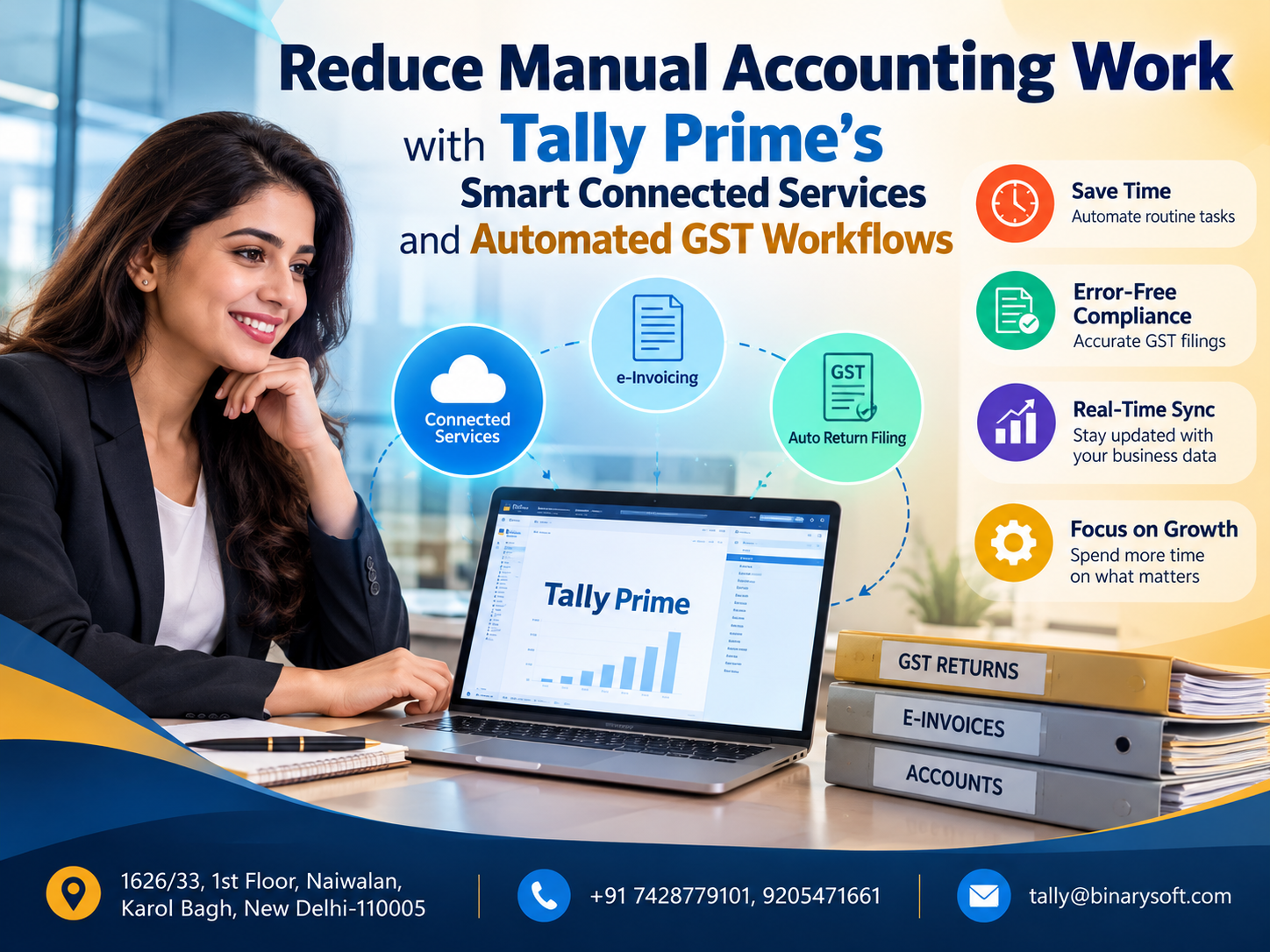
Connected GST capabilities available in supported Tally Prime releases can further assist with certain return-related and reconciliation workflows.
However, businesses should review the accuracy of GST details before submitting statutory returns.
5. Integrated Accounting and Inventory Management
One of the biggest advantages of Tally Prime is the connection between inventory transactions and financial accounting.
In businesses that use separate billing and inventory systems, employees may need to update the same transaction multiple times.
For example, a sale might be recorded in billing software, entered separately into accounting records, and deducted manually from an inventory spreadsheet.
Such duplication increases the possibility of inconsistent records.
With integrated inventory and accounting workflows, relevant sales and purchase transactions can update stock and accounting information together.
Important inventory features
Stock item management: Maintain detailed records of products, units, stock groups, and applicable classifications.
Godown management: Track inventory across warehouses, stores, and storage locations where configured.
Batch-wise tracking: Manage inventory batches and applicable expiry information for relevant product categories.
Stock valuation: Review inventory values using supported valuation methods.
Reorder monitoring: Identify items requiring replenishment based on configured inventory parameters.
Stock movement reporting: Examine inward and outward stock transactions.
For wholesalers, retailers, manufacturers, and distributors, these capabilities improve visibility over stock movement and related financial information.
6. Improve Financial Accuracy Through Automated Accounting Entries
Financial accuracy depends on recording transactions consistently and classifying them correctly.
Manual accounting systems often involve repeated calculations, separate registers, and multiple spreadsheets.
These processes may create discrepancies between sales figures, customer balances, inventory values, and bank records.
Tally Prime uses an integrated accounting structure that supports double-entry bookkeeping and transaction-based financial reporting.
How integrated accounting improves accuracy
When a properly configured sales voucher is recorded, the system can reflect the corresponding accounting impact in relevant ledgers.
For example, consider a credit sale with the following details:
|
Particulars
|
Amount
|
|---|
|
Product taxable value
|
₹50,000
|
|
CGST at 9%
|
₹4,500
|
|
SGST at 9%
|
₹4,500
|
|
Total invoice amount
|
₹59,000
|
For an eligible intra-state taxable transaction, the accounting entry would generally be:
|
Ledger
|
Debit
|
Credit
|
|---|
|
Customer account
|
₹59,000
|
|
|
Sales account
|
|
₹50,000
|
|
Output CGST
|
|
₹4,500
|
|
Output SGST
|
|
₹4,500
|
Tally Prime can record the relevant accounting impact through the configured sales voucher.
This helps maintain consistency between invoice information, customer balances, sales records, and applicable tax ledgers.
Nevertheless, accurate accounting still requires correct voucher selection, master data, tax classification, and periodic verification.
7. Advanced Customer Ledger and Outstanding Payment Management
Customer payment management is a major concern for businesses that provide goods or services on credit.
A company may report strong sales while experiencing financial pressure because customers have not paid their invoices on time.
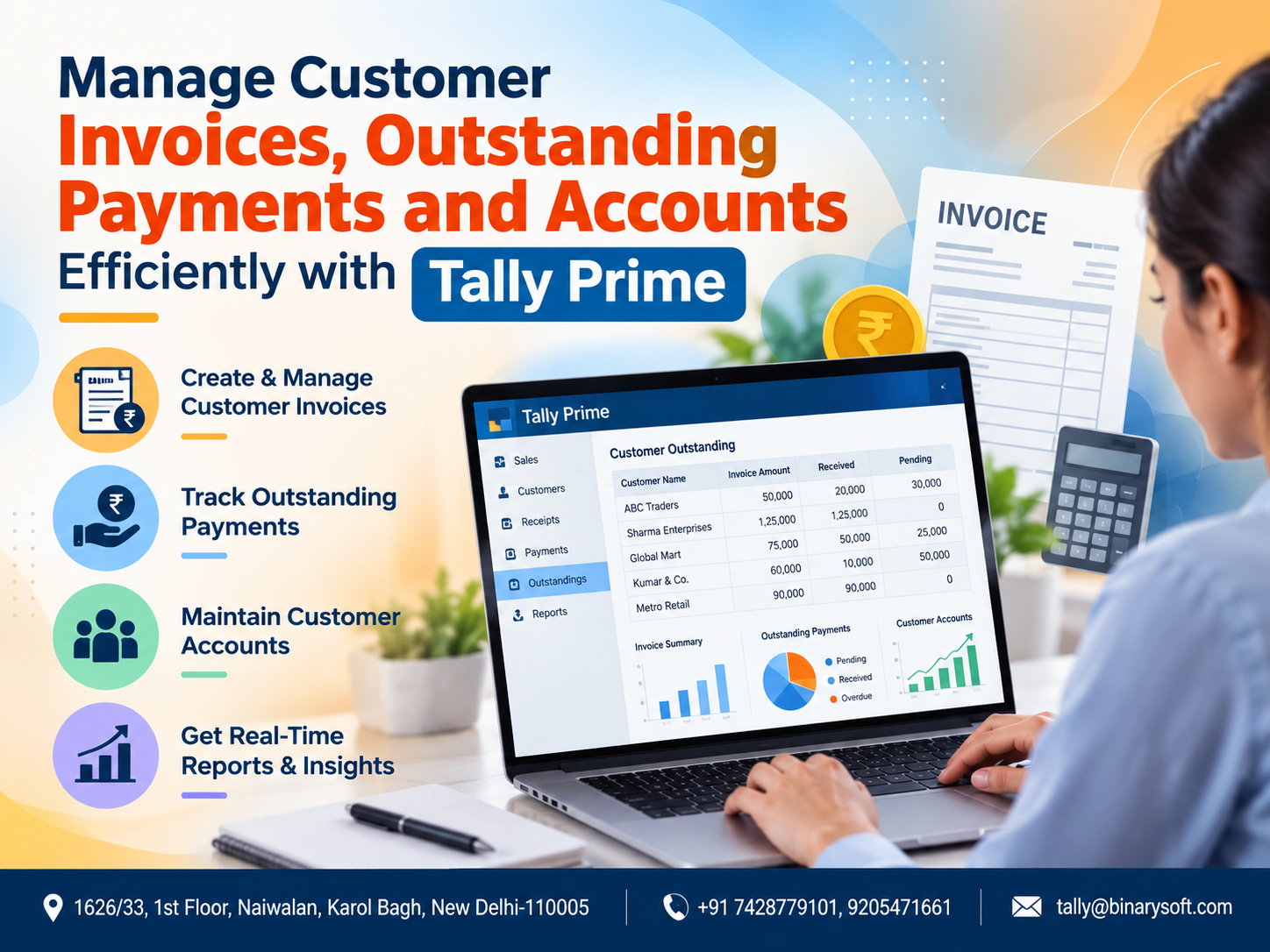
Tally Prime helps businesses monitor outstanding receivables through customer ledgers and bill-wise accounting.
Customer payment tracking
Businesses can maintain records of:
-
Customer invoices.
-
Credit periods and due dates.
-
Outstanding invoice balances.
-
Partial payments.
-
Advance receipts.
-
Overdue transactions.
-
Customer-wise outstanding amounts.
Bill-wise accounting
Bill-wise tracking helps businesses identify the specific invoices against which payments have been received or remain outstanding.
For example, if a customer has three unpaid invoices, the business can examine each invoice separately rather than relying only on the total ledger balance.
This improves payment follow-up and makes account reconciliation easier.
Credit control
Businesses can configure relevant credit limits and review customer outstanding positions before extending additional credit.
Such controls support more disciplined sales and collection decisions.
8. Smarter Purchase Accounting and Supplier Payment Management
Accurate supplier records are just as important as customer accounting.
Businesses must monitor purchase invoices, supplier advances, outstanding balances, and payment due dates.
Poor supplier accounting can result in duplicate payments, missed due dates, and disagreements over balances.
Tally Prime supports organized purchase and payable management through supplier ledgers and bill-wise transaction recording.
Benefits for purchase management
-
Record purchase invoices systematically.
-
Maintain supplier-wise account balances.
-
Track payment obligations.
-
Review overdue supplier invoices.
-
Record purchase returns and debit notes.
-
Monitor purchase-related taxes.
-
Reconcile supplier balances.
For businesses managing multiple vendors, these features can improve financial planning and reduce administrative confusion.
9. Advanced Banking and Bank Reconciliation Features
Banking transactions form an essential part of business accounting.
Businesses regularly receive customer payments, transfer funds to suppliers, pay operational expenses, and monitor bank balances.
When banking information is not reconciled regularly, differences may remain undetected.
Tally Prime provides banking and reconciliation capabilities that help businesses compare recorded transactions with bank statements.
Bank reconciliation
Bank reconciliation helps identify differences between accounting records and actual bank transactions.
These differences may arise from:
-
Unpresented cheques.
-
Deposits not yet credited.
-
Bank charges.
-
Interest entries.
-
Incorrect transaction amounts.
-
Duplicate or missing accounting entries.
Supported bank statement import and reconciliation functionality can reduce the effort involved in matching transactions.
Availability and automation levels depend on the bank, file format, product release, and enabled features.
Better banking visibility
Regular reconciliation helps businesses maintain more reliable cash and bank balances.
It also supports better payment planning and reduces the risk of unnoticed accounting discrepancies.
10. Real-Time Financial Reporting for Better Business Decisions
Business owners need more than accurate invoices.
They also need reliable information about profitability, expenses, liabilities, cash flow, and overall financial performance.
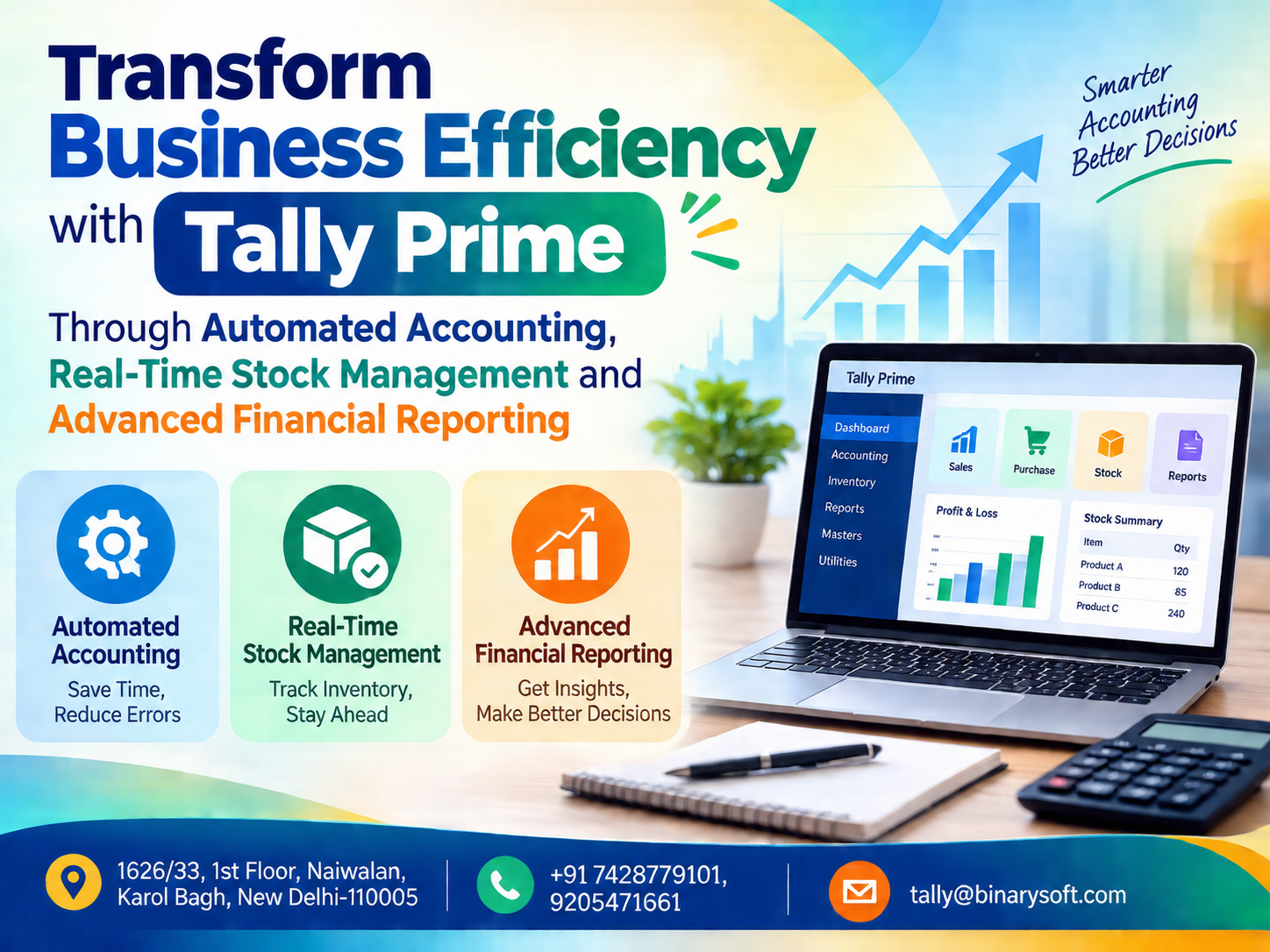
Tally Prime provides financial reports based on recorded accounting transactions.
Important financial reports
|
Report
|
Business purpose
|
|---|
|
Balance Sheet
|
Review assets, liabilities, and capital
|
|
Profit & Loss Account
|
Evaluate income, expenses, and profitability
|
|
Trial Balance
|
Review ledger balances
|
|
Cash/Bank Book
|
Monitor cash and banking transactions
|
|
Sales Register
|
Examine recorded sales
|
|
Purchase Register
|
Review purchase transactions
|
|
Outstanding Receivables
|
Monitor customer dues
|
|
Outstanding Payables
|
Review supplier obligations
|
|
Stock Summary
|
Check inventory quantities and values
|
|
Cash Flow Statement
|
Analyze cash inflows and outflows
|
These reports can help business owners identify financial trends and respond to emerging problems.
For example, a business might discover that sales are increasing but customer collections are slowing.
By reviewing receivables and cash flow information together, management can make better credit and purchasing decisions.
11. Cost Centre Accounting for Department-Wise Profitability
Growing businesses often need to monitor expenses and performance across departments, projects, or branches.
A company may operate several retail outlets or manage multiple service projects simultaneously.
Without proper classification, management may find it difficult to determine which business activities are profitable.
Tally Prime supports cost centre accounting, allowing relevant transactions to be allocated to defined departments, projects, or business units.
Practical applications
A construction company can track project-related expenses.
A service organization can review departmental costs.
A distribution business can allocate certain expenses across branches.
A professional services firm can monitor costs associated with client assignments.
These capabilities improve internal reporting and help management understand where resources are being utilized.
12. Faster Billing for Retailers, Wholesalers and Distributors
Different businesses have different invoicing requirements.
A retail store may need quick invoice processing during busy customer hours.
A wholesale distributor may need detailed item-wise billing, credit tracking, and warehouse management.
A service provider may require professional invoices with service descriptions, applicable taxes, and payment terms.
Tally Prime can be configured to support these different workflows.
Retail businesses
Retailers can benefit from organized product masters, invoice generation, sales recording, and stock reporting.
Wholesale businesses
Wholesalers can manage customer credit transactions, bulk sales invoices, inventory movements, and outstanding receivables.
Distribution companies
Distributors can use inventory locations, purchase and sales records, customer ledgers, and stock movement reports.
Service businesses
Service providers can maintain service ledgers, generate tax invoices, track customer payments, and review financial performance.
The suitability of particular features depends on each organization's operational requirements and software configuration.
13. Improve Cash Flow Through Accurate Billing and Payment Monitoring
Cash flow problems can occur even in profitable businesses.
When invoices are delayed or payment records are inaccurate, customer collections may slow down.
Similarly, poor supplier payment planning can create unnecessary financial pressure.
Advanced invoicing and accounting processes help businesses improve cash flow visibility.
How Tally Prime supports cash flow management
Timely invoicing: Prompt invoice generation can reduce delays in requesting customer payments.
Outstanding monitoring: Receivables reports help identify unpaid and overdue invoices.
Payment allocation: Bill-wise accounting improves visibility into which invoices have been settled.
Expense tracking: Accounting reports help management review operational expenditure.
Cash flow reporting: Financial statements provide information about recorded cash movements.
Supplier payment planning: Payable reports help businesses prepare for upcoming obligations.
These capabilities do not automatically guarantee improved cash flow, but they provide information that supports more disciplined financial decisions.
14. Reduce Manual Accounting Work and Administrative Costs
Repetitive data entry consumes employee time and increases the possibility of mistakes.
Businesses using separate spreadsheets for sales, purchases, inventory, and customer balances may spend several hours reconciling information.
Tally Prime can reduce duplication by integrating relevant business processes.
Common manual tasks that can be reduced
-
Re-entering invoice amounts into accounting registers.
-
Calculating routine invoice totals manually.
-
Maintaining separate customer outstanding spreadsheets.
-
Updating inventory after every recorded sale.
-
Preparing financial summaries from disconnected records.
-
Searching multiple registers for transaction details.
-
Repeatedly calculating tax amounts.
Automation allows accounting teams to devote more attention to reviewing transactions, resolving discrepancies, and supporting management decisions.
However, businesses should still maintain approval procedures, transaction verification, and periodic accounting reviews.
15. Data Security and User Access Management
Financial information is one of the most valuable assets of a business.
Customer records, supplier balances, purchase prices, sales transactions, and profitability reports should be protected from unauthorized access.
Tally Prime provides security and access-control capabilities that help organizations manage accounting data.
Important security practices
-
Configure user access rights according to responsibilities.
-
Use strong passwords and appropriate security settings.
-
Restrict sensitive accounting operations.
-
Maintain regular backups.
-
Store backup copies securely.
-
Review user permissions periodically.
-
Protect computers and network access.
-
Keep supported software versions updated.
Businesses should also establish internal policies for data recovery and access management.
A secure accounting environment depends on both software features and responsible operational practices.
16. Multi-User Accounting for Growing Businesses
As businesses expand, multiple employees may need access to accounting information.
Sales teams may prepare invoices, purchase departments may record supplier transactions, and accountants may review financial records.
TallyPrime Gold supports multi-user access, subject to the applicable licensing and system configuration.
Benefits of multi-user accounting
Multiple authorized employees can work with company data according to their permissions.
This can improve coordination between sales, purchase, inventory, and accounting departments.
It also reduces dependency on a single computer or employee for routine accounting activities.
Businesses should choose the appropriate licensing option based on the number of users, workload, and operational requirements.
17. Advanced Accounting Solutions for Small and Medium Enterprises
Small and medium enterprises often operate with limited administrative resources.
Business owners may personally supervise billing, purchasing, collections, and financial reporting.
As transaction volumes increase, maintaining accurate records becomes more difficult.
Tally Prime provides a scalable accounting environment that can support businesses at different stages of growth.
Benefits for SMEs
Improved financial organization: Maintain sales, purchase, receipt, payment, and journal transactions in one accounting system.
Reduced billing delays: Use structured invoice formats and reusable masters.
Better customer management: Track outstanding invoices and customer balances.
Inventory visibility: Monitor stock quantities and movement.
Compliance support: Maintain GST-related records and reports.
Management reporting: Review profitability, expenses, and financial position.
For SMEs, these capabilities can help establish more disciplined accounting practices without requiring several disconnected software applications.
18. How to Implement Advanced Tally Prime Invoicing and Accounting Solutions
Successful implementation requires proper planning, configuration, and employee training.
Simply installing accounting software does not automatically eliminate financial errors.
Businesses should follow a structured implementation process.
Step 1: Evaluate existing accounting challenges
Identify common problems such as delayed billing, incorrect tax calculations, missing stock records, and customer payment discrepancies.
Step 2: Create and configure company data
Set up company information, financial year details, accounting options, and applicable statutory settings.
Step 3: Configure accounting masters
Create relevant customer ledgers, supplier ledgers, sales accounts, purchase accounts, expense accounts, and tax ledgers.
Step 4: Configure inventory masters
Define stock items, units of measurement, stock groups, warehouses, and other relevant inventory information.
Step 5: Configure GST details
Enter applicable GST registration information, tax classifications, and required statutory settings.
Step 6: Set up invoice formats
Configure sales invoice layouts, relevant fields, and printing preferences.
Step 7: Establish credit and payment controls
Configure bill-wise accounting, payment terms, and appropriate customer credit policies.
Step 8: Train employees
Provide practical training on invoice entry, purchase recording, receipt and payment vouchers, GST reporting, and reconciliation.
Step 9: Verify opening balances and transactions
Review migrated balances, inventory quantities, outstanding invoices, and accounting classifications.
Step 10: Monitor reports regularly
Review sales, purchases, stock, receivables, payables, and financial statements to identify inconsistencies early.
19. Common Accounting Mistakes Businesses Should Avoid
Even with advanced accounting software, incorrect configuration and poor transaction discipline can create reporting problems.
Businesses should pay particular attention to the following issues.
Incorrect GST classification: Wrong tax rates or transaction classifications can result in incorrect invoice values.
Duplicate ledger creation: Creating multiple ledgers for the same customer can fragment outstanding balances.
Unadjusted customer advances: Advances should be correctly allocated or adjusted against relevant transactions.
Missing inventory entries: Unrecorded stock movements can cause differences between physical stock and accounting records.
Delayed bank reconciliation: Unreconciled transactions can distort available bank balance information.
Incorrect opening balances: Inaccurate starting balances affect subsequent financial reports.
Insufficient backups: Missing backups increase the risk of permanent data loss.
Regular review procedures and employee training help minimize these risks.
20. Business Example: Measuring the Benefits of Faster Invoicing
Consider a wholesale company generating approximately 100 invoices daily.
Suppose its previous billing process required an average of six minutes per invoice, while a properly configured integrated workflow reduces the average processing time to three minutes.
Illustrative billing efficiency comparison
Previous daily billing time
10 hours
Improved daily billing time
5 hours
0 hrs3 hrs6 hrs9 hrs12 hrsPrevious processImproved process
Illustrative scenario, not a measured Tally Prime performance benchmark.
Savings over 26 working days
130 hours
This hypothetical example illustrates the potential value of improving invoice processing.
Actual savings depend on transaction complexity, employee experience, business processes, system configuration, and the extent of automation.
Businesses should evaluate their own workflows before estimating financial or productivity benefits.
21. Why Choose Tally Prime for Long-Term Business Accounting?
Businesses need accounting solutions that support both daily operations and future expansion.
An effective system should provide reliable transaction recording, financial reporting, statutory compliance support, and operational visibility.
Tally Prime combines several essential business functions within an integrated environment.
Its accounting and invoicing capabilities can help organizations establish consistent transaction records while reducing the complexity associated with maintaining separate financial systems.
For businesses planning to expand into additional locations, introduce new product categories, or increase transaction volumes, organized accounting information becomes increasingly valuable.
A properly implemented accounting system also helps business owners delegate routine tasks while maintaining visibility over financial performance.
22. How Binarysoft Technologies Helps Businesses Implement Tally Prime
Choosing the right accounting software is only one part of improving business operations.
Correct configuration, practical training, and ongoing technical support are equally important.
Binarysoft Technologies Pvt. Ltd., an Authorized Tally Partner in New Delhi, helps businesses evaluate and implement Tally Prime solutions according to their operational requirements.
Tally Prime services and support
-
Tally Prime licensing guidance.
-
Accounting software implementation.
-
GST configuration assistance.
-
Sales and purchase invoice setup.
-
Inventory and stock management configuration.
-
Customer and supplier ledger management.
-
Accounting data migration assistance.
-
Banking and reconciliation workflow guidance.
-
Tally Prime user training.
-
Technical support and troubleshooting.
-
Multi-user accounting setup guidance.
-
Business accounting process improvement.
Whether a business operates in retail, wholesale, distribution, manufacturing, or professional services, an appropriate implementation can help improve accounting consistency and operational efficiency.
23. The Future of Business Invoicing and Financial Accuracy
The future of business accounting is increasingly connected, data-driven, and focused on reducing unnecessary manual work.
Businesses are placing greater importance on timely financial reporting, digital transaction records, automated calculations, and integration between operational departments.
As accounting software continues to evolve, organizations can benefit from reviewing their existing processes and identifying opportunities for improvement.
Key priorities include faster invoice preparation, accurate tax classification, reliable inventory information, regular bank reconciliation, and timely receivable monitoring.
However, technology should support—not replace—sound accounting judgment.
Businesses that combine suitable accounting software with trained employees, accurate master data, and strong internal controls are better positioned to maintain financial reliability.
Conclusion: Build a Faster, More Accurate and Financially Organized Business with Tally Prime
Advanced Tally Prime invoicing and accounting solutions can help businesses improve billing efficiency, strengthen financial accuracy, and simplify everyday accounting operations.
By integrating invoicing, GST accounting, inventory management, banking, customer ledgers, supplier accounts, and financial reporting, Tally Prime provides a structured environment for managing essential business transactions.
Faster invoice preparation reduces unnecessary administrative delays, while properly maintained accounting records help business owners understand their financial position.
Customer outstanding reports support better collection planning, inventory information improves stock visibility, and financial statements provide insights for management decisions.
For retailers, wholesalers, distributors, manufacturers, service providers, and growing enterprises, investing in well-configured accounting processes can contribute to long-term operational stability.
With implementation guidance and support from Binarysoft Technologies, businesses can work toward more reliable accounting, improved productivity, and better financial control.
Powered by Binarysoft Technologies
Authorized Tally Partner
Location: 1626/33, 1st Floor, Naiwalan, Karol Bagh, New Delhi – 110005, INDIA
Contact us: +91 7428779101, 9205471661
Email us: tally@binarysoft.com
Business Hours: 10:00 AM – 6:00 PM, Monday to Friday
Frequently Asked Questions
What are advanced Tally Prime invoicing and accounting solutions?
Advanced Tally Prime invoicing and accounting solutions include integrated billing, GST calculations, customer ledger management, inventory accounting, banking reconciliation, and financial reporting features that help businesses manage transactions more efficiently.
How does Tally Prime help businesses generate invoices faster?
Tally Prime allows businesses to maintain customer, supplier, and product masters, configure invoice formats, and calculate applicable amounts automatically. These features reduce repetitive entry and improve billing consistency.
CA. Pankaj Bhadoria brings practical experience in GST, accounting, and business process consulting. He works closely with MSMEs to resolve compliance challenges and improve operational transparency. His articles aim to simplify complex regulations for everyday business use.