Call CA Tally HelpDesk
+91 9205471661,
7428779101
In 2026, the pressure on Indian sellers is less about one sudden rule change and more about the speed at which business now moves. Buyers expect invoices immediately, marketplaces release complex settlement files, payment gateways split fees before payouts, and finance teams are expected to close books without delays. For Amazon sellers, wholesalers, distributors, and fast-moving retailers, one wrong invoice number, missing return entry, or mismatched TCS line can create days of follow-up. The practical benefit of getting records right is simple: cleaner books, quicker payment conversations, fewer disputes, easier GST review, and stronger control over cash. A next-gen e-invoice dispatch system is not only about sending a document. It is about connecting sales, returns, settlements, tax data, bank receipts, and TallyPrime records into one disciplined workflow that helps business owners trust their numbers.
What Next-Gen E-Invoice Dispatch Really Means
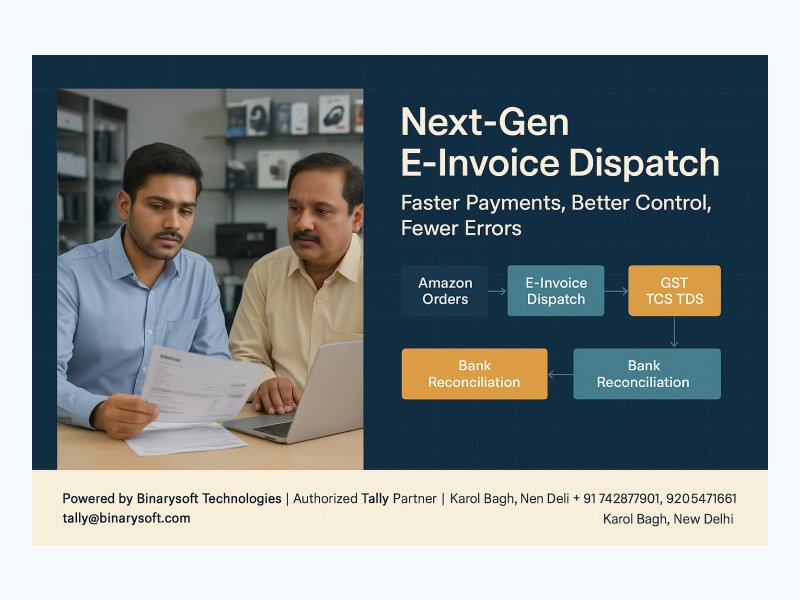
An e-invoice dispatch system is often misunderstood as a tool that only sends invoice PDFs by email. In a modern business, dispatch is a complete chain. It begins when sales data is captured, continues through invoice validation, tax classification, e-invoice generation where applicable, buyer communication, accounting entry, settlement tracking, and ends only when the payment is matched and exceptions are closed.
For sellers using marketplaces such as Amazon, the chain becomes more complicated. The buyer may pay Amazon first, Amazon may deduct commission and other fees, returns may be processed after the sale, TCS and TDS may appear in reports, and the net settlement received in the bank may look nothing like the gross invoice value. If the accounting team records only the bank receipt as sales, the books may look simple for a week but become confusing during GST reconciliation, profitability review, and year-end closing.
A next-gen system therefore combines three capabilities. First, it prepares correct invoice data before dispatch. Second, it sends or stores invoices in a controlled way, with status tracking. Third, it reconciles what was billed, what was returned, what was deducted, what was collected as tax, and what was finally received in the bank.
The phrase zero errors should be understood as an operating discipline, not a magic promise. No responsible system can guarantee that business users will never enter wrong data or that external marketplace reports will never contain timing differences. What a well-designed workflow can do is reduce avoidable errors, highlight exceptions early, and create review points before mistakes become filing or payment problems.
Why Faster Payments Depend on Cleaner Invoice Dispatch
Payment delays are not always caused by customers who do not want to pay. Many delays begin with small documentation issues. The buyer says the invoice was not received. The purchase team says the GST number is wrong. The accounts department says the e-invoice details do not match. The marketplace settlement team says the order was refunded. The bank statement shows a lower amount than expected. Each of these issues turns into a call, a message, or an internal investigation.
When invoices are dispatched quickly and accurately, the payment conversation starts on stronger ground. The seller can say which invoice was issued, when it was shared, which order it relates to, what tax details were used, whether an e-invoice or IRN was required, whether a return has been processed, and which settlement batch contains the payout. This reduces ambiguity. It also helps the business owner separate real collection problems from accounting classification problems.
For Amazon and other marketplace sellers, faster payment control does not mean that the marketplace will pay before its defined cycle. It means the seller can understand each settlement faster, identify missing amounts earlier, and avoid waiting until month-end to discover that returns, fees, or tax deductions were incorrectly booked. In many businesses, that alone improves cash confidence.
An Illustrative Story from Karol Bagh
Consider an illustrative story of a mobile accessories seller near Gaffar Market in Karol Bagh. This is not presented as a real customer case, but it reflects a situation many small and mid-sized sellers will recognize. The seller, let us call him Rakesh, runs a compact but busy business. His shelves are full of chargers, cables, phone covers, Bluetooth speakers, and small electronics accessories. The shop opens early, marketplace orders are checked before lunch, and local dealers keep calling for urgent supply.
For years, Rakesh believed that if money came into the bank, the business was fine. His staff printed marketplace order summaries, packed goods, and kept a notebook of dispatched parcels. Invoices were sometimes created at the end of the day, sometimes the next morning, and sometimes only when a buyer asked. Amazon settlements were downloaded once or twice a month. Fees, shipping adjustments, returns, TCS, and TDS were all treated as background noise because the net bank credit felt like the real number.
Then one festive season, the pressure became emotional. Sales were high, but cash felt tight. Rakesh had promised a supplier in Nehru Place that payment would be cleared before the weekend. His son, who had recently joined the business, opened the settlement report and saw that several orders marked as shipped had later been refunded. Some fees were booked twice. TCS was treated as an expense in one sheet and as receivable in another. One high-value B2B invoice had been sent late, and the buyer held payment because the accounts team could not match the document with their purchase record.
Rakesh did not lose the business, but he lost sleep. The painful part was not that the business had no sales. The painful part was that nobody could confidently explain where the money was stuck. That is the moment many sellers realize that dispatch is not clerical work. It is financial control.
In a better workflow, Rakesh's team would capture order data daily, validate invoice fields before dispatch, separate marketplace reports from bank receipts, book Amazon fees and tax deductions into proper ledgers, and reconcile settlement batches against invoices and returns. Instead of asking where did the money go, they could ask a better question: which exact order, fee, return, or deduction explains the difference?
The Core Problem: Sellers Mix Up Sales, Settlements, and Bank Receipts
One of the most common accounting problems for marketplace sellers is treating three different records as if they are the same. They are not. A sales invoice records what was sold. A marketplace settlement report explains how the marketplace calculated the payout after fees, refunds, taxes, and other adjustments. A bank receipt proves how much money reached the bank on a specific date.
If a seller books the bank credit as sales, the books may ignore gross turnover, output GST, returns, marketplace fees, TCS, TDS, and receivables. If the seller books the marketplace settlement as a bank receipt without checking the actual bank credit, timing differences may remain hidden. If the seller books every order as final sale but does not book returns, turnover and stock may be inflated. If the seller books TCS as an expense instead of a receivable or tax credit subject to proper verification, the profit and tax position may be distorted.
The correct approach is to respect the purpose of each source. Order reports support invoice creation and sales recognition. Return reports support credit notes and stock adjustment. Settlement reports explain deductions and payouts. Bank statements confirm actual receipt. GST reports support statutory review. TallyPrime becomes the central accounting record only when these sources are mapped carefully and reviewed regularly.
What Sellers Should Verify Before Designing the Workflow
Tax and product features change over time, and every business has its own facts. Before finalizing an e-invoice dispatch and accounting workflow, sellers should verify important points with their accountant, GST consultant, or current product documentation. This includes e-invoicing applicability, GST registration details, invoice series rules, place of supply treatment, HSN or SAC classification, marketplace TCS and TDS reporting, input tax credit eligibility, return treatment, and TallyPrime feature availability for their license and version.
This article explains practical accounting organization and control principles. It does not replace professional tax advice. It also does not claim a recent regulatory change unless the reader verifies it from official sources. The safest business habit is to build a workflow that can adapt when compliance requirements or software capabilities change.
The Building Blocks of a Next-Gen Dispatch System
A reliable e-invoice dispatch system has several building blocks. Each block reduces a different type of risk. When they work together, sellers get speed without losing control.
Clean Master Data
Master data is the foundation. If buyer GSTIN, legal name, address, state, pincode, item description, HSN or SAC, tax rate, and unit of measurement are wrong, the invoice will carry the mistake forward. For marketplace orders, buyer details may be limited or masked depending on the report available. Sellers should define how B2C and B2B orders will be handled and what details are required for each invoice type. Any tax rate, HSN, threshold, or classification should be confirmed with the accountant or current GST guidance.
Defined Invoice Series
Invoice numbering should be logical and controlled. Many sellers use separate series for online marketplace sales, offline counter sales, wholesale B2B sales, export sales, or branch-wise sales. The exact design depends on business structure and accountant advice. The important point is consistency. Frequent changes in invoice series create avoidable reconciliation work.
Pre-Dispatch Validation
Before an invoice is sent, the system or user should validate basic fields. Is the party correct? Is the GST registration selected correctly? Is the place of supply correct? Is the item tax classification correct? Is the order reference captured? Is the invoice date aligned with the dispatch and accounting policy? Is an e-invoice required for this transaction? These questions prevent small mistakes from becoming payment disputes.
E-Invoice Generation Where Applicable
For businesses covered under e-invoicing requirements, invoice data may need to be reported to the designated system and relevant e-invoice details such as IRN or QR information may need to be reflected as per current rules. Applicability, thresholds, transaction coverage, and technical process must be verified from current official guidance and product documentation. A next-gen dispatch system should make this step structured, not accidental.
Controlled Dispatch
Dispatch means the invoice reaches the right recipient or is stored in the right marketplace or customer channel. For some buyers, email is enough. For others, portal upload is required. For internal control, the team should record dispatch status, date, and responsible user. If invoice dispatch is treated casually, the business may discover payment problems only after the due date.
Settlement Reconciliation
For marketplace sellers, the invoice is only the beginning. The business must reconcile gross sales, returns, fees, tax deductions, reimbursements, storage charges, advertising charges if applicable, and the net amount credited to the bank. Without settlement reconciliation, a seller may not know whether profit is being eaten by returns, deductions, or pricing errors.
Exception Management
A modern system should not hide exceptions. It should show them clearly. Examples include missing order ID, invoice without settlement reference, settlement without invoice, return without credit note, bank receipt without settlement report, TCS not matched, TDS not matched, fee GST not reviewed, and negative payout not explained. Exceptions should be assigned, corrected, and closed.
How TallyPrime Fits into the Workflow
TallyPrime is widely used by Indian businesses for accounting, GST, inventory, and business reporting. The exact features available to a seller depend on the product version, configuration, license, and current documentation. Sellers should check the latest TallyPrime help resources or speak with an authorized Tally partner before implementing a process. At a practical level, TallyPrime can serve as the central books of account where sales, credit notes, receipts, Amazon fees, tax ledgers, TCS, TDS, and bank reconciliation are organized.
The key is not simply entering data into TallyPrime. The key is designing the chart of accounts, voucher flow, item masters, and references so that marketplace reports can be reconciled properly. If data is entered randomly, TallyPrime will store it faithfully but the reports may not answer business questions. If data is organized carefully, the owner can see gross sales, returns, net sales, fees, taxes, receivables, and bank receipts with clarity.
Suggested Ledger Structure for Marketplace Sellers
The exact ledger structure should be finalized with an accountant, but the following approach is useful for discussion. Sellers can create separate sales ledgers for Amazon sales if they want marketplace-wise reporting. They may also maintain different ledgers for taxable sales categories, B2B and B2C sales, or state-wise reporting if required. The goal is to make GST review and profitability analysis easier without making daily entry too complicated.
Common ledgers may include Amazon Sales, Amazon Sales Returns, Amazon Settlement Receivable, Amazon Commission or Referral Fee, Amazon Shipping Fee or Delivery Charge, Amazon Closing Fee, Amazon Storage or Other Charges if applicable, Amazon Advertising Expense if applicable, GST Input on Marketplace Fees subject to eligibility and documentation, TCS Receivable, TDS Receivable, Output GST ledgers, Bank Account, and Rounding Off or Minor Difference ledger. Names should be clear enough that a new accountant can understand them without asking the owner.
A useful principle is to separate revenue, deductions, tax receivables, and bank movements. Marketplace fee is not the same as return. TCS is not the same as commission. TDS is not the same as GST. Bank receipt is not the same as gross sale. When these are mixed, reconciliation becomes guesswork.
Organizing Amazon Sales in TallyPrime
Amazon sales should ideally be organized from the order and invoice perspective, not merely from the payout perspective. For each sale, the accounting team should identify order ID, invoice number, invoice date, buyer category, item or SKU, quantity, taxable value, tax amount, shipping or other charges if billed, and total invoice value. If the seller maintains inventory in TallyPrime, SKU mapping becomes especially important because returns and stock movement must match the original sale.
For high-volume sellers, manual entry of every order may not be practical. They may use import utilities, integrations, or structured data entry processes. The method should be verified against current TallyPrime capabilities and partner solutions. Even when imports are used, the business should review samples regularly to ensure that tax ledgers, item names, quantities, and references are mapping correctly.
A simple example helps. Suppose an Amazon order has a gross invoice value, a taxable value, and GST. The sale entry should capture the gross sale and output tax as applicable. Later, when Amazon deducts commission and other charges in the settlement, those deductions should be booked separately. If the seller only books the net amount received in the bank as sales, the books will not show the full invoice value or the deduction pattern.
Organizing Amazon Returns and Refunds
Returns are one of the biggest sources of confusion. A return is not simply negative sales in a spreadsheet. It should be represented through appropriate accounting entries such as credit notes and inventory adjustment where relevant. The timing of return approval, goods received back, refund issued, and marketplace settlement adjustment may not be the same. This timing difference should be managed rather than ignored.
For example, an order sold in March may be returned in April. The marketplace may adjust the refund in an April settlement. The GST and accounting treatment should be verified with the accountant based on current rules and the seller's facts. Operationally, the team should capture the original order ID, original invoice number, return date, returned quantity, condition of goods, credit note reference, and settlement reference.
Common return mistakes include reducing the bank receipt without booking a credit note, booking the return twice because it appears in both return report and settlement report, failing to bring returned stock back into inventory, not separating damaged returns from saleable returns, and ignoring tax impact. A next-gen dispatch and reconciliation system should make returns visible, because returns directly affect cash, stock, GST, and profit.
Organizing Amazon Settlements
The settlement report is the marketplace's explanation of payout. It may contain sales, refunds, commission, shipping fees, promotional charges, reimbursements, taxes collected or deducted, reserves, and other adjustments depending on the marketplace format. The settlement report should be treated as a reconciliation document, not as a replacement for the sales invoice.
In TallyPrime, a seller can use the settlement report to clear Amazon Settlement Receivable and book deductions into their respective ledgers. If an invoice creates a receivable from Amazon or the marketplace channel, the settlement entry reduces that receivable. Fees are booked to expense ledgers. TCS and TDS may be booked to receivable or tax ledgers subject to accountant advice and valid reports. The net amount should match the bank receipt or be explainable through timing differences.
The best practice is to reconcile settlement batch by batch. Each settlement batch should have a settlement ID or reference. The finance team should record the settlement period, payout date, gross order value included, refunds included, total fees, tax deductions, reimbursements, net payout, and bank credit reference. This batch discipline helps when an auditor, accountant, or owner asks why the bank received a particular amount.
Organizing Amazon Fees
Marketplace fees may include referral fees, closing fees, shipping or delivery-related fees, storage fees, technology charges, advertising-related charges, or other deductions depending on the seller's services and marketplace program. The exact nature and tax treatment of each fee should be verified from marketplace tax invoices and professional advice. From an accounting control perspective, fees should not be hidden inside sales.
If fees are netted against sales, the business owner loses visibility. A product may appear profitable on gross selling price but become unprofitable after commission, shipping deductions, advertising spend, return cost, packaging, and damage. Separate fee ledgers allow the owner to analyze true marketplace economics. They also support review of input GST where eligible and supported by proper documentation.
A practical example is a product sold for a certain price where Amazon deducts referral fee and shipping-related charge before paying the seller. If the seller books only the net bank credit, the profit report may show lower sales but no expense. If the seller books gross sale and separate fee expenses, the profit report becomes more meaningful. The owner can then decide whether to raise price, reduce discount, change fulfillment method, or stop selling a low-margin SKU.
Organizing TCS in TallyPrime
Marketplace TCS can appear in marketplace reports and tax statements. The accounting treatment and claim process should be confirmed with the accountant based on current GST law and portal data. In books, sellers often treat TCS as a receivable or recoverable amount rather than a normal business expense, subject to proper verification. The important control point is that TCS should not disappear inside net settlement.
The team should maintain a ledger for TCS receivable or similar account as advised. Settlement entries should identify the TCS amount separately. Periodically, the amount in books should be matched with marketplace reports and the relevant GST portal information. Differences should be investigated early. If TCS is booked incorrectly as commission expense, the profit and tax review may become distorted.
Organizing TDS in TallyPrime
TDS reporting in marketplace or digital commerce contexts can depend on the type of transaction and current law. Sellers should verify applicability, rates, statements, and credit reflection with their accountant. From a bookkeeping perspective, TDS deducted by a platform or buyer is usually tracked separately so the business can reconcile it with certificates, statements, and income tax records where applicable.
In TallyPrime, sellers may maintain a TDS receivable or tax deducted ledger as advised. The settlement or receipt entry should separate TDS from fees and bank amount. The team should periodically compare TDS ledger balances with available tax credit information. The common mistake is treating TDS as a marketplace fee. That may understate recoverable tax credit and overstate expenses.
Organizing GST Data in TallyPrime
GST data quality depends on correct invoice details, tax classification, GSTIN, place of supply, HSN or SAC, taxable value, tax amount, credit notes, debit notes, and purchase or expense tax invoices. TallyPrime can help organize GST records when masters and entries are configured correctly, but sellers should verify current software features and GST reporting requirements before filing. Never assume that a report is correct merely because it was generated from software. The data behind the report must be correct.
For Amazon sellers, GST organization includes output GST on sales, GST impact of returns and credit notes, GST on marketplace fee invoices where input credit may be available subject to rules and documentation, and reconciliation with marketplace GST reports. B2B transactions require extra attention because buyer GSTIN and invoice reporting affect the buyer's ability to match records. B2C transactions still require correct tax classification and reporting.
A useful monthly practice is to compare TallyPrime sales registers with marketplace sales reports, credit note reports with return reports, expense ledgers with marketplace fee tax invoices, and tax ledgers with filing data. Any differences should be categorized as timing difference, missing entry, duplicate entry, wrong tax classification, or report format issue.
Marketplace Reports Are Not Bank Receipts
This point deserves repetition because it is the heart of marketplace reconciliation. A marketplace report explains transaction economics. A bank receipt confirms money movement. They are connected, but they are not the same document.
The settlement report may show that Amazon calculated a payout for a certain period. The bank statement may show the net credit on a different date. A reserve or adjustment may hold back part of the amount. A refund may be adjusted in the same settlement. Fees may be deducted before payout. TCS and TDS may be reported separately. If the accountant treats the bank credit as full sales, all these details vanish.
The better method is to create a receivable from sales, reduce it through settlement deductions, and match the final payout with the bank. For small sellers, this can be simplified, but the logic should remain intact. The bank is the last step, not the starting point for understanding sales.
Common Reconciliation Mistakes Sellers Should Avoid
Many sellers do not make accounting mistakes because they are careless. They make them because marketplace data is complex and time pressure is real. The following mistakes are common and costly.
- Booking net bank receipt as sales: This hides gross sales, GST, fees, TCS, TDS, and returns.
- Ignoring settlement IDs: Without settlement references, it becomes difficult to explain payouts later.
- Double-counting returns: The same return may appear in a return report and settlement report.
- Treating TCS as expense: TCS should be reviewed and booked as advised by the accountant, often as a recoverable or receivable item.
- Treating TDS as commission: TDS should be separately tracked where applicable and reconciled with tax records.
- Not booking marketplace fee GST properly: Input tax credit eligibility and documentation should be verified.
- Using one ledger for all Amazon deductions: This makes profitability analysis weak.
- Not matching bank date with settlement period: Date differences can create unnecessary confusion.
- Ignoring negative settlements: Negative payouts often indicate returns, reserves, or high deductions that need review.
- Not reconciling stock returns: Returned goods should be checked for condition and inventory impact.
How an E-Invoice Dispatch Workflow Reduces Errors
A strong dispatch workflow reduces errors by introducing checkpoints. Before invoice creation, master data is checked. Before dispatch, invoice fields are validated. After dispatch, delivery or sharing status is monitored. After settlement, payments and deductions are matched. At month-end, GST and tax reports are reviewed. Each checkpoint catches a different error.
For example, a wrong GSTIN may be caught before dispatch. A missing order ID may be caught during invoice entry. A return without credit note may be caught during settlement reconciliation. A fee invoice not booked may be caught during monthly GST review. A payout mismatch may be caught during bank reconciliation. The system does not depend only on memory.
In practical terms, error reduction requires clear responsibility. The person who packs orders should not be the only person responsible for tax correctness. The person who downloads settlement reports should not silently adjust differences. The accountant should not receive incomplete documents after the filing deadline. A next-gen system defines who checks what and when.
Designing a Daily Routine for Sellers
Daily discipline is more effective than month-end rescue. Sellers should create a short daily routine that their team can actually follow. A complex process that nobody follows is less useful than a simple process executed consistently.
A practical daily routine may include downloading or reviewing new marketplace orders, confirming dispatch status, creating or importing sales invoices, checking B2B buyer details where relevant, validating tax classification, dispatching invoices through the required channel, marking invoice dispatch status, recording obvious cancellations, and saving order references. For high-volume sellers, the routine may be split between operations and accounts.
The daily routine should also include exception notes. If an invoice could not be created because buyer details were incomplete, it should be listed. If a product tax classification is unclear, it should be sent to the accountant. If a shipment was cancelled after invoice creation, the corrective entry should be scheduled. This reduces silent backlog.
Designing a Weekly Settlement Routine
Weekly settlement review is important for Amazon sellers because payout cycles and return cycles can quickly create confusion. The weekly routine should not wait for GST filing. It should focus on business clarity.
The team should download settlement reports, identify settlement IDs, compare included orders with sales entries, identify refunds and returns, book marketplace fees into proper ledgers, separate TCS and TDS, match net payout with bank receipts, and create a difference report. If a settlement is not fully reconciled, the reason should be written clearly. Examples include bank credit pending, return credit note pending, fee invoice pending, order not found, or timing difference.
Weekly review gives the owner early warning. If returns are rising on one SKU, pricing is wrong on another, or fees are higher than expected, the business can act before the month closes.
Designing a Monthly GST and Profitability Routine
Monthly review should connect compliance and business performance. The accountant or finance team should compare TallyPrime data with marketplace reports, GST summaries, return records, fee invoices, TCS and TDS records, and bank reconciliation. Any tax rate, filing rule, or reconciliation requirement should be confirmed from current official guidance and professional advice.
Profitability review should not stop at sales. The owner should see gross marketplace sales, returns, net sales, marketplace fees, advertising costs if any, packaging, courier or fulfillment-related costs, damaged returns, tax credits, and net margin. Many marketplace sellers discover that their best-selling SKU is not always their best profit contributor. Clean accounting makes that insight visible.
Practical Example: From Order to Bank Receipt
Imagine a seller receives an Amazon order for a mobile charger. The order is shipped. The sales invoice is created in TallyPrime with item details, tax classification, invoice number, and order reference. The invoice is dispatched or stored as required. At this point, the books show a sale and a receivable from the marketplace or relevant party based on the accounting design.
Later, Amazon includes the order in a settlement. The settlement shows the sale value, deducts marketplace fees, identifies tax deductions where applicable, and calculates a net payout. The accountant books the fees to expense ledgers, separates TCS and TDS as advised, and reduces the marketplace receivable. The bank statement then shows the net amount received. The bank receipt is matched with the settlement ID.
If the product is returned after payout, the next settlement may include a refund adjustment. The accountant should book a credit note or return entry, adjust inventory where relevant, and reconcile the refund in the settlement. This keeps sales, returns, stock, GST, and bank aligned.
Practical Example: Why Net Sales Booking Misleads the Owner
Assume a seller receives a net payout from Amazon and books it directly as sales. The owner sees sales in the books equal to bank credits. At first, this feels simple. But the owner cannot see gross marketplace turnover, cannot analyze fees, cannot identify returns separately, cannot match output GST properly, and cannot track TCS or TDS recoverables. When the accountant asks for reconciliation, the team has to rebuild everything from reports.
Now compare this with a structured approach. Gross sales are booked based on invoices. Returns are booked through credit notes. Fees are booked separately. TCS and TDS are tracked. Bank receipts are matched with settlements. The owner can ask meaningful questions. Which SKU has the highest return rate? Which fee is rising? Which settlement is pending? Which tax credit is not matched? The same business becomes more controllable.
Inventory and SKU Discipline
For sellers dealing in products, invoice accuracy is connected to inventory accuracy. A wrong SKU in the invoice affects stock, returns, pricing, and profitability. In Karol Bagh and Gaffar Market type businesses, similar-looking products can create real confusion. A fast charger, regular charger, premium cable, and economy cable may look similar in a rush, but their cost and selling price differ.
In TallyPrime, item masters should be named clearly. Sellers should avoid vague item names such as charger, cable, or cover when multiple variants exist. Better naming includes brand, model, wattage, color, pack size, or other useful identifiers. The exact level of detail depends on business volume. Barcode or SKU mapping may be considered where practical.
Returned stock should not automatically be treated as saleable. A returned power bank with damaged packaging may need a different treatment from a sealed returned phone cover. Operational notes should flow to accounts where value impact exists. Clean dispatch and return processes help protect both customer satisfaction and margin.
Data Import and Automation: Useful but Not a Substitute for Review
Automation can save time, especially for sellers with hundreds or thousands of orders. Data import tools, integrations, and partner solutions may help bring marketplace orders or vouchers into TallyPrime. Sellers should verify compatibility, data security, mapping options, and current product support before adopting any tool. Automation should be tested with sample data before live use.
The biggest risk in automation is silent wrong mapping. If one tax ledger, item group, state code, or fee ledger is mapped incorrectly, the system can repeat the mistake at scale. Therefore, automation should be paired with review reports. A daily or weekly sample check can catch issues early. Users should review unmatched entries, negative values, tax exceptions, and missing references.
A next-gen dispatch system is not simply automatic. It is controlled automation. The goal is to reduce manual effort while preserving accounting responsibility.
Document Management and Audit Readiness
Good accounting is not only entries. It is also evidence. Sellers should maintain access to invoices, e-invoice details where applicable, marketplace settlement reports, fee invoices, TCS and TDS reports, bank statements, return reports, credit notes, delivery evidence, and accountant working papers. Documents should be organized by period and marketplace.
If a buyer disputes an invoice after three months, the team should be able to locate the invoice, dispatch record, order ID, and payment status quickly. If the accountant asks for fee invoices, the team should not search across personal email accounts and WhatsApp messages. If a tax review requires reconciliation, reports should be available in a structured folder.
Audit readiness is not only for large companies. Even small sellers benefit from disciplined records because it saves time, reduces panic, and improves credibility with lenders, suppliers, and buyers.
Role-Based Control in the Dispatch Process
As businesses grow, one person cannot control everything. Role-based control helps. Sales or operations may confirm order dispatch. Accounts may create or review invoices. A senior user may approve unusual credit notes or large adjustments. The owner may review exception reports rather than every transaction.
In TallyPrime and related workflows, access and approval options should be checked from current product documentation and implementation support. The principle is simple: users should have the access they need, but sensitive actions should be controlled. Deleting vouchers, changing invoice numbers, altering tax ledgers, or modifying settlement entries should not be casual actions.
Control does not mean slowing the business. It means preventing avoidable damage. A small unauthorized change can create a large reconciliation problem later.
What Faster Dispatch Looks Like in Real Life
Faster dispatch is not about rushing. It is about removing unnecessary waiting. In a well-designed process, order data arrives in a structured format, invoices are generated with correct references, e-invoice requirements are checked where applicable, documents are sent or stored promptly, and settlement tracking begins immediately. The team does not wait until the buyer complains.
For a wholesale buyer, faster dispatch may mean the buyer's accounts team receives the invoice before goods arrive. For a marketplace seller, it may mean the invoice and order reference are correctly available before settlement. For the owner, it means fewer unanswered questions at month-end. For the accountant, it means less time spent cleaning data and more time advising the business.
Better Control: The Reports Owners Should Review
Owners do not need to review every voucher, but they should review the right reports. A practical dashboard or report pack can include daily invoices dispatched, invoices pending dispatch, marketplace sales by period, returns by SKU, settlement batches reconciled, unreconciled payout difference, marketplace fees as percentage of sales, TCS balance, TDS balance, bank reconciliation status, and GST exception list.
The exact report names and availability depend on the software setup and implementation. The idea is to move from gut feeling to informed review. If returns rise from one product category, the owner should see it. If marketplace fees increase, the owner should ask why. If TCS or TDS balances do not match reports, the team should investigate before year-end.
Zero-Error Discipline: What It Really Requires
Zero-error discipline requires three habits. First, standardization. The team should know how to name items, choose ledgers, enter references, and process returns. Second, validation. Important fields should be checked before dispatch and before filing. Third, reconciliation. Sales, settlements, bank, tax, and inventory should be compared regularly.
It also requires humility. Even experienced accountants can make mistakes when reports are complex. Even good software can produce poor results if masters are wrong. Even careful staff can miss an exception during festive rush. A strong system assumes errors can happen and creates checkpoints to catch them.
Implementation Checklist for Sellers
Before implementing a next-gen e-invoice dispatch and reconciliation process, sellers can use the following checklist. It should be adapted with the help of an accountant and an authorized Tally partner.
- Confirm applicability: Verify e-invoicing, GST, TCS, TDS, and filing requirements from current official guidance and accountant advice.
- Clean master data: Review party details, GSTINs, addresses, item names, HSN or SAC, tax ledgers, and units.
- Define invoice series: Decide separate series for marketplace, offline, branch, or B2B sales if needed.
- Map marketplace reports: Identify order report, return report, settlement report, fee invoices, tax reports, and bank statements.
- Create ledgers: Separate sales, returns, fees, TCS, TDS, GST, receivables, and bank ledgers.
- Capture references: Record order ID, invoice number, settlement ID, bank reference, and return reference.
- Validate before dispatch: Check buyer details, item details, tax classification, invoice date, and e-invoice requirement where applicable.
- Reconcile weekly: Match settlements with invoices, returns, fees, tax deductions, and bank receipts.
- Review monthly: Compare TallyPrime records with marketplace reports and GST summaries.
- Control exceptions: Maintain a pending list for missing invoices, unmatched returns, unreconciled payouts, and tax differences.
- Document everything: Store invoices, settlement files, fee invoices, credit notes, bank statements, and tax reports systematically.
- Train the team: Ensure operations and accounts understand the difference between sale, settlement, deduction, and bank receipt.
Questions to Ask Before Choosing a Dispatch Solution
Not every business needs the same level of automation. A seller with 20 orders per week has different needs from a seller with 2,000 orders per day. Before choosing a dispatch system, integration, or implementation partner, ask practical questions.
- Can the solution handle our invoice volume without manual chaos?
- Can it capture order ID, settlement ID, and return references?
- Can it support e-invoice workflow where applicable, based on current product capability?
- Can marketplace fees, TCS, TDS, GST, and bank receipts be separated clearly?
- Can data be reviewed before final posting?
- Can exceptions be reported instead of hidden?
- Can our accountant understand and audit the entries?
- Can staff learn the process without depending on one person?
- Is data security and backup handled responsibly?
How Small Sellers Can Start Without Overcomplicating
A small seller does not need to build a large enterprise system on day one. The first step can be simple: stop booking net bank receipts as sales without understanding the settlement. Create separate ledgers for sales, returns, marketplace fees, TCS, TDS, and bank. Add order ID and settlement ID references. Reconcile one settlement batch properly. Then repeat.
Once the basic discipline works, the seller can improve invoice dispatch tracking, data import, SKU mapping, exception reporting, and automation. The process should mature with volume. The worst approach is to wait for perfect software while bad data accumulates. The second worst approach is to automate a broken process.
Start with clarity. Then add speed.
How Growing Sellers Can Scale the Workflow
Growing sellers need stronger controls because transaction volume multiplies small mistakes. They should consider structured voucher import, defined approval rights, separate responsibility for operations and accounts, monthly reconciliation calendar, exception ageing report, and SKU-level profitability review. They should also document standard operating procedures so the process does not depend on one employee's memory.
For businesses selling across multiple marketplaces or branches, marketplace-wise ledgers and cost centers may be useful, depending on the accounting design and TallyPrime configuration. Sellers should consult their accountant and Tally implementation partner before restructuring books. The goal is to get reports that support decisions without creating unnecessary complexity.
Human Side of Better Accounting
Accounting errors are often discussed as technical issues, but the emotional cost is real. A business owner who cannot explain cash flow feels anxious. A staff member who is blamed for a mismatch may lose confidence. A supplier who is paid late may reduce credit. A buyer whose invoice is wrong may stop trusting the seller. Clean invoice dispatch protects relationships.
In markets like Karol Bagh, trust is a daily currency. Shopkeepers, distributors, accountants, transporters, and customers work in tight timelines. When records are organized, conversations become calmer. The owner can negotiate with suppliers honestly. The accountant can advise instead of firefighting. The next generation joining the family business can see numbers clearly and make better decisions.
Security, Backup, and Continuity
A next-gen system should also protect data. Invoice records, customer details, marketplace reports, and tax files are sensitive. Sellers should maintain secure user access, regular backups, and controlled sharing of reports. Cloud or remote access arrangements should be evaluated for security, reliability, and suitability. Product features and hosting arrangements should be verified from current documentation and trusted partners.
Business continuity matters. If the accountant's computer fails one day before filing, data should not disappear. If one employee leaves, the settlement process should still be understandable. If the owner travels, reports should be available through approved access. Control includes the ability to continue operations during disruption.
What Accountants Should Communicate to Sellers
Accountants play a critical role in helping sellers avoid messy books. They should explain that marketplace sales cannot be judged only from bank receipts. They should define required ledgers, voucher types, tax review points, and document requirements. They should also provide a monthly pending list instead of waiting until the financial year ends.
Good communication includes simple language. Instead of saying reconciliation pending, the accountant can say five settlement batches are not matched with bank, two return reports are not booked, TCS in books differs from report, and fee tax invoices for one period are missing. Specific feedback leads to action.
What Business Owners Should Demand from Their Process
Business owners should demand clarity, not just compliance. They should be able to ask: How much did we sell on Amazon this month? How much was returned? How much did we pay in marketplace fees? What tax amounts are recoverable or adjustable subject to rules? Which settlement is unreconciled? Which SKU loses money after returns? Which invoices are pending dispatch? Which buyer has a payment issue due to documentation?
If the current process cannot answer these questions, the business is operating with blind spots. A next-gen e-invoice dispatch system closes those blind spots by connecting documents, data, and money.
Conclusion
The future of invoice dispatch is not just faster emailing of PDFs. It is a controlled financial workflow that begins with clean data and ends with reconciled payment. For sellers in Karol Bagh, Gaffar Market, and across India, the challenge is clear: marketplace reports are getting more detailed, buyer expectations are faster, and accounting mistakes are more expensive. The opportunity is equally clear. With disciplined invoice creation, correct e-invoice handling where applicable, structured dispatch, separate ledgers for Amazon sales, returns, settlements, fees, TCS, TDS, and GST, and regular reconciliation in TallyPrime, sellers can reduce confusion and gain better control.
Faster payments come from fewer documentation disputes. Better control comes from separating sales from settlements and bank receipts. Zero-error discipline comes from validation, review, and accountability. The result is not only cleaner compliance. It is a business owner who can look at the numbers and make decisions with confidence.
If you want to modernize your TallyPrime accounting, e-invoice dispatch, Amazon reconciliation, GST data organization, or marketplace settlement workflow, connect with Tally@Cloud powered by Binarysoft Technologies, an Authorized Tally Partner. Visit or contact us at 1626/33, 1st Floor, Naiwalan, Karol Bagh, New Delhi - 110005, INDIA. Call +91 7428779101, 9205471661 or email tally@binarysoft.com. Contact hours: 10:00 AM - 6:00 PM, Mon-Fri.
FAQ
What is a next-gen e-invoice dispatch system?
A next-gen e-invoice dispatch system is a controlled workflow for creating, validating, sharing, tracking, and reconciling invoices. It connects invoice data with e-invoice requirements where applicable, buyer communication, marketplace settlements, returns, fees, GST, TCS, TDS, and bank receipts. The purpose is to reduce avoidable errors and improve payment clarity.
Can TallyPrime manage Amazon sales, returns, fees, TCS, TDS, and GST?
TallyPrime can be used to organize these records through proper ledgers, voucher entries, item masters, references, and reconciliation reports. The exact features, import options, and e-invoice capabilities available to your business should be checked from current TallyPrime documentation or an authorized Tally partner. The accounting structure should also be approved by your accountant.
Why should sellers not book Amazon bank payouts directly as sales?
Amazon bank payouts are usually net receipts after fees, refunds, tax deductions, and other adjustments. If the net bank amount is booked as sales, the books may hide gross turnover, GST, marketplace fees, returns, TCS, TDS, and receivables. Sellers should distinguish invoices, settlement reports, and bank receipts.
How should Amazon returns be recorded in TallyPrime?
Returns should generally be linked with the original order and invoice, supported by credit notes or appropriate accounting entries, and matched with settlement adjustments. Inventory impact should also be reviewed if goods are returned. The GST and timing treatment should be confirmed with your accountant based on current rules.
Is TCS or TDS a marketplace expense?
TCS and TDS should not be casually treated as marketplace expenses. They are usually tracked separately as tax-related receivables or credits, subject to applicable law, statements, and accountant advice. Sellers should reconcile these amounts with marketplace reports and relevant tax records.
How often should marketplace sellers reconcile settlements?
Weekly reconciliation is practical for many active sellers, while high-volume sellers may need daily review. At minimum, settlements should be reconciled before monthly GST and management review. Each settlement should be matched with invoices, returns, fees, TCS, TDS, and bank receipts.
Does a next-gen dispatch system guarantee zero errors?
No responsible system can guarantee that no error will ever occur. Zero-error should be treated as a discipline: clean master data, validation before dispatch, controlled user access, clear ledger mapping, regular reconciliation, and exception reporting. These practices significantly reduce avoidable mistakes.
What should sellers verify before implementing e-invoice dispatch?
Sellers should verify e-invoicing applicability, GST requirements, invoice series rules, HSN or SAC classification, tax rates, TCS and TDS treatment, input tax credit eligibility, and current TallyPrime features. These points should be confirmed with an accountant, official guidance, and current product documentation.
Frequently Asked Questions
What is a next-gen e-invoice dispatch system?
A next-gen e-invoice dispatch system is a controlled workflow for creating, validating, sharing, tracking, and reconciling invoices. It connects invoice data with e-invoice requirements where applicable, buyer communication, marketplace settlements, returns, fees, GST, TCS, TDS, and bank receipts. The purpose is to reduce avoidable errors and improve payment clarity.
Can TallyPrime manage Amazon sales, returns, fees, TCS, TDS, and GST?
TallyPrime can be used to organize these records through proper ledgers, voucher entries, item masters, references, and reconciliation reports. The exact features, import options, and e-invoice capabilities available to your business should be checked from current TallyPrime documentation or an authorized Tally partner. The accounting structure should also be approved by your accountant.
Why should sellers not book Amazon bank payouts directly as sales?
Amazon bank payouts are usually net receipts after fees, refunds, tax deductions, and other adjustments. If the net bank amount is booked as sales, the books may hide gross turnover, GST, marketplace fees, returns, TCS, TDS, and receivables. Sellers should distinguish invoices, settlement reports, and bank receipts.
How should Amazon returns be recorded in TallyPrime?
Returns should generally be linked with the original order and invoice, supported by credit notes or appropriate accounting entries, and matched with settlement adjustments. Inventory impact should also be reviewed if goods are returned. The GST and timing treatment should be confirmed with your accountant based on current rules.
Is TCS or TDS a marketplace expense?
TCS and TDS should not be casually treated as marketplace expenses. They are usually tracked separately as tax-related receivables or credits, subject to applicable law, statements, and accountant advice. Sellers should reconcile these amounts with marketplace reports and relevant tax records.
How often should marketplace sellers reconcile settlements?
Weekly reconciliation is practical for many active sellers, while high-volume sellers may need daily review. At minimum, settlements should be reconciled before monthly GST and management review. Each settlement should be matched with invoices, returns, fees, TCS, TDS, and bank receipts.
Does a next-gen dispatch system guarantee zero errors?
No responsible system can guarantee that no error will ever occur. Zero-error should be treated as a discipline: clean master data, validation before dispatch, controlled user access, clear ledger mapping, regular reconciliation, and exception reporting. These practices significantly reduce avoidable mistakes.
What should sellers verify before implementing e-invoice dispatch?
Sellers should verify e-invoicing applicability, GST requirements, invoice series rules, HSN or SAC classification, tax rates, TCS and TDS treatment, input tax credit eligibility, and current TallyPrime features. These points should be confirmed with an accountant, official guidance, and current product documentation.
CA. Rohin Mehtaal is a Chartered Accountant with experience in accounting systems, audit support, and GST compliance. He has assisted businesses in adopting structured financial processes and improving inventory accuracy. His writing emphasizes clarity, control, and data-driven decision making.