Call CA Tally HelpDesk
+91 9205471661,
7428779101
Introduction: Why Smart Inventory Management Is Becoming Essential for Indian Businesses
Every product sitting inside a warehouse represents money invested, customer expectations and future business opportunities. Yet many manufacturers, retailers, traders and wholesale distributors still struggle to answer basic questions: How much stock is available? Which products are selling quickly? Which items are lying unsold? Can the business fulfil tomorrow's orders without purchasing additional inventory?
In today's competitive business environment, inventory management is no longer simply about counting products. It directly influences profitability, customer satisfaction, cash flow and operational efficiency.
A small stock mismatch can delay a customer order. Excess purchasing can block working capital. Poor warehouse coordination can create unnecessary expenses, while inaccurate inventory records can affect financial reporting.
This is where Tally Prime inventory management tools become valuable.
By connecting stock transactions with purchases, sales, accounting and GST records, Tally Prime helps businesses maintain better control over daily operations.
Whether you operate a manufacturing unit, wholesale distribution network, retail shop or trading company, effective inventory management can transform the way your business operates.
A Story Every Business Owner Can Relate To: When One Missing Product Nearly Cost a Customer
Rajesh owned a growing electrical goods distribution business in Delhi. His company supplied switches, cables, lighting products and electrical accessories to contractors and retailers.
Business was expanding, and customer orders were increasing every month.
However, his inventory records were maintained through spreadsheets, handwritten registers and verbal updates from warehouse employees.
One afternoon, an important customer placed a large order for electrical cables required urgently at a construction site.
Rajesh confidently accepted the order because his spreadsheet showed sufficient stock.
When the warehouse team started preparing the shipment, they discovered that several cable rolls had already been dispatched against previous orders.
The available stock was considerably lower than expected.
The customer was disappointed, delivery was delayed, and Rajesh feared losing a valuable business relationship.
That evening, while reviewing his records, Rajesh realised something important.
His business did not suffer from a lack of customers. It suffered from a lack of reliable inventory information.
He decided to introduce a structured stock management process using Tally Prime.
Stock items were organised into categories, warehouse locations were recorded, purchase and sales entries were maintained consistently, and regular inventory reports became part of daily operations.
Gradually, Rajesh gained better visibility into available stock, pending orders and purchasing requirements.
Instead of depending entirely on phone calls and manual registers, he could make decisions using organised inventory information.
The biggest change was not merely operational.
It was emotional.
He no longer needed to worry constantly about whether the next customer order would expose another inventory mistake.
This is an illustrative business story showing how structured inventory management can improve operational confidence.
1. Understanding Inventory Management in Tally Prime
Inventory management involves monitoring the movement, quantity, value and availability of goods throughout business operations.
For manufacturers, this includes raw materials, work-in-progress and finished goods.
For traders and wholesalers, inventory management focuses on purchases, sales, stock availability and warehouse movements.
For retailers, it involves maintaining accurate product quantities, monitoring fast-moving products and reducing stock shortages.
Tally Prime brings inventory accounting and financial accounting into a connected business environment.
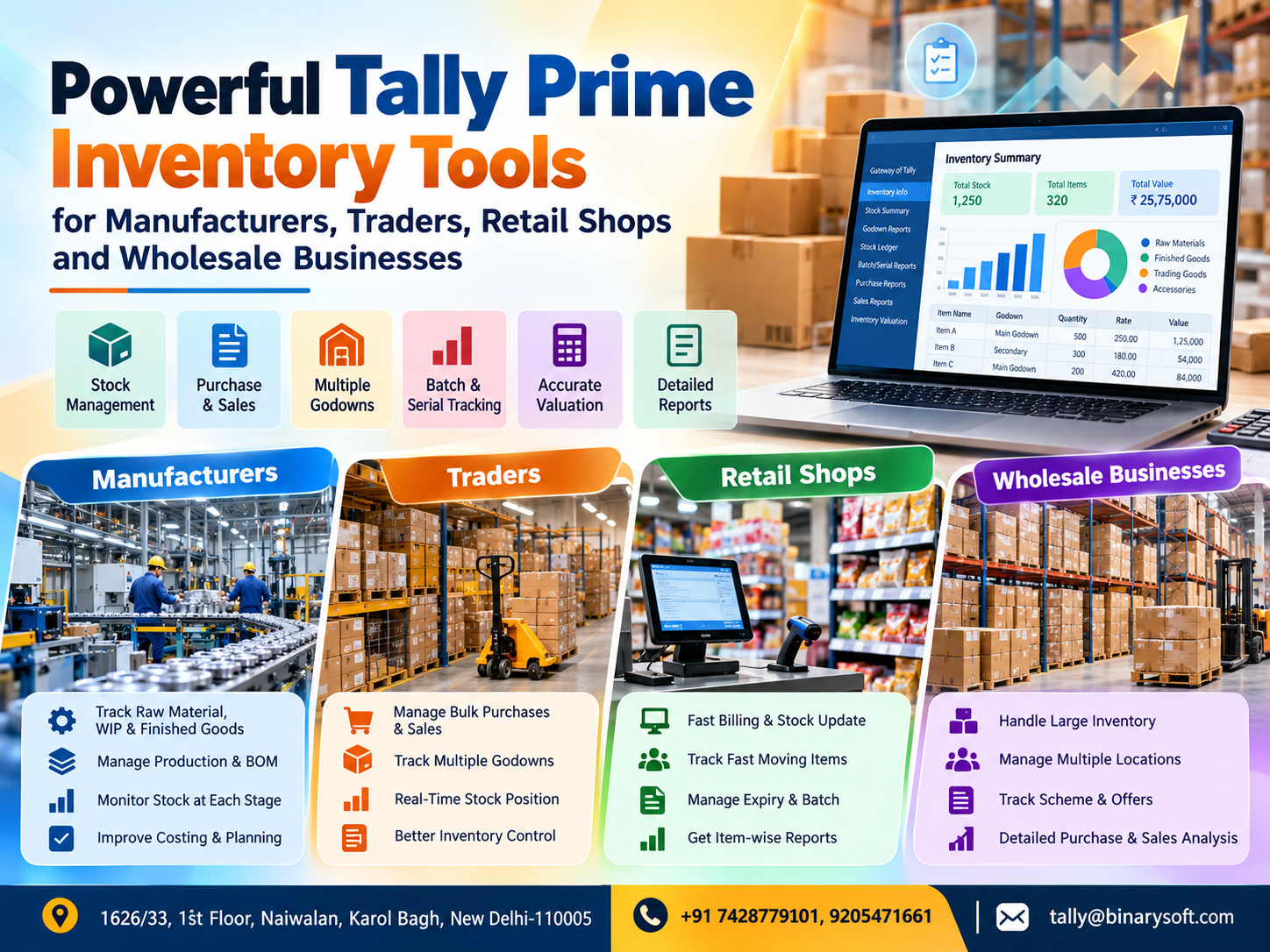
Its inventory capabilities include stock item creation, stock groups, units of measurement, godown management, batch tracking, inventory vouchers, stock valuation and detailed inventory reports.
When configured correctly and supported by disciplined transaction entry, these tools help businesses reduce manual errors and improve stock visibility.
2. Stock Item Management: Build a Strong Foundation for Inventory Accuracy
Every inventory management system begins with properly organised stock records.
Tally Prime allows businesses to create individual stock items and maintain important information about products.
For example, an electrical distributor may create stock items for copper wires, modular switches, circuit breakers, LED lights and electrical panels.
Each item can be assigned a suitable unit of measurement and organised into relevant stock groups.
Benefits of structured stock item management
-
Better identification of products during billing and purchasing.
-
Improved consistency in stock records.
-
Faster inventory report analysis.
-
Easier identification of slow-moving products.
-
Reduced confusion between similar products.
Businesses dealing with hundreds or thousands of products can use a consistent naming convention to make inventory records easier to maintain.
For example, instead of creating multiple confusing names for the same cable, a business can adopt a standard format based on brand, specification, size and unit.
Accurate stock masters help prevent errors from spreading across purchases, sales and inventory reports.
3. Stock Groups and Categories for Better Product Classification
Businesses often handle products belonging to multiple brands, specifications and business divisions.
Without classification, inventory reports become difficult to understand.
Tally Prime supports stock groups and stock categories to help organise products.
Consider a wholesale electronics business.
It may create stock groups such as mobile accessories, computer accessories, networking products and electrical equipment.
Within these groups, stock categories can provide an additional classification dimension.
This makes it easier to analyse inventory across different product segments.
Why classification matters
Proper classification helps management understand which product groups contribute more revenue, which categories require additional purchasing and where excess inventory may be accumulating.
Manufacturers can similarly organise raw materials, packaging materials, spare parts and finished goods.
Well-planned stock classification makes everyday inventory management more systematic and scalable.
4. Multiple Godown Management for Warehouse and Location Control
Businesses operating multiple warehouses, stores or storage locations need clear information about where products are physically available.
Tally Prime supports godown or location-based inventory management.
A wholesale distributor operating from Karol Bagh, Bawana and Naraina can maintain separate inventory records for different locations.
For example:
|
Location
|
Product
|
Available quantity
|
|---|
|
Karol Bagh
|
LED Lights
|
250
|
|
Bawana
|
LED Lights
|
600
|
|
Naraina
|
LED Lights
|
150
|
|
Total
|
LED Lights
|
1,000
|
Illustrative inventory quantities.
Instead of treating all stock as a single undifferentiated quantity, businesses can identify where goods are stored.
Tally Prime also supports stock transfers between locations through appropriate inventory vouchers.
Business advantages
Warehouse managers can identify stock availability at individual locations, coordinate transfers and reduce unnecessary purchases when goods are already available elsewhere.
This is particularly valuable for distributors, multi-branch traders and retailers operating multiple storage facilities.
For cloud-based deployments, authorised employees may access the same centrally maintained inventory records remotely, subject to the configured hosting environment and access controls.
5. Batch-Wise Inventory Tracking for Better Product Control
Batch-wise inventory management is especially important for businesses handling products with manufacturing batches, expiry dates or traceability requirements.
Pharmaceutical distributors, food businesses, cosmetic suppliers and certain manufacturing companies frequently require this capability.
Tally Prime supports batch-wise stock tracking for applicable inventory items.
Businesses can record batches and, where relevant, manufacturing and expiry information.
For example, a food distributor may receive 500 cartons of packaged products in one batch and another 300 cartons in a later batch.
Maintaining separate batch records helps identify which stock belongs to each receipt.
How batch tracking helps
Batch management improves product traceability, supports expiry monitoring and helps businesses select appropriate stock during dispatch.
It also assists with identifying specific inventory when quality concerns arise.
However, batch tracking works effectively only when employees consistently record the correct batch during purchases, transfers and sales.
For expiry-sensitive products, businesses should combine software tracking with suitable physical stock rotation procedures.
6. Manufacturing Inventory Management with Tally Prime
Manufacturing businesses face inventory challenges that are different from those of ordinary trading businesses.
A manufacturer must monitor raw materials, production consumption, finished goods and material wastage.
Tally Prime provides inventory tools that can support basic manufacturing stock accounting.
Bill of Materials
A Bill of Materials, commonly called BOM, defines the quantity of components or raw materials required to manufacture a finished product.
Consider a furniture manufacturer producing wooden tables.
|
Material
|
Quantity per table
|
|---|
|
Wooden Board
|
2 pieces
|
|
Metal Supports
|
4 pieces
|
|
Screws
|
16 pieces
|
|
Packaging Material
|
1 set
|
With an appropriately configured BOM, the business can establish standard material requirements for production.
Manufacturing journal entries can record consumption of raw materials and creation of finished goods.
This helps maintain more organised records of production-related stock movement.
Why manufacturers benefit
Manufacturers can compare expected material consumption with actual usage, improve raw material planning and identify unusual inventory variations.
For complex production environments requiring detailed machine scheduling, advanced work-in-progress management or specialised shop-floor automation, additional software or integrations may be necessary.
Nevertheless, Tally Prime provides a useful foundation for manufacturing inventory accounting.
7. Inventory Vouchers for Accurate Stock Movement
Inventory vouchers are essential for recording transactions that affect stock.
Tally Prime provides different voucher types for specific inventory activities.
Receipt Note: Records goods received from suppliers before the relevant purchase accounting is completed, where that workflow is used.
Delivery Note: Records goods dispatched to customers before final sales invoicing, where applicable.
Stock Journal: Records stock transfers, consumption and production-related inventory adjustments.
Physical Stock Voucher: Helps record actual counted quantities and adjust inventory records when differences are identified.
Rejections In and Rejections Out: Support the recording of returned or rejected goods in applicable workflows.
By selecting suitable vouchers, businesses can create a clearer record of stock movement.
For example, a distributor may receive goods today, complete quality verification tomorrow and process the purchase invoice later.
A properly designed inventory workflow helps keep these stages organised without losing track of the goods.
8. Integrated Purchase, Sales and Inventory Accounting
One of the major advantages of Tally Prime is its ability to connect inventory records with accounting transactions.
When a business records an inventory-linked purchase, the relevant stock quantities can be updated.
Similarly, an inventory-linked sales invoice can reduce available stock quantities.
This reduces the need to maintain completely separate stock and accounting registers.
Practical example
A wholesaler purchases 200 units of a product at ₹500 each.
The total purchase value is ₹1,00,000 before applicable taxes.
Later, the business sells 80 units at ₹700 each.
The sales value becomes ₹56,000 before applicable taxes.
Assuming no other stock movement, the remaining quantity is 120 units.
Tally Prime can reflect these inventory transactions in stock reports while maintaining the corresponding accounting records.
Actual inventory valuation depends on the configured valuation method and other relevant transactions.
This integration helps business owners review stock movement and financial performance from connected records.
9. Reorder Level Management to Prevent Stock Shortages
Running out of popular products can directly affect sales and customer relationships.
At the same time, purchasing excessive quantities increases storage expenses and blocks working capital.
Tally Prime provides reorder-level management to help businesses plan replenishment.
A retailer can define minimum stock requirements and reorder quantities for important products.
For example, if a popular product has a reorder level of 100 units, management can review replenishment requirements when available stock approaches that threshold.
Reorder reports help purchasing teams identify products requiring attention.
However, effective purchasing decisions should also consider seasonal demand, supplier delivery schedules, outstanding orders and expected sales.
10. Stock Valuation for Better Financial Planning
Inventory represents a significant investment for many businesses.
Accurate valuation is therefore important for financial reporting, profitability analysis and working capital management.
Tally Prime supports multiple stock valuation methods, including FIFO and average-cost approaches.
The appropriate method depends on business requirements and applicable accounting policies.
Stock valuation reports help management understand how much capital is invested in inventory.
For example, a wholesaler holding goods valued at ₹25 lakh may discover that a substantial portion belongs to products with limited sales movement.
This information can encourage better purchasing decisions and more effective stock clearance planning.
11. Inventory Reports for Smarter Business Decisions
Tally Prime provides inventory reports that help businesses analyse stock positions and movements.
Stock Summary: Displays recorded stock quantities and values for the selected reporting period.
Movement Analysis: Helps identify how inventory has moved through business transactions.
Stock Ageing Analysis: Supports identification of inventory that has remained in stock for extended periods.
Godown Summary: Provides location-wise inventory information.
Reorder Status: Helps identify replenishment requirements based on configured stock levels.
Stock Item Analysis: Supports investigation of individual product movements and transactions.
These reports help business owners move beyond basic stock counting toward more informed inventory planning.
A retail shop can identify products requiring replenishment, while a manufacturer can examine material consumption and stock availability.
The reliability of these reports depends on accurate and timely transaction recording.
12. GST Billing and Inventory Management
GST-compliant invoicing is an important requirement for registered businesses in India.
Tally Prime supports inventory-linked GST invoicing through properly configured tax information, stock items and transaction records.
Businesses can maintain relevant HSN details, tax classifications and applicable GST rates.
When an inventory-linked sales invoice is recorded, the transaction can affect both stock quantities and accounting records.
This connection reduces duplication between billing and inventory activities.
It also supports reconciliation between stock movement and sales records.
Businesses must ensure that tax rates, classifications and return information are reviewed according to applicable GST requirements.
Software assists with compliance, but correct tax treatment remains the responsibility of the business.
13. How Tally Prime Helps Different Types of Businesses
|
Business type
|
Inventory requirements
|
Useful Tally Prime tools
|
|---|
|
Manufacturers
|
Raw materials, production and finished goods
|
BOM, Manufacturing Journal, Stock Journal
|
|
Wholesale traders
|
Bulk purchasing, distribution and warehouse control
|
Godowns, Reorder Levels, Stock Summary
|
|
Retail shops
|
Daily billing and product availability
|
Stock Items, Sales Vouchers, Stock Reports
|
|
Pharmaceutical distributors
|
Batch and expiry tracking
|
Batch Management, Expiry Details
|
|
Electronics distributors
|
Product classification and location tracking
|
Stock Groups, Categories, Godowns
|
|
Food businesses
|
Perishable inventory and stock rotation
|
Batch Tracking, Stock Ageing
|
The flexibility of Tally Prime allows businesses to configure inventory processes according to their operational requirements.
14. Case Study 1: Manufacturing Business Improves Raw Material Control
Illustrative case study based on common manufacturing inventory challenges.
A small furniture manufacturing company in Delhi handled wooden boards, hardware, adhesives, packaging materials and finished furniture products.
Its production team frequently faced unexpected material shortages.
Although the purchasing department maintained records, material consumption was not consistently connected with production entries.
This resulted in unnecessary purchases, delayed production and difficulty estimating product costs.
The solution
The company introduced a structured inventory process using Tally Prime.
Raw materials were classified into stock groups, finished goods were created as separate stock items, and Bills of Materials were configured for frequently manufactured products.
Manufacturing Journal entries were used to record material consumption and finished goods production.
Warehouse locations were also organised for better stock visibility.
The outcome
The company gained a clearer understanding of raw material requirements and production-related stock movement.
Purchasing decisions became more structured, and management could investigate differences between expected and actual material consumption.
The business also developed a more reliable foundation for product costing.
Most importantly, production planning became less dependent on informal communication between departments.
15. Case Study 2: Wholesale Distributor Gains Better Warehouse Visibility
Illustrative case study showing how multi-location inventory management can support distribution operations.
A wholesale electrical goods distributor operated from three warehouses in Delhi.
The company supplied electrical accessories to retailers, contractors and commercial customers.
Its biggest challenge was identifying which warehouse had sufficient stock to fulfil urgent orders.
Warehouse employees frequently exchanged phone calls to confirm quantities.
Sometimes, the purchasing team ordered products even though stock was available at another location.
The solution
The company configured separate godowns in Tally Prime and organised products into suitable stock groups.
Purchases, sales and warehouse transfers were recorded using appropriate vouchers.
Management introduced regular reviews of Stock Summary, Godown Summary and Reorder Status reports.
Employees were trained to record inventory transactions consistently.
The outcome
The distributor gained better visibility into location-wise inventory.
Warehouse transfers became easier to coordinate, unnecessary duplicate purchases could be identified, and the sales team had more reliable information when accepting customer orders.
The improvement demonstrated how inventory accuracy can strengthen both operational efficiency and customer confidence.
16. Tally Prime on Cloud for Remote Inventory Access
As businesses expand across locations, accessing inventory records from a single office can become inconvenient.
Tally Prime on Cloud can help organisations use a centrally hosted accounting and inventory environment.
With suitable hosting arrangements, authorised employees may access Tally Prime remotely through supported devices and connections.
This can be valuable for business owners travelling between offices, accountants working remotely and managers supervising multiple branches.
Benefits of cloud deployment
-
Remote access to centrally maintained inventory and accounting records.
-
Support for authorised multi-user working, subject to licensing and configuration.
-
Reduced dependence on a single office computer.
-
Centralised backup arrangements when included in the hosting service.
-
Easier coordination between accounting and inventory teams.
Cloud deployment should include appropriate access permissions, secure connections, reliable backup procedures and tested recovery arrangements.
Businesses should also understand that remote access does not automatically create a separate warehouse scanning system or replace disciplined stock entry.
17. How to Start Inventory Management in Tally Prime
Businesses planning to introduce Tally Prime inventory management can follow a structured implementation process.
Step 1: Create the company and configure inventory features. Enable the relevant options according to business requirements.
Step 2: Create stock groups and categories. Organise products logically to support billing and reporting.
Step 3: Create stock items and units. Define product names, units of measurement and relevant tax details.
Step 4: Configure godowns. Create separate storage locations wherever location-wise inventory tracking is required.
Step 5: Enable batch tracking where necessary. Configure batches and expiry information for applicable products.
Step 6: Enter opening stock accurately. Verify quantities and values before beginning routine transactions.
Step 7: Record daily inventory movements. Maintain purchases, sales, transfers, returns and production entries.
Step 8: Review inventory reports. Regularly analyse stock availability, valuation, ageing and replenishment requirements.
Step 9: Perform physical verification. Compare actual inventory with recorded quantities and investigate discrepancies.
Step 10: Train employees. Establish responsibilities for stock entries, approvals, verification and reporting.
Successful inventory implementation depends on both software configuration and employee discipline.
18. Common Inventory Management Mistakes Businesses Should Avoid
Even powerful inventory software cannot deliver accurate results when business processes are inconsistent.
Common mistakes include creating duplicate stock items, using incorrect units, delaying purchase entries and recording warehouse transfers without proper documentation.
Businesses should also avoid ignoring physical stock verification.
An inventory report may appear accurate while physical quantities differ because of damage, theft, incorrect dispatches or unrecorded transactions.
Another common mistake is purchasing based entirely on historical demand without considering current market conditions.
Regular reporting, consistent documentation and periodic review help prevent these problems.
19. Why Inventory Management Matters for Business Growth
Inventory management affects much more than warehouse operations.
It influences customer service, cash flow, profitability and business reputation.
When businesses maintain accurate inventory records, they can make better decisions about purchasing, production, distribution and sales.
Manufacturers can plan raw material requirements more effectively.
Wholesalers can coordinate stock across locations.
Retailers can identify products that require replenishment.
Distributors can reduce confusion during order fulfilment.
Over time, structured inventory management creates a stronger operational foundation for expansion.
Instead of relying on assumptions, business owners can use organised records to support important decisions.
Conclusion: Build a More Efficient Business with Tally Prime Inventory Management
Powerful inventory management is essential for manufacturers, traders, retail shops and wholesale businesses seeking sustainable growth.
Tally Prime offers practical tools for stock classification, batch tracking, multiple godowns, manufacturing entries, stock valuation, reorder planning and inventory reporting.
By connecting inventory management with accounting and GST invoicing, businesses can reduce duplicate work and improve operational visibility.
When implemented with accurate data entry, regular stock verification and suitable internal controls, these capabilities can help organisations manage resources more effectively.
For businesses requiring remote accessibility, Tally Prime on Cloud can provide additional flexibility through an appropriately configured hosting environment.
The objective is not simply to maintain stock records. It is to develop a business where purchasing, production, sales and management decisions are supported by reliable information.
Powered by Binarysoft Technologies Authorized Tally Partner
Location: 1626/33, 1st Floor, Naiwalan, Karol Bagh, New Delhi – 110005, INDIA
Contact us: +91 7428779101, 9205471661
Email us: tally@binarysoft.com
Business Hours: 10:00 AM – 6:00 PM, Monday to Friday
Frequently Asked Questions
What is inventory management in Tally Prime?
Inventory management in Tally Prime involves recording and monitoring stock items, purchases, sales, transfers, manufacturing consumption and inventory valuation through connected business records.
Is Tally Prime suitable for manufacturing businesses?
Yes. Tally Prime supports Bills of Materials, Manufacturing Journals, raw material tracking and finished goods inventory management. Complex manufacturing operations may require additional systems or integrations.
CA. Yashvardhan Kedia focuses on taxation, business accounting, and compliance management for MSMEs. He helps business owners understand financial information and establish practical processes for maintaining accurate books.