Call CA Tally HelpDesk
+91 9205471661,
7428779101
Introduction: Why Real Estate Firms Are Reconsidering TallyPrime Cloud Costs in 2026
In 2026, real estate businesses are facing growing pressure to manage construction expenses, project-wise profitability, GST compliance, customer collections, contractor payments, and financial reporting without delays. Developers, builders, property consultants, and real estate management companies often operate across multiple construction sites and offices, making traditional desktop-based accounting increasingly inconvenient. When financial records remain accessible from only one location, even a small delay in updating project expenses or customer receipts can affect management decisions.
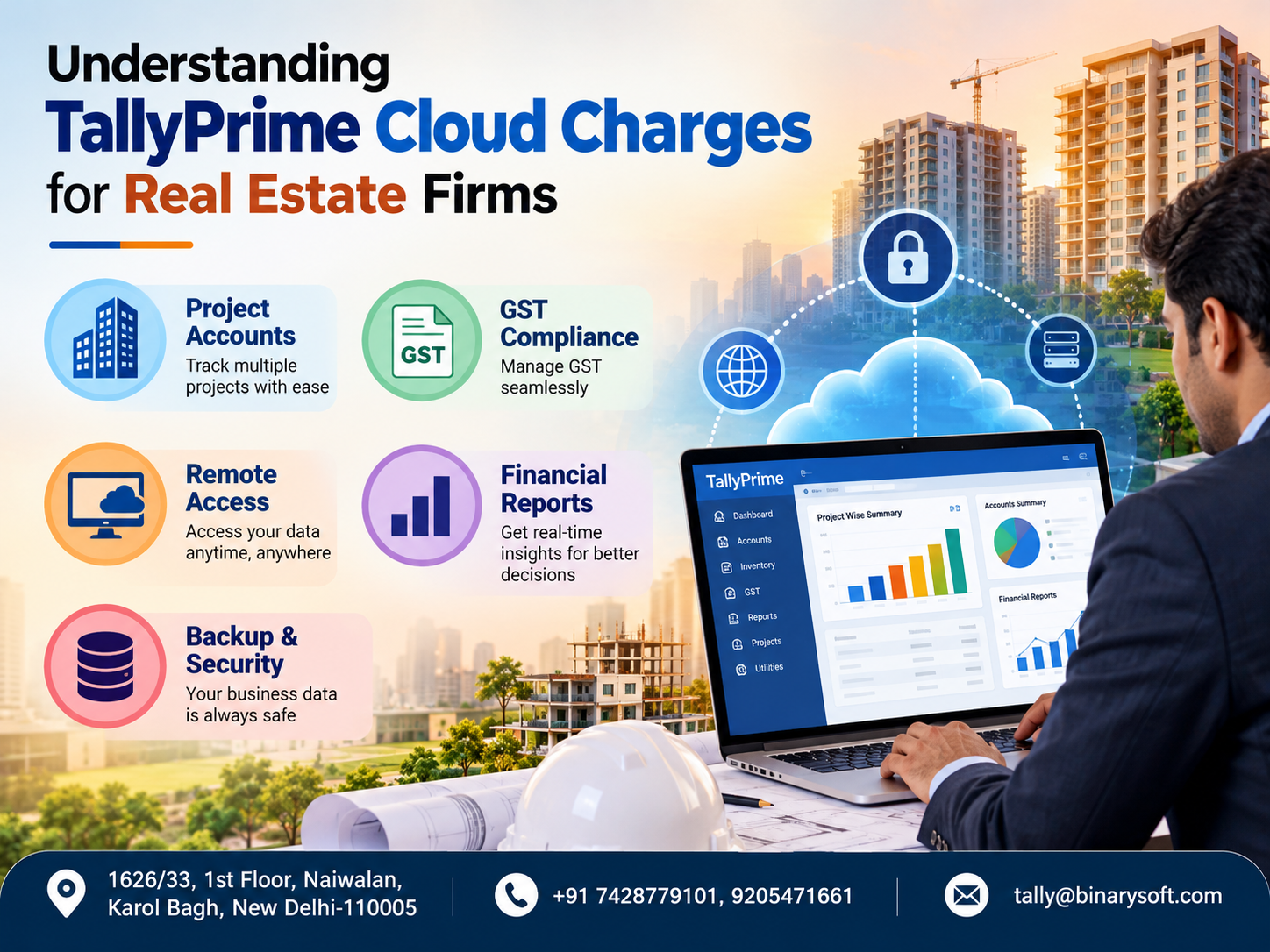
This is why understanding TallyPrime Cloud charges for real estate firms has become important. Cloud hosting allows authorized employees, accountants, and management teams to access TallyPrime remotely through a secure environment, subject to the hosting provider's configuration.
However, businesses must evaluate more than the monthly subscription price. Server performance, concurrent users, data backup, security, technical support, and existing TallyPrime licensing all influence the actual cost. Choosing the right cloud solution can improve financial visibility while reducing operational disruptions.
1. What Is TallyPrime on Cloud for Real Estate Businesses?
TallyPrime on Cloud is a hosting arrangement that allows businesses to run their TallyPrime accounting software on a remotely accessible server instead of relying entirely on a computer located in their office.
The accounting software continues to provide its regular features, while the cloud hosting infrastructure enables authorized users to access it from different locations.
For real estate businesses, this arrangement can be particularly useful because accounting activities are frequently distributed across construction sites, head offices, sales departments, and project management teams.
A typical real estate company may need to maintain:
-
Project-wise construction expenses and budgets
-
Land acquisition and development costs
-
Contractor and subcontractor payments
-
Material purchase and inventory records
-
Customer advances and installment receipts
-
GST-related transactions and reconciliation
-
Vendor outstanding balances
-
Project profitability and cash flow reports
-
Bank transactions and reconciliations
-
Financial statements and management reports
When these records are maintained in TallyPrime through a properly configured cloud environment, authorized personnel can work with a centrally hosted company dataset.
For example, an accountant working from the head office may record contractor invoices while the finance manager reviews the same company's financial information remotely.
This can reduce dependence on transferring accounting files between different offices.
However, cloud hosting does not automatically synchronize separate company datasets or provide a dedicated real estate ERP system. The required accounting structure, user permissions, and workflows must still be configured appropriately.
2. Why Real Estate Firms Need Cloud-Based Accounting
Real estate accounting differs from many other businesses because projects can continue for several months or years.
During this period, businesses must manage substantial financial commitments, including land payments, construction materials, contractor bills, statutory obligations, and customer collections.
A delay in obtaining accurate financial information can affect project execution.
Multiple Project Locations
A real estate developer may manage residential apartments in Noida, commercial construction in Gurugram, and another development project in Delhi.
Although these projects operate from different locations, financial management may be handled by one centralized accounting department.
Cloud hosting can help authorized staff access the accounting system without being physically present in the same office.
Continuous Contractor Payments
Contractors may submit bills at different construction stages.
The finance department needs to verify payments against approved work, outstanding advances, and applicable deductions.
With properly maintained accounting records, TallyPrime can support contractor ledger tracking and project-related expense analysis.
Project-Wise Financial Monitoring
Real estate management needs to understand how much money has been spent on each project.
Project-wise accounting structures using cost centres and appropriate ledgers can help businesses analyze expenses.
Management Access
Company directors frequently travel between construction sites, customer meetings, and corporate offices.
Remote access enables them to review financial reports without requiring the accountant to send separate files every time.
Business Continuity
If the office computer fails, accounting operations may stop until the system is restored.
A professionally managed cloud environment with tested backups and recovery procedures can reduce this dependency.
3. Understanding TallyPrime Cloud Charges in India
One of the most common questions real estate companies ask is:
How much does TallyPrime Cloud cost per month?
There is no single universal cloud hosting price because different providers offer different server configurations, security controls, backup policies, user capacities, and support arrangements.
The following figures are illustrative budgeting estimates, not verified quotations or official Tally pricing.
|
Cloud hosting requirement
|
Illustrative monthly budget
|
|---|
|
Basic hosting for a small accounting team
|
₹800–₹1,500
|
|
Standard hosting with additional resources
|
₹1,500–₹3,000
|
|
Multi-user hosting for growing businesses
|
₹3,000–₹6,000
|
|
Advanced hosting with higher resources and security requirements
|
₹6,000–₹12,000+
|
|
Customized enterprise cloud infrastructure
|
Based on quotation
|
Actual charges can vary significantly depending on the provider, server resources, concurrent users, service-level commitments, and included services.
The prices above should not be treated as a live Binarysoft Technologies price list.
Important Cost Considerations
Before selecting a cloud hosting package, real estate businesses should verify whether the quotation includes:
-
TallyPrime software licensing or only hosting
-
Server infrastructure and resource allocation
-
Number of permitted concurrent users
-
Backup frequency and retention
-
Data restoration assistance
-
Security controls and access management
-
Technical support availability
-
Initial setup and data migration
-
Applicable GST
-
Renewal charges and upgrade conditions
A package that appears inexpensive initially may become more expensive if essential services are charged separately.
4. What Factors Affect TallyPrime Cloud Pricing?
Several technical and operational factors determine cloud hosting charges.
Number of Users
A small property consultancy may require access for only one accountant.
A large construction company may require simultaneous access for accounts executives, finance managers, and senior management.
More concurrent users generally require greater server capacity.
Businesses must also ensure that their TallyPrime licensing supports the intended simultaneous usage.
Server RAM and Processing Capacity
Real estate firms handling large accounting datasets, numerous vouchers, inventory transactions, and multiple users may need higher server resources.
Insufficient capacity can affect responsiveness, especially during reporting, data processing, and simultaneous access.
Storage Requirements
A real estate company may maintain accounting information for several financial years.
Additional storage may be required for accounting data, backups, and other permitted business files.
The provider should clarify whether backup storage is included in the quoted capacity.
Backup Services
Daily backups, multiple recovery points, off-site copies, and longer retention periods may affect pricing.
Backup frequency should be selected based on the maximum amount of accounting work the business can afford to lose.
Security Features
Security requirements may include encrypted remote connections, multi-factor authentication, restricted access, monitoring, and controlled administrative privileges.
The availability and cost of these features depend on the hosting provider.
Technical Support
A real estate firm should evaluate the quality and availability of technical support, particularly during month-end closing, GST return preparation, and statutory audit periods.
5. An Illustrative Cloud Cost Calculation for a Real Estate Firm
Consider a medium-sized real estate development company operating three construction projects.
The company requires cloud access for five accounting and finance employees.
Its estimated monthly budget might look like this:
|
Expense component
|
Illustrative monthly cost
|
|---|
|
Cloud server hosting
|
₹3,500
|
|
Enhanced backup service
|
₹500
|
|
Additional security and administration
|
₹500
|
|
Technical support
|
₹500
|
|
Total before GST
|
₹5,000
|
|
GST at an assumed 18%
|
₹900
|
|
Total monthly budget
|
₹5,900
|
The annualized amount would be ₹70,800, including the assumed GST.
This example excludes TallyPrime licensing, initial migration, additional software licenses, and other potential charges. The actual GST treatment and rate should be verified against the invoice and applicable tax rules.
Rather than selecting hosting only by price, management should compare the annual expense with operational requirements such as remote accessibility, reduced downtime, support responsiveness, and backup recovery capability.
6. Real Estate Project Accounting Using TallyPrime
Project accounting is one of the most important requirements for developers and builders.
A company may operate several projects simultaneously, each with different budgets, payment schedules, and profitability expectations.
TallyPrime supports accounting classifications such as cost centres, which can help businesses analyze transactions by project when configured and used consistently.
Creating Project-Wise Cost Centres
Consider a company operating three projects:
The accounting team can create separate cost centres for these projects.
Expenses can then be allocated to the relevant project.
For example:
|
Expense category
|
Green Valley
|
Sunrise Plaza
|
Heritage Tower
|
|---|
|
Cement purchases
|
₹8,50,000
|
₹6,20,000
|
₹4,75,000
|
|
Steel purchases
|
₹12,00,000
|
₹9,50,000
|
₹7,25,000
|
|
Contractor charges
|
₹6,00,000
|
₹4,50,000
|
₹3,80,000
|
|
Site expenses
|
₹1,50,000
|
₹1,20,000
|
₹95,000
|
|
Total
|
₹28,00,000
|
₹21,40,000
|
₹16,75,000
|
Illustrative project accounting figures.
These records can help management identify where expenditure is concentrated.
Project Budget Monitoring
Real estate companies should compare actual expenditure against approved budgets.
For example, if a project has an approved construction budget of ₹5 crore and recorded expenses of ₹3.2 crore, management can assess the remaining budget alongside committed costs and expected future expenditure.
TallyPrime can provide underlying accounting information, while detailed budget-versus-actual or construction progress analysis may require additional configuration, reports, or integration.
Construction Work-in-Progress
Real estate businesses may need to classify certain project expenditures as inventory or work-in-progress, depending on the nature of the project and applicable accounting standards.
These classifications should be designed with guidance from the company's accountant or auditor.
Cloud hosting makes the accounting records accessible remotely, but it does not determine the correct accounting treatment automatically.
7. A Real Estate Developer's Story: When Delayed Accounting Created Financial Pressure
Consider the fictional experience of a real estate developer, Rajesh, who managed a residential construction business in Delhi NCR.
His company was developing two apartment projects while preparing to launch a third.
For several years, the accounts department maintained TallyPrime on a desktop computer at the head office.
The arrangement appeared sufficient until the business expanded.
One afternoon, Rajesh received an urgent call from a contractor requesting payment for completed construction work.
The contractor explained that labor payments were due and further delays could interrupt work at the site.
Rajesh contacted his accounts department to confirm the outstanding amount.
Unfortunately, the accountant was visiting another project location, and the latest transactions had not been entered.
The finance manager had an older report showing a different outstanding balance.
Rajesh faced an uncomfortable decision: release payment without complete verification or delay the contractor and risk affecting construction progress.
He chose to wait for confirmation.
That evening, he received another call, this time from a customer asking whether a recent installment had been recorded.
Again, the answer was delayed.
For Rajesh, the problem was no longer simply about accounting software. It was about the confidence of contractors, customers, and employees who depended on timely financial decisions.
The company subsequently evaluated a cloud-hosted TallyPrime environment.
After implementing remote access, defined accounting responsibilities, and a regular transaction-entry process, the finance team could review centrally maintained records from authorized locations.
Contractor payments became easier to verify, and management had more consistent access to updated accounting reports.
The cloud solution did not eliminate the need for accurate entries or proper approvals. However, it reduced the company's dependence on one office computer.
Rajesh realized that the value of accessible accounting information was not measured only by the monthly hosting charge.
It was also reflected in the time saved, fewer information delays, and greater confidence in financial decisions.
8. GST Management for Real Estate Businesses Using TallyPrime
GST compliance is an important consideration for builders, developers, and real estate service providers.
However, GST treatment in the real estate sector is complex and depends on the nature of the transaction, project classification, applicable notifications, and eligibility conditions.
TallyPrime can assist with recording GST transactions and generating applicable accounting and GST reports when transactions and tax configurations are maintained correctly.
GST on Construction Services
GST treatment may differ between residential construction, commercial construction, works contracts, and other real estate-related services.
For certain qualifying residential real estate projects, effective GST rates of 1% or 5% without input tax credit may apply, subject to the applicable conditions.
Other transactions can attract different rates and input tax credit treatment.
Businesses should not apply one GST rate uniformly to all real estate transactions.
GST on Contractor Bills
Real estate companies frequently receive invoices from contractors and subcontractors.
The accounting team needs to verify:
-
Supplier GSTIN and invoice details
-
Nature and classification of services
-
Applicable GST rate
-
Place of supply
-
Input tax credit eligibility
-
Reverse charge applicability, where relevant
-
Payment and outstanding balances
Correct accounting classification is essential for reliable GST reporting.
Input Tax Credit Monitoring
ITC eligibility for real estate developers is subject to specific restrictions and conditions.
An invoice containing GST does not automatically mean that the developer can claim the tax as input credit.
Finance teams should reconcile relevant records and verify eligibility before claiming credit.
GST Reconciliation
TallyPrime's available GST features can help users review transactions and prepare relevant returns, depending on the software release, configuration, and connected services.
A cloud-hosted installation can make these functions remotely accessible, but hosting itself does not create new GST functionality.
9. Remote Access to TallyPrime for Real Estate Owners and Accountants
Remote access is one of the primary reasons businesses consider cloud hosting.
A construction company may have an accountant working at its head office, a finance manager working from another branch, and a director traveling between project sites.
With a suitable cloud configuration, these employees can access the hosted accounting environment using approved devices and credentials.
Access From Different Locations
Authorized users may connect from their office, home, or another approved location.
This can be useful during travel, emergencies, and temporary office closures.
Centralized Accounting Data
Instead of maintaining separate copies of company data across several computers, a cloud-hosted arrangement can support work on a centrally maintained dataset.
This reduces the risk of confusion caused by different file versions.
Management Reporting
A director may need to review cash balances, outstanding receivables, or project expenditure before approving a major purchase.
Remote access can make these reports available without waiting for someone to email a backup file.
Controlled User Access
Not every employee should have unrestricted access to financial records.
User permissions should be configured according to responsibilities.
For example, an accounts executive may need voucher-entry permissions, while senior management may require broader reporting access.
Remote access should not be confused with unrestricted access. The provider and business must implement appropriate authentication and access controls.
10. Financial Reports That Real Estate Management Should Monitor
Financial reporting is essential for understanding whether a project is financially sustainable.
TallyPrime provides several accounting reports that can help management monitor business performance.
Balance Sheet
The balance sheet presents the company's assets, liabilities, and equity.
For real estate businesses, relevant balances may include project inventory, construction work-in-progress, receivables, loans, and vendor liabilities.
Profit and Loss Account
The Profit and Loss Account helps management review recognized income and expenses.
For real estate developers, revenue and cost recognition must follow the applicable accounting framework. Customer collections should not automatically be treated as revenue.
Cash Flow Statement
Cash flow reporting is particularly important because construction projects can require substantial expenditure before customer collections are fully received.
A company may report accounting profits while still experiencing liquidity pressure.
Outstanding Receivables
Customer receivable reports help identify unpaid amounts and overdue balances.
For developers, detailed installment tracking may require additional structures or specialized systems.
Outstanding Payables
Vendor and contractor outstanding reports can help finance teams plan payments.
This is particularly useful when several projects compete for limited working capital.
Project-Wise Expense Reports
With suitable cost-centre allocations, businesses can analyze expenses associated with different projects.
Bank Reconciliation
Regular bank reconciliation helps identify unrecorded receipts, payments, and discrepancies.
For companies handling numerous customer transactions, timely reconciliation can improve financial control.
11. Backup and Data Recovery: Protecting Real Estate Financial Records
Accounting data represents years of financial activity.
For a real estate company, losing this information could affect customer records, contractor balances, GST documentation, and statutory reporting.
Therefore, backup arrangements should be a major factor when evaluating TallyPrime Cloud charges.
Why Backups Matter
Potential causes of data loss include hardware failure, accidental deletion, ransomware, software problems, and unauthorized changes.
Cloud hosting alone does not guarantee that data is protected from these risks.
Recommended Backup Practices
Real estate businesses should consider a backup policy that includes:
-
Regular automated backups
-
Multiple recovery points
-
Off-site or logically isolated backup storage
-
Encryption of backup data
-
Restricted backup access
-
Defined retention periods
-
Periodic restoration testing
Understanding Recovery Objectives
Two important measures are:
Recovery Point Objective (RPO): The maximum acceptable period of data loss following an incident.
Recovery Time Objective (RTO): The target time required to restore the service after a disruption.
For example, a business requiring an RPO of four hours needs a backup or replication strategy capable of meeting that requirement.
The actual recovery capability should be documented by the provider rather than assumed.
12. Security Features to Evaluate Before Choosing TallyPrime Cloud
Real estate companies manage commercially sensitive information, including land acquisition costs, vendor agreements, customer financial records, and project profitability.
Security should therefore be treated as a core hosting requirement.
Secure Connections
Remote sessions should use appropriately encrypted communication channels.
Multi-Factor Authentication
Where supported, multi-factor authentication can reduce the risk of unauthorized access resulting from compromised passwords.
User Permissions
Employees should receive only the access necessary to perform their duties.
Server Maintenance
The hosting provider should maintain operating systems, apply relevant security updates, and manage vulnerabilities.
Malware Protection
Endpoint and server security controls can help reduce exposure to malware and ransomware.
Monitoring and Logs
Appropriate logs can support investigation of unauthorized access and operational incidents.
Data Ownership
The hosting agreement should clearly state that the business retains ownership of its accounting data.
It should also explain how the company can export or retrieve its data if it changes providers.
Data Location and Compliance
Businesses should understand where their accounting data and backups are stored and assess any applicable contractual, privacy, or regulatory obligations.
No cloud solution should be described as completely risk-free or immune to cyberattacks.
13. TallyPrime Cloud vs Traditional Desktop Accounting
|
Feature
|
Traditional desktop setup
|
Cloud-hosted TallyPrime
|
|---|
|
Primary access
|
Office computer or local network
|
Authorized remote connection
|
|
Multiple locations
|
May require additional arrangements
|
Designed for remote accessibility
|
|
Infrastructure
|
Business-managed hardware
|
Provider-managed or shared responsibilities
|
|
Backup
|
Business must arrange
|
May be included in hosting plan
|
|
Internet dependency
|
Local work may continue offline
|
Remote connection generally requires internet
|
|
Security
|
Depends on local controls
|
Depends on provider and customer controls
|
|
Maintenance
|
Internal IT or local support
|
Often supported by hosting provider
|
|
Ongoing costs
|
Hardware, maintenance, licensing
|
Hosting, licensing, and optional services
|
|
Performance
|
Depends on local hardware
|
Depends on server and network performance
|
Neither arrangement is automatically superior in every situation.
A single-office business with reliable local infrastructure may find desktop accounting sufficient.
A real estate firm operating across several locations may find cloud hosting more convenient.
14. How TallyPrime Cloud Can Help Control Construction Project Costs
Construction cost control is essential for maintaining profitability.
Unexpected increases in steel prices, labor charges, transportation expenses, or contractor payments can affect project margins.
TallyPrime can help maintain the financial records needed for cost analysis.
Material Expense Tracking
Companies can record purchases of cement, steel, electrical supplies, plumbing materials, and other construction inputs.
Where suitable inventory configurations are used, stock records can support material monitoring.
Contractor Ledger Management
Separate contractor ledgers help maintain transaction histories, advances, bills, and outstanding balances.
Site Expense Allocation
Expenses can be allocated to relevant project cost centres.
Budget Comparison
Accounting data can be exported or used with additional reporting tools to compare expenditure against approved budgets.
Identifying Unusual Expenditure
Management can review reports to investigate unexpectedly high costs.
However, cloud hosting does not independently prevent cost overruns. Accurate entries, approval workflows, and management review remain essential.
15. TallyPrime Cloud for Real Estate Brokers and Property Consultants
Cloud accounting is not limited to large developers.
Real estate brokers and property consulting firms can also benefit from remotely accessible accounting.
Their requirements may include:
-
Brokerage income tracking
-
Customer and vendor ledgers
-
Office expenses
-
Employee reimbursements
-
GST invoices
-
Bank reconciliation
-
Receivables and payables
-
Monthly financial reports
For example, a property consulting firm operating across Delhi and Gurugram may maintain its accounts centrally while authorized employees work from different branches.
A small firm should still compare hosting charges with its actual requirements.
If only one employee uses TallyPrime from a single office, an additional cloud subscription may not be necessary.
16. TallyPrime Cloud for Large Real Estate Developers
Larger developers often have more demanding accounting requirements.
They may manage multiple projects, extensive vendor networks, significant customer collections, and several finance employees.
A larger hosting environment may require:
-
Higher RAM and CPU allocation
-
Sufficient concurrent-user capacity
-
Increased storage
-
Stronger identity and access management
-
Advanced backup retention
-
Disaster recovery arrangements
-
Monitoring and support commitments
-
Integration compatibility testing
Some developers may also require specialized software for construction planning, procurement approvals, customer relationship management, and regulatory reporting.
TallyPrime Cloud can serve as an accounting component within this broader technology environment, but it should not be assumed to replace every function of a dedicated real estate management system.
17. Common Mistakes While Selecting TallyPrime Cloud Hosting
Choosing Only the Lowest Price
A cheaper package may have limited resources, inadequate support, or weak backup arrangements.
Ignoring Concurrent User Requirements
A company should confirm both hosting capacity and TallyPrime license compatibility before deployment.
Assuming All Backups Are Automatic
Some hosting packages may not include the required backup frequency or retention.
Not Testing Performance
Businesses should test common tasks such as voucher entry, ledger opening, and financial report generation.
Overlooking Internet Connectivity
Remote cloud access depends on a suitable internet connection.
A backup internet connection may be valuable for businesses that require uninterrupted accounting access.
Ignoring Data Exit Procedures
Companies should understand how their data will be returned if the hosting agreement ends.
Confusing Hosting With Software Licensing
A cloud hosting subscription and a TallyPrime software license are separate commercial components unless a provider explicitly includes both.
18. How to Choose the Right TallyPrime Cloud Plan for Your Real Estate Business
The right cloud package depends on business size, accounting complexity, and operational requirements.
A small property consultancy may need a simple environment for one user.
A medium-sized developer may require multiple concurrent users and more server resources.
A large developer may need a customized environment with enhanced security, monitoring, and recovery arrangements.
Before finalizing a provider, businesses should request a written quotation specifying server configuration, user capacity, licensing requirements, backup commitments, technical support, taxes, and renewal terms.
It is also advisable to test the proposed environment with a representative accounting dataset.
A suitable cloud plan should provide enough capacity for present operations while allowing expansion as the business grows.
19. Why Real Estate Firms Can Consider Binarysoft Technologies
Real estate companies evaluating TallyPrime Cloud need to understand both accounting requirements and hosting infrastructure.
Binarysoft Technologies, an Authorized Tally Partner, can be contacted to discuss TallyPrime requirements for builders, developers, property consultants, and other real estate businesses.
The discussion can cover areas such as:
-
TallyPrime licensing requirements
-
Cloud hosting options and charges
-
Multi-user accounting requirements
-
Project-wise accounting configurations
-
GST accounting workflows
-
Remote access requirements
-
Backup and data protection expectations
-
Accounting reports and operational support
Businesses should request confirmation of the specific services, features, and support arrangements available under the proposed plan.
The objective is to choose an accounting environment appropriate for the company's scale and working practices rather than purchasing unnecessary infrastructure.
20. Long-Term Benefits of Investing in TallyPrime Cloud
The financial benefits of cloud hosting are not limited to reducing expenditure on local hardware.
For real estate firms, potential advantages include easier remote access, more consistent availability of centrally maintained records, and reduced reliance on a particular office computer.
These advantages may help finance teams complete routine tasks more efficiently.
A company that previously spent considerable time transferring accounting files between branches may be able to reduce that administrative work.
Management may also obtain reports more conveniently when financial records are entered promptly and accurately.
However, businesses should distinguish between potential benefits and guaranteed savings.
Actual return on investment depends on existing infrastructure, hosting charges, employee workflows, data quality, and the level of support provided.
Conclusion
Understanding TallyPrime Cloud charges for real estate firms requires more than comparing monthly hosting prices.
Builders, developers, and property consultants need an accounting environment that supports their financial processes, including project expense allocation, contractor payments, GST accounting, customer collections, financial reporting, and secure access.
Cloud hosting can make TallyPrime accessible from multiple approved locations while reducing dependence on local office infrastructure.
However, the success of the arrangement depends on selecting suitable server resources, compatible software licensing, effective security controls, reliable backup procedures, and responsive technical support.
For small firms, a basic hosting package may be sufficient. Medium and large developers may need higher-capacity or customized arrangements.
Before making a decision, real estate businesses should evaluate their concurrent users, data volume, operational requirements, and expected growth.
The most suitable solution is not necessarily the cheapest package. It is the one that offers an appropriate balance of cost, performance, security, accessibility, and support.
Powered by Binarysoft Technologies
Authorized Tally Partner
Location: 1626/33, 1st Floor, Naiwalan, Karol Bagh, New Delhi – 110005, INDIA
Contact Us: +91 7428779101, 9205471661
Email: tally@binarysoft.com
Business Hours: 10:00 AM – 6:00 PM, Monday to Friday
Contact Binarysoft Technologies to discuss TallyPrime licensing, cloud hosting requirements, remote accounting access, and suitable solutions for your real estate business.
Frequently Asked Questions
What are the TallyPrime Cloud charges for real estate firms in India?
TallyPrime Cloud hosting charges vary according to the number of users, server capacity, backup requirements, security features, and support services. Illustrative budgets may start around ₹800–₹1,500 per month for basic hosting, while larger configurations can cost significantly more. Actual prices should be confirmed through a current quotation.
Can real estate developers manage multiple projects in TallyPrime Cloud?
Yes. TallyPrime supports cost centres and accounting classifications that can help businesses maintain project-wise financial records. Appropriate setup and consistent transaction allocation are necessary.
CA. Rudransh Suryavanshi focuses on GST compliance, financial management, and internal controls. He regularly contributes content on business accounting solutions and effective tax planning strategies.