Call CA Tally HelpDesk
+91 9205471661,
7428779101

Introduction: Why Indian Businesses Need Smarter Accounting and Financial Control in 2026
In 2026, running a successful business requires much more than recording sales and purchases. Indian retailers, wholesalers, distributors, manufacturers and service providers are managing GST compliance, changing customer expectations, digital payments, inventory movements and increasing pressure on working capital. A single billing mistake, delayed customer payment or unnoticed stock shortage can disrupt daily operations and affect profitability.
Many growing businesses still depend on spreadsheets, handwritten records and disconnected software applications. As transactions increase, these methods create unnecessary duplication, reporting delays and opportunities for errors.
TallyPrime provides an integrated business management environment that brings accounting, GST billing, inventory control, banking and financial reporting together. Instead of waiting until the end of the month to understand financial performance, business owners can review their records regularly, identify problems earlier and make more confident decisions.
For businesses planning sustainable growth, efficient accounting is no longer simply an administrative requirement. It is an essential part of business success.
1. What Is TallyPrime and Why Is It Important for Modern Businesses?
TallyPrime is business management software designed to simplify financial accounting, invoicing, taxation, inventory tracking and business reporting.
It helps organizations maintain structured records while reducing the need to manage separate applications for everyday accounting activities.
Whether a business handles fifty transactions daily or thousands of transactions monthly, TallyPrime can support organized financial operations.
Major Business Activities Managed Through TallyPrime
-
Financial accounting and ledger management
-
GST-compliant sales and purchase invoicing
-
Inventory and warehouse management
-
Accounts receivable and payable tracking
-
Banking and bank reconciliation
-
Purchase and sales order processing
-
Manufacturing and stock movement
-
Financial statements and management reports
-
Cost centre and departmental accounting
-
Data security, backup and controlled user access
By bringing these activities together, businesses can reduce repeated data entry and improve the consistency of their records.
2. Simplify Financial Accounting with TallyPrime
Accurate accounting is essential for understanding business profitability, maintaining financial discipline and preparing reliable financial statements.
TallyPrime provides a structured accounting environment in which transactions can be recorded using familiar accounting principles.
Maintain Complete Financial Records
Businesses can create and manage ledgers for customers, suppliers, banks, expenses, income and other financial accounts.
Common accounting vouchers include:
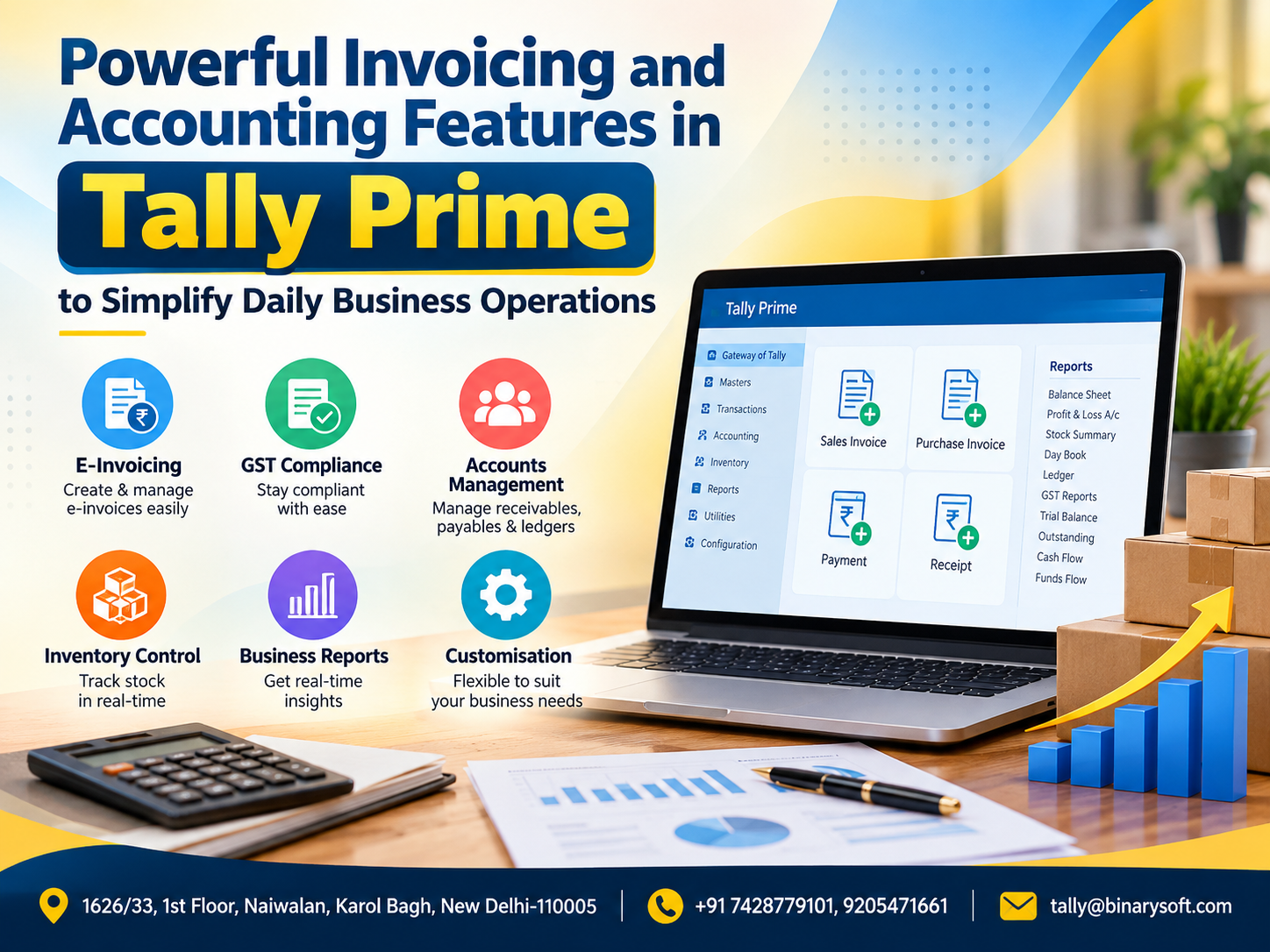
Sales Voucher: Records goods or services sold to customers.
Purchase Voucher: Records purchases of goods, raw materials and services.
Payment Voucher: Records payments made through cash, bank or other supported modes.
Receipt Voucher: Records payments received from customers and other parties.
Contra Voucher: Records transfers between cash and bank accounts.
Journal Voucher: Records accounting adjustments and non-cash transactions.
Practical Example
A wholesale business purchases goods worth ₹1,00,000 plus applicable GST and later sells part of the inventory for ₹75,000 plus GST.
TallyPrime can record both transactions, update relevant ledgers, reflect stock movements where inventory accounting is enabled and include the transactions in financial reports.
This helps the business understand sales performance, outstanding liabilities and available inventory.
3. GST Billing and Compliance Management
GST compliance is a major responsibility for Indian businesses. Incorrect invoice details, missing GSTIN information and mismatched purchase records can create reconciliation problems.
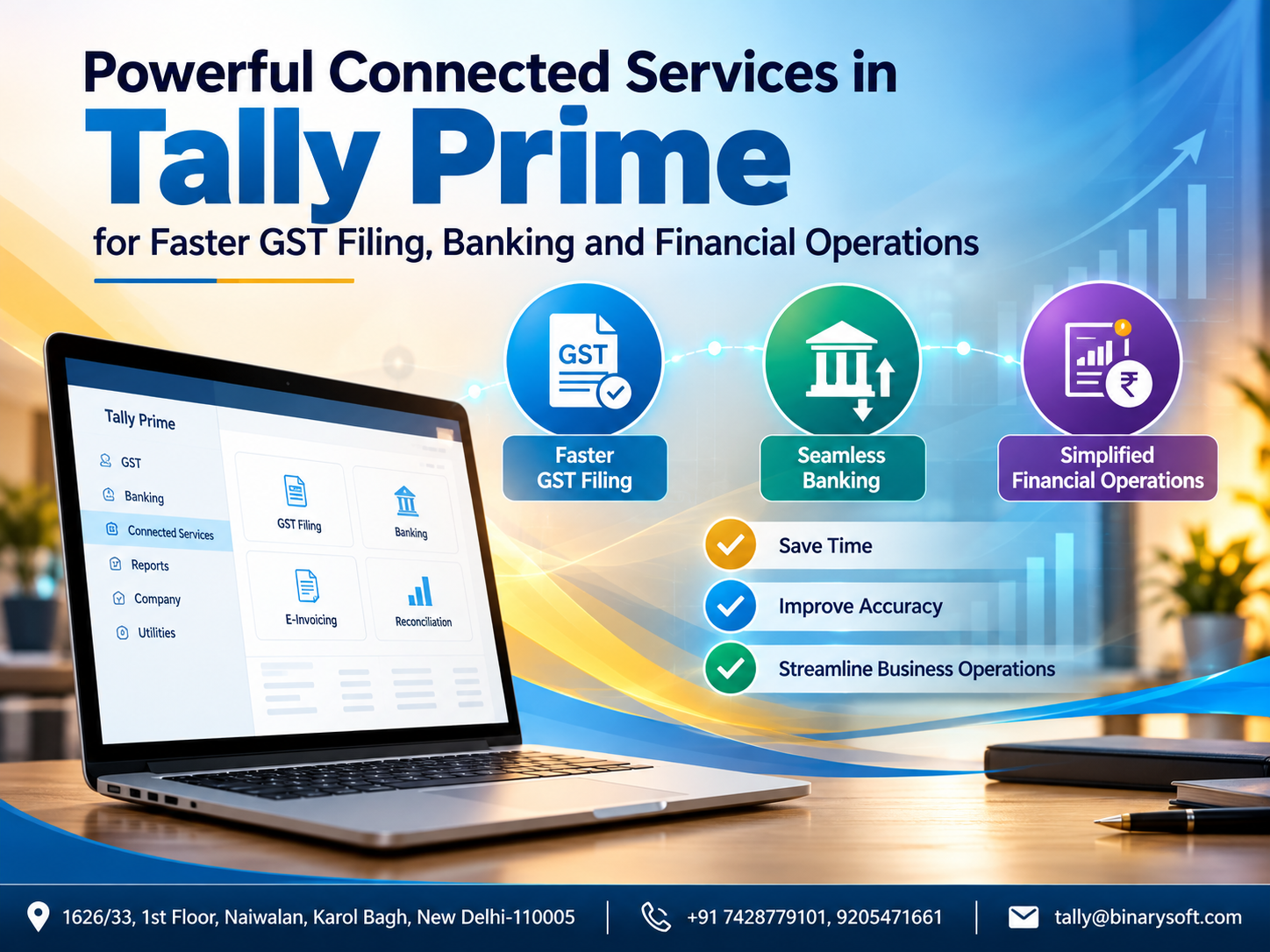
TallyPrime supports GST accounting and helps businesses maintain the information required for preparing GST returns.
GST Features That Help Businesses
GST-Compliant Invoicing
Businesses can create invoices containing customer details, GSTIN, taxable value, applicable tax rates, HSN or SAC information and tax amounts.
Input Tax Credit Tracking
Purchase records can be maintained to support input tax credit reconciliation and verification.
GST Return Preparation
TallyPrime provides GST-related reports and, in supported releases and configurations, connected GST functions for downloading, reconciling and filing returns.
E-Invoicing and E-Way Bills
Eligible businesses can use supported e-invoicing and e-way bill capabilities, subject to applicable statutory requirements and connectivity.
GST Reconciliation
Accounting records can be compared with relevant GST portal information to identify differences requiring investigation.
Why This Matters
Instead of collecting invoice information manually at the end of every tax period, accountants can maintain organized transaction records throughout the month.
However, software assistance does not replace verification. Businesses must review GST classifications, eligibility for input tax credit, return figures and statutory deadlines before filing.
4. Inventory Management for Retailers, Wholesalers and Manufacturers
Inventory represents a significant investment for product-based businesses.
Excess stock can block working capital, while insufficient stock may lead to missed orders and disappointed customers.
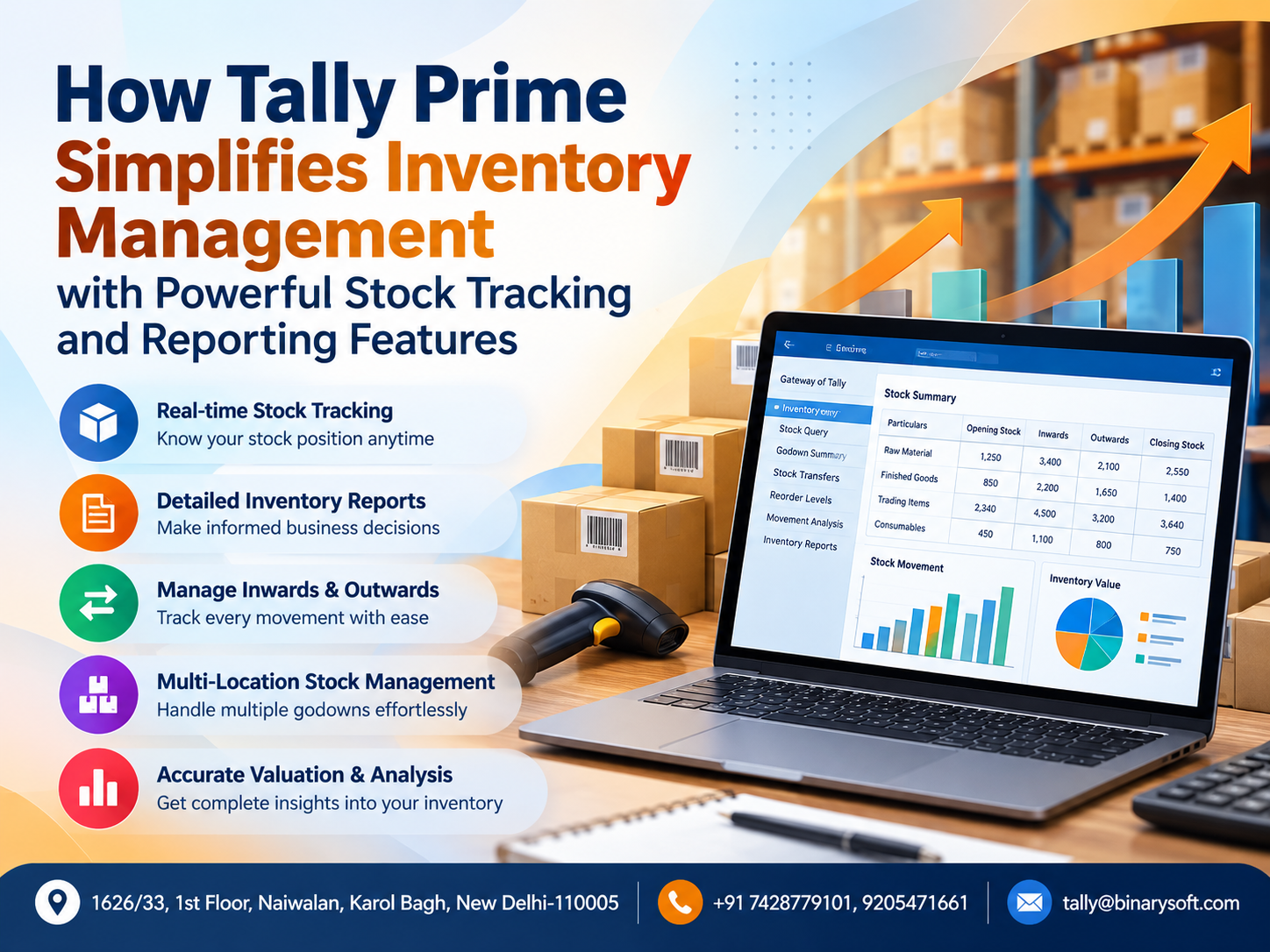
TallyPrime helps businesses monitor stock quantities, movements and valuation.
Important Inventory Capabilities
Stock Item Management: Create individual stock items with appropriate units of measurement.
Stock Groups: Organize products into meaningful categories for easier reporting.
Godown Management: Track inventory stored across different warehouses or locations.
Batch Management: Maintain batch-wise information for applicable products.
Stock Valuation: Review inventory values using supported valuation methods.
Reorder Planning: Use stock reports and reorder information to support purchasing decisions.
Manufacturing Records: Record production and material consumption using appropriate inventory vouchers and manufacturing configurations.
Example: Electronics Distribution Business
An electronics distributor handles 600 product varieties across two warehouses.
Without structured inventory records, staff may struggle to identify available stock and locate items.
With TallyPrime, the distributor can organize stock groups, maintain godown-wise quantities and review stock summaries.
This improves visibility and helps purchasing teams identify shortages before confirming large orders.
5. Banking, Payments and Reconciliation
Banking activities are directly connected to business cash flow.
When bank transactions are not reconciled regularly, businesses may overlook duplicate entries, missing receipts, bank charges or outstanding payments.
TallyPrime supports bank-related accounting and reconciliation activities.
How TallyPrime Helps
Businesses can record bank payments and receipts, manage bank ledgers, track cheque transactions and reconcile accounting entries with bank statements.
Supported banking and connected features may also help automate selected reconciliation activities, depending on the software release and bank integration.
Practical Banking Example
A company records 150 payment and receipt transactions during a week.
Its accountant imports or reviews a supported bank statement and compares transactions with accounting records.
Unmatched entries can then be investigated.
This reduces the time spent checking individual entries and improves confidence in reported bank balances.
6. Credit Control and Outstanding Payment Management
Sales growth does not always translate into healthy cash flow.
A business may generate substantial revenue while struggling to pay suppliers because customers have not cleared their invoices.
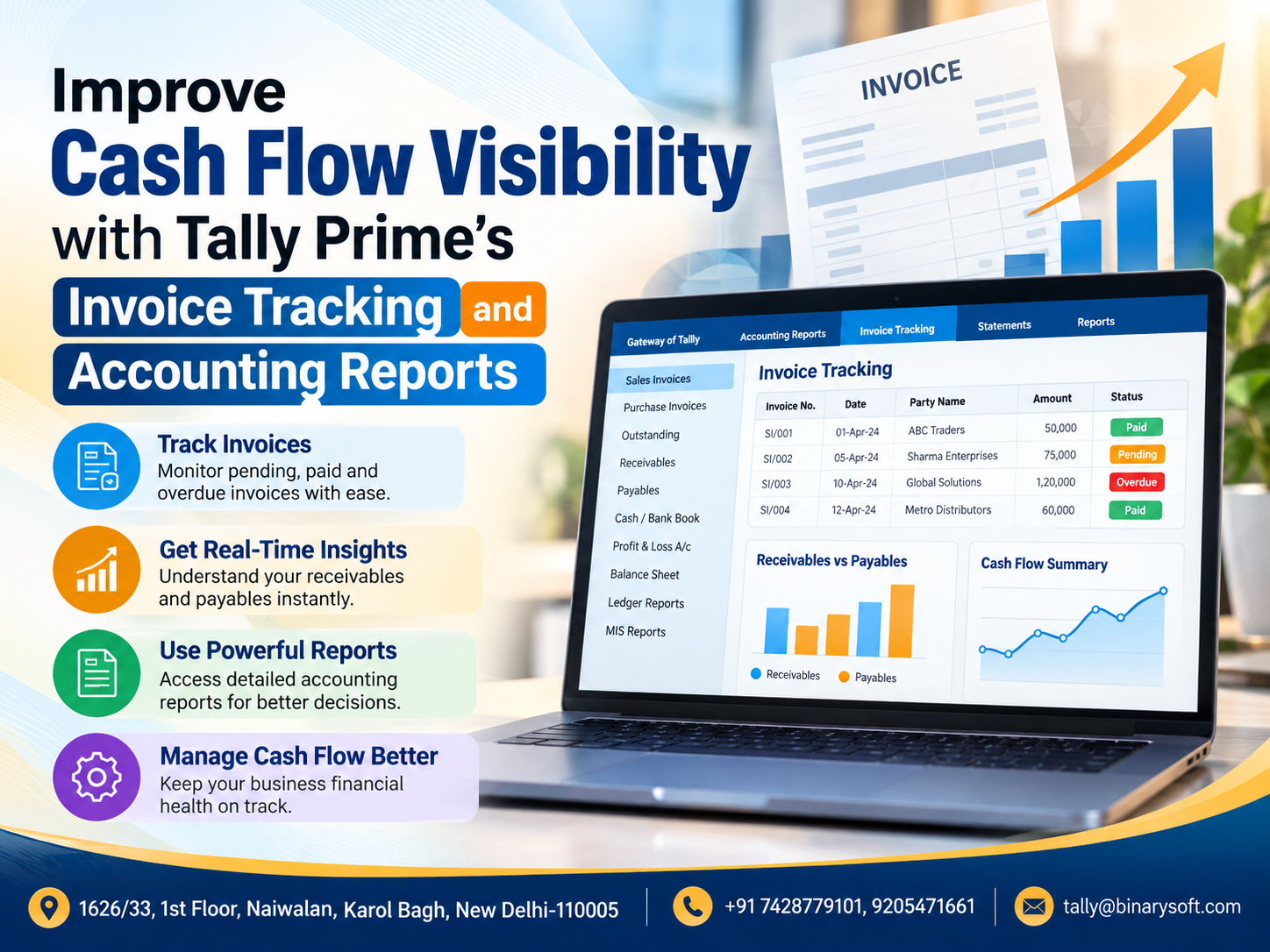
TallyPrime provides bill-wise tracking and outstanding reports that help businesses monitor receivables and payables.
Key Credit Management Activities
Businesses can assign credit periods, track pending invoices, review ageing reports and monitor overdue customer balances.
For example, a distributor allowing 30-day credit can identify invoices that remain unpaid after their due dates.
The finance team can then prioritize collection efforts and communicate with customers.
Regular monitoring also helps management evaluate whether credit terms remain appropriate.
7. Financial Reporting for Better Business Decisions
Business owners need timely information about profitability, expenses, liabilities and financial position.
TallyPrime provides financial and operational reports based on recorded transactions.
|
Report
|
Business Benefit
|
|---|
|
Balance Sheet
|
Understand assets, liabilities and capital
|
|
Profit and Loss Account
|
Review income, expenses and profitability
|
|
Cash Flow Statement
|
Understand cash movements
|
|
Trial Balance
|
Review ledger balances
|
|
Stock Summary
|
Monitor inventory quantities and values
|
|
Outstanding Reports
|
Track customer and supplier balances
|
|
Sales Register
|
Analyze recorded sales transactions
|
|
Purchase Register
|
Review procurement activity
|
These reports help owners move from assumptions to evidence-based decisions.
For example, management may discover that sales have increased but profitability has declined because purchasing costs and operating expenses have risen.
That insight can support changes in pricing, purchasing or expense management.
8. An Emotional Business Story: The Shopkeeper Who Nearly Lost Control of His Business
Rajesh operated a family wholesale business in Delhi.
For nearly fifteen years, he relied on handwritten records, spreadsheets and the experience of trusted employees.
His business was growing, but so were the difficulties.
Customers regularly requested copies of old invoices. Supplier balances were difficult to verify. Stock records did not always match warehouse quantities.
One evening, Rajesh received an urgent call from a long-standing customer.
The customer needed a large delivery the following morning.
Rajesh confidently accepted the order because his records showed sufficient stock.
But when the warehouse team checked, several required items were missing.
The customer cancelled part of the order.
Rajesh returned home disappointed. His family noticed that the business he had worked so hard to build was becoming a source of constant anxiety.
The problem was not a lack of customers or effort. It was the absence of reliable business information.
Rajesh decided to organize his accounting and inventory processes.
He introduced structured stock records, regular invoice entry, customer outstanding tracking and monthly financial reviews using TallyPrime.
Gradually, his business became easier to monitor.
Employees could check recorded stock availability. Accountants could identify overdue invoices. Rajesh could review financial reports without waiting for scattered spreadsheets to be consolidated.
The most meaningful change was not simply faster accounting.
It was the confidence to make commitments based on better information.
This is an illustrative story reflecting challenges commonly experienced by growing trading businesses.
9. Case Study One: Wholesale Trading Business Improves Inventory and Credit Visibility
Business Background
A hypothetical wholesale electrical goods distributor in Karol Bagh manages approximately 800 stock items and supplies retailers throughout Delhi NCR.
The company faces frequent challenges with stock visibility, customer outstanding balances and delayed monthly reporting.
Challenges
Before adopting a more integrated accounting process, its teams maintained inventory and customer records in separate spreadsheets.
This caused repeated data entry, inconsistent balances and delays in preparing financial reports.
TallyPrime Implementation
The business organized its products into stock groups, created customer and supplier ledgers, enabled bill-wise accounting and introduced warehouse-wise stock tracking.
Sales invoices were recorded alongside inventory movements.
Accountants reviewed outstanding reports weekly and reconciled bank transactions regularly.
Illustrative Results
After three months, the business observed the following improvements in this modeled scenario:
|
Performance Indicator
|
Before
|
After
|
|---|
|
Monthly reporting preparation
|
4 days
|
1 day
|
|
Weekly stock verification work
|
12 hours
|
5 hours
|
|
Overdue invoice review
|
Irregular
|
Weekly
|
|
Inventory records
|
Multiple spreadsheets
|
Centralized records
|
These figures are illustrative, not independently verified customer results.
Key Learning
Better inventory visibility and consistent credit monitoring can help wholesalers reduce administrative delays and make more informed purchasing decisions.
10. Case Study Two: Manufacturing Enterprise Streamlines Production Accounting
Business Background
A hypothetical small manufacturing enterprise in Faridabad produces packaging materials for regional customers.
The company purchases raw materials, processes production orders and supplies finished goods to distributors.
Operational Problems
Management struggles to connect raw material consumption with finished goods production.
Production-related expenses are recorded separately, making it difficult to review product costs.
TallyPrime Implementation
The company introduces structured raw material and finished goods records.
Appropriate manufacturing vouchers and bills of materials are configured to record production activities.
Cost centres are used where suitable to classify selected operational expenses.
Purchase, production and sales records are reviewed together.
Illustrative Improvements
In this modeled example, production-related accounting records become easier to trace, stock discrepancies are investigated more systematically and monthly cost reviews become more consistent.
The business gains a clearer understanding of material consumption and production costs.
Key Learning
Manufacturing businesses benefit when inventory, production and financial accounting records follow a consistent process.
Accurate source data and regular physical stock verification remain essential.
11. How to Start Using TallyPrime: Step-by-Step Guide
Businesses planning to implement TallyPrime should follow a structured process.
Step 1: Create the Company
Enter the company name, financial year, accounting period and applicable statutory details. Verify the information before recording transactions.
Step 2: Configure Accounting Masters
Create ledgers for customers, suppliers, bank accounts, expenses, income and tax-related accounts. Configure GST details as applicable.
Step 3: Set Up Inventory
Create stock groups, stock items, units of measurement and godowns. Configure batch tracking or manufacturing requirements where needed.
Step 4: Record Daily Transactions
Enter sales, purchases, receipts, payments and other vouchers consistently. Review invoices and tax classifications for accuracy.
Step 5: Review Reports and Protect Data
Check financial statements, stock summaries, GST reports and outstanding balances. Establish a regular backup process and suitable user access controls.
12. TallyPrime on Cloud for Flexible Business Operations
Businesses operating across offices, warehouses or branches may require access to their accounting environment from different locations.
TallyPrime can be deployed in a suitable cloud-hosted environment through an appropriate hosting arrangement.
Potential Benefits
Cloud hosting can support remote access, centralized infrastructure, collaboration among authorized users and simplified access to a hosted accounting environment.
It may also reduce dependence on a single office computer.
However, cloud hosting does not automatically guarantee security, uninterrupted access or data protection.
Businesses should evaluate hosting performance, backup arrangements, access controls, licensing requirements, support quality and recovery procedures.
For organizations with multiple users, selecting suitable TallyPrime licensing and infrastructure is especially important.
13. Data Security and User Access Management
Financial information includes sensitive customer, supplier and business records.
Protecting this information should be part of every accounting implementation.
TallyPrime provides security-related capabilities, including user access controls and company data protection options.
Businesses should establish appropriate permissions for accounting staff, managers and administrators.
Regular backups, secure devices, updated software and restricted administrative access further strengthen protection.
Cloud-hosted environments should also be evaluated for authentication, infrastructure security and disaster recovery arrangements.
14. Which Businesses Can Benefit from TallyPrime?
TallyPrime supports a wide range of accounting and business management requirements.
Retail Businesses: GST billing, sales accounting, stock tracking and daily financial review.
Wholesale Traders: Bulk invoicing, inventory management, credit control and supplier accounting.
Manufacturers: Raw material tracking, production records, finished goods accounting and cost analysis.
Service Providers: Service invoicing, expense tracking, customer balances and profitability reporting.
Distributors: Order management, stock visibility, outstanding payments and sales analysis.
Growing Enterprises: Departmental accounting, financial reporting, controlled access and multi-location operations.
The most suitable configuration depends on the organization's transaction volume, reporting requirements and operating processes.
15. Why Integrated Accounting Supports Long-Term Business Growth
Business growth requires more than increasing revenue.
Organizations must maintain profitability, protect cash flow, control inventory and meet compliance obligations.
An integrated accounting environment helps connect these responsibilities.
When sales records, inventory movements, customer balances and financial statements are maintained consistently, management can review business performance with greater confidence.
Reliable reporting also supports discussions with lenders, accountants, auditors and business partners.
The objective is not merely to digitize paperwork.
It is to build a more organized business where financial information supports daily decisions.
Conclusion
TallyPrime offers Indian businesses a practical way to bring accounting, GST billing, inventory management, banking and financial reporting into a structured environment.
From small retail stores to wholesale distributors and manufacturing enterprises, businesses can benefit from more consistent transaction records, improved financial visibility and better operational control.
Successful implementation depends on accurate data entry, appropriate configuration, regular reconciliation, trained employees and disciplined reporting.
For organizations considering cloud-based accounting or improving their existing TallyPrime setup, the priority should be to choose a solution that matches their business requirements, security expectations and future growth plans.
With the right processes and support, TallyPrime can become an important part of a more efficient and financially informed business.
Powered by Binarysoft Technologies
Authorized Tally Partner
Location: 1626/33, 1st Floor, Naiwalan, Karol Bagh, New Delhi – 110005, INDIA
Contact us: +91 7428779101, 9205471661
Email us: tally@binarysoft.com
Business Hours: 10:00 AM – 6:00 PM, Monday to Friday
Frequently Asked Questions
Is TallyPrime suitable for small businesses?
Yes. TallyPrime can be configured for small retailers, service providers, traders and growing enterprises according to their accounting requirements.
Can TallyPrime help with GST return filing?
Yes. It provides GST reports and supported connected GST capabilities. Available filing and reconciliation features depend on the installed release and configuration.
How does TallyPrime help manage outstanding payments?
It provides bill-wise accounting, outstanding balances and ageing information that help businesses review overdue customer and supplier invoices.
How can Binarysoft Technologies help businesses implement TallyPrime?
Binarysoft Technologies can assist businesses with TallyPrime licensing, configuration, accounting setup, cloud hosting requirements, user training and ongoing support according to their operational needs.
CA. Rishaan Lodha focuses on accounting controls, taxation, and financial reporting for trading and service organizations. He helps businesses improve transaction recording, reconciliations, and documentation for efficient financial management.