Call CA Tally HelpDesk
+91 9205471661,
7428779101
Introduction: Why Modern Businesses Need Reliable Cloud Deployment
Imagine a growing business that depends on several digital applications to manage customers, inventory, online orders, accounting and daily operations.
Its development team regularly introduces new features, fixes technical problems and improves application performance.
However, every software update introduces a potential risk.
A small configuration mistake can interrupt an important application. An incorrect deployment may prevent employees from accessing business information. Different servers may accidentally run different versions of the same application.
These challenges become more serious as businesses expand.
Traditional deployment methods often involve manual commands, configuration changes and coordination between developers and infrastructure administrators.
When multiple teams manage the same environment, maintaining consistency becomes difficult.
This is where GitOps offers a powerful approach.
GitOps uses version-controlled configuration files to define how applications should operate.
Instead of manually changing production infrastructure, teams record approved changes in Git repositories.
Automation tools continuously compare the desired configuration with the actual environment and help maintain consistency.
When combined with Argo CD, AWS CodeCommit, Amazon Elastic Kubernetes Service (EKS) and AWS Cloud Development Kit (CDK), GitOps can provide a structured approach to managing cloud-native applications.
For businesses that use Tally Prime alongside e-commerce platforms, reporting portals and other digital services, reliable deployment practices can support the availability of these connected applications.
Understanding GitOps helps organisations develop more dependable technology systems while reducing unnecessary manual intervention.
1. What Is GitOps?
GitOps is an operational approach that uses Git repositories to manage application deployment configurations and infrastructure definitions.
Git acts as a version-controlled source of truth.
The repository contains declarations describing how applications should be deployed and configured.
A GitOps controller monitors the repository and compares its configuration with the actual state of the target environment.
When differences appear, the controller can report them or reconcile the environment according to configured policies.
Key Principles of GitOps
Declarative Configuration
Applications and infrastructure are described using configuration files.
These files define the intended state rather than requiring administrators to execute every operational step manually.
Version Control
Changes are recorded in Git.
Teams can examine modification history, review contributions and identify earlier configurations.
Automated Reconciliation
A GitOps controller compares the intended configuration with the deployed environment.
Controlled Change Management
Teams can use pull requests, approvals and automated validation before introducing changes.
Operational Visibility
Administrators can identify configuration differences and review deployment status.
GitOps is particularly valuable for cloud-native applications managed through Kubernetes.
2. An Emotional Story: The Deployment Failure That Threatened a Growing Business
Arjun was the technology manager of a rapidly growing distribution company.
The organisation had started as a small family business but gradually expanded into online sales.
Its customers included retailers, contractors and commercial organisations.
To support expansion, the company introduced several digital applications.
An online ordering platform accepted customer requests.
A warehouse application coordinated product dispatch.
A reporting portal helped management monitor operational performance.
The company's accounting team continued using its established financial management software.
Everything worked smoothly until a major festive-season promotion.
The development team had prepared an important update to the online ordering application.
The update was intended to improve performance during periods of high demand.
Unfortunately, the deployment involved several manual configuration changes.
One server received the updated settings, while another continued using an older configuration.
Within minutes, customers began experiencing errors.
Some orders failed to process correctly.
The customer support team received repeated complaints.
Arjun and his colleagues spent hours investigating the problem.
The company eventually restored the previous application version, but the incident caused considerable stress.
That evening, Arjun remained in the office long after everyone else had left.
He worried about the customers who had trusted the company.
He also felt responsible for the employees who had worked hard to prepare the promotional campaign.
The next morning, he proposed changing the deployment process.
Instead of relying on manual server modifications, the company began introducing GitOps.
Application configurations were maintained in version-controlled repositories.
Changes required review before approval.
Automated deployment tools compared the intended configuration with the running environment.
The team also introduced monitoring, testing and recovery procedures.
Over time, deployments became more predictable.
Arjun understood that automation could not prevent every software failure.
However, it could help the team manage changes more consistently and investigate problems more efficiently.
The experience taught him that reliable technology is not simply about keeping servers running. It is about protecting customer trust and the hard work behind every business transaction.
This fictional story illustrates why disciplined deployment management matters.
3. Understanding the Difference Between Traditional CI/CD and GitOps
Continuous Integration and Continuous Delivery, commonly called CI/CD, help development teams build, test and release software.
In a conventional deployment pipeline, the delivery system may directly execute commands against production infrastructure.
For example, a deployment pipeline may build a container image and instruct a Kubernetes cluster to run the new version.
This approach can work effectively.
However, teams must carefully manage deployment permissions and configuration consistency.
GitOps introduces a different model for continuous deployment.
Traditional Deployment
A developer commits application code.
The CI pipeline builds and tests the application.
The pipeline creates a container image.
The deployment process pushes the new configuration to the target environment.
GitOps Deployment
A developer commits application code.
The CI pipeline builds and tests the application.
The pipeline publishes a container image.
An approved change updates the desired deployment configuration in Git.
A GitOps controller detects the configuration change.
The controller synchronises the Kubernetes environment according to the approved configuration.
Key Difference
Traditional deployment pipelines often push changes directly to infrastructure.
GitOps controllers generally pull configuration information from an approved source and reconcile the target environment.
Both approaches can use strong security and approval controls.
GitOps adds a structured reconciliation mechanism that helps identify configuration differences.
4. Important Technologies Used in GitOps Architecture
Several technologies work together to implement GitOps on AWS.
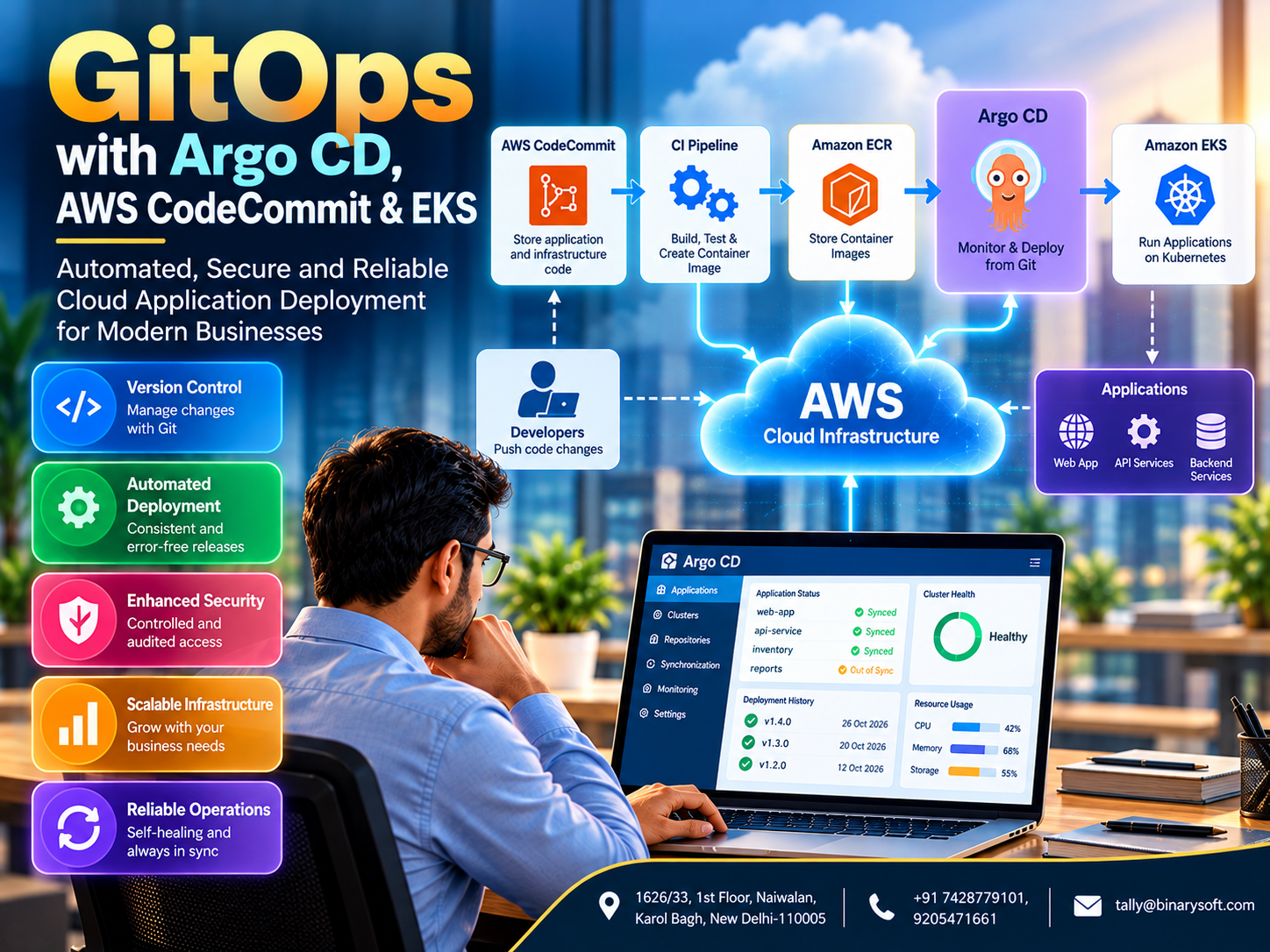
Argo CD
Argo CD is a declarative continuous delivery tool designed for Kubernetes.
It monitors application configuration sources and compares them with deployed resources.
Argo CD can identify differences between the desired and actual states.
Depending on its configuration, it can automatically synchronise changes.
AWS CodeCommit
AWS CodeCommit is a managed Git repository service.
It allows organisations to store and manage source code and configuration files.
It integrates with AWS identity and access management capabilities.
AWS restored CodeCommit to general availability for new customers in November 2025, making it available again for new repository adoption.
Amazon EKS
Amazon Elastic Kubernetes Service is a managed Kubernetes service.
It helps organisations deploy and operate containerised applications.
Amazon EKS manages important Kubernetes control-plane responsibilities while customers remain responsible for appropriate application and infrastructure configuration.
AWS CDK
AWS Cloud Development Kit allows developers to define cloud infrastructure using supported programming languages.
Infrastructure definitions can be version-controlled and deployed through AWS CloudFormation.
Amazon ECR
Amazon Elastic Container Registry stores container images.
A CI pipeline can publish tested application images to ECR for subsequent deployment.
AWS CodeBuild
AWS CodeBuild provides managed build environments.
It can compile applications, run tests and create container images.
Together, these services can support a structured cloud application delivery process.
5. How GitOps Architecture Works with Argo CD and Amazon EKS
A typical GitOps architecture contains several connected components.
The process begins when a developer makes an approved application change.
A continuous integration pipeline builds and tests the software.
The resulting container image is stored in a registry such as Amazon ECR.
A deployment configuration repository specifies which image version should run.
Argo CD monitors the repository.
When an approved configuration change is detected, Argo CD compares it with the Kubernetes environment.
If the application configuration differs, Argo CD can initiate synchronisation according to its configured policy.
Kubernetes then works toward the declared application state.
Example
Suppose an application currently uses version 1.2.
The development team releases version 1.3.
The CI pipeline builds the new image and publishes it.
A reviewed Git change updates the deployment configuration from version 1.2 to version 1.3.
Argo CD detects the modification.
After synchronisation, Kubernetes begins updating the application deployment.
The deployment's success still depends on application health, resource availability and configuration correctness.
GitOps improves deployment consistency, but it does not guarantee that every new application version will function correctly.
6. Benefits of GitOps for Cloud Infrastructure Management
Consistent Deployments
GitOps helps ensure that application environments follow approved configuration definitions.
Reduced Manual Changes
Automated reconciliation reduces the need for repetitive deployment commands.
Better Change Tracking
Git records configuration history and supports review workflows.
Easier Configuration Recovery
Teams can restore earlier configuration versions when necessary.
However, reverting a Git change does not automatically reverse database migrations or recover lost business data.
Improved Collaboration
Developers and infrastructure administrators can review changes through established approval procedures.
Configuration Drift Detection
Argo CD can identify differences between declared and deployed resources.
Scalability
GitOps can support the management of multiple applications and Kubernetes environments.
Operational Transparency
Deployment dashboards provide visibility into application synchronisation and health status.
These benefits make GitOps useful for organisations managing complex cloud-native applications.
7. Step-by-Step Guide to Implementing GitOps on AWS
A practical GitOps implementation should begin with a clearly defined architecture.
Step 1: Identify Application Requirements
Determine which applications will run on Kubernetes.
Evaluate computing resources, networking, storage and security requirements.
Step 2: Prepare the AWS Environment
Configure an AWS account, appropriate identity permissions and the necessary development tools.
Common tools include the AWS CLI, Kubernetes command-line utilities and AWS CDK.
Step 3: Create a Git Repository
Create a repository using AWS CodeCommit or another supported Git provider.
The repository can contain Kubernetes manifests, Helm configuration or other deployment definitions.
Step 4: Define Infrastructure Using AWS CDK
Use AWS CDK to describe the required infrastructure.
Depending on the architecture, this may include networking resources, IAM roles and an Amazon EKS cluster.
Step 5: Deploy the EKS Cluster
Provision the Kubernetes environment using an approved infrastructure deployment process.
Configure access permissions and network security.
Step 6: Configure Argo CD
Argo CD can be deployed through a supported self-managed installation or an available managed EKS capability.
The setup process depends on the selected approach.
Step 7: Connect the Git Repository
Configure Argo CD to access the repository containing deployment manifests.
Use suitable authentication and least-privilege permissions.
Step 8: Define the Application
Create an Argo CD application configuration identifying the source repository, target revision, configuration path and deployment destination.
Step 9: Enable Appropriate Synchronisation
Choose whether synchronisation should require manual approval or operate automatically.
Production environments may require additional safeguards.
Step 10: Validate the Deployment
Check application health, resource availability and deployment status.
Step 11: Configure Monitoring
Introduce logging, alerts and application performance monitoring.
Step 12: Test Recovery Procedures
Verify how the team will respond to unsuccessful deployments, configuration errors and infrastructure incidents.
These steps provide a conceptual implementation framework. Production deployment requires environment-specific configuration and security review.
8. Understanding AWS CDK in GitOps Workflows
AWS CDK helps development teams manage infrastructure through code.
Instead of creating every cloud resource manually, teams define infrastructure using supported programming languages.
For example, a CDK project may describe an EKS cluster, network configuration and IAM roles.
The infrastructure definitions can be stored in Git.
Changes can then follow review and approval procedures.
Advantages of AWS CDK
Infrastructure definitions can be reused.
Teams can maintain version history.
Deployment processes become more consistent.
Configuration changes can be reviewed before implementation.
However, infrastructure provisioning and Kubernetes application reconciliation are separate responsibilities.
AWS CDK commonly provisions cloud infrastructure, while Argo CD manages declared Kubernetes application resources.
Combining these approaches can provide better control over different parts of the environment.
9. How GitOps Supports Application Reliability
Reliability is one of the most important requirements for business applications.
Employees and customers expect applications to remain accessible and operate consistently.
GitOps contributes to reliability through configuration management.
Drift Detection
Unexpected configuration differences can be identified.
Repeatable Deployments
Approved deployment definitions can be reused across environments.
Controlled Updates
Changes can pass through testing and review before production deployment.
Configuration History
Teams can examine previous configurations when investigating incidents.
Faster Investigation
Deployment records can help identify recent changes associated with a problem.
Automated Reconciliation
Argo CD can restore declared configuration when drift occurs, subject to its synchronisation settings.
However, GitOps alone does not provide complete business continuity.
Reliable operations also require application testing, infrastructure monitoring, data backups and disaster recovery planning.
10. How GitOps Can Support Business Applications Connected to Tally Prime
Tally Prime is an accounting and business management application.
It supports invoicing, inventory management, GST-related accounting and financial reporting.
GitOps tools such as Argo CD are designed primarily for managing Kubernetes applications.
Tally Prime itself should not be described as a Kubernetes-native application or as having built-in GitOps support.
However, businesses may operate external applications that exchange authorised information with Tally Prime.
These applications can benefit from GitOps.
E-Commerce Integration Services
An online sales platform may use containerised services to process customer orders.
GitOps can manage deployment configurations for those services.
Inventory Integration Applications
A business may operate an external warehouse management application.
GitOps can help maintain the Kubernetes infrastructure supporting that application.
Customer Portals
Customer-facing applications can use automated deployment workflows.
Reporting Services
External reporting systems may process authorised business information.
GitOps can support the deployment of these services.
API Integration Layers
Businesses may develop integration services that communicate with Tally Prime through supported interfaces.
GitOps can help manage the deployment of these external services.
The main benefit is improved management of connected cloud applications rather than direct modification of Tally Prime's accounting functionality.
11. Case Study One: An E-Commerce Company Improves Deployment Consistency
Illustrative case study
A growing e-commerce company operated several cloud applications.
Its systems handled customer orders, product catalogues, inventory coordination and payment notifications.
The Challenge
Different developers managed deployment configurations.
Occasionally, manual changes caused inconsistencies between testing and production environments.
The technical team spent considerable time investigating deployment problems.
The Solution
The company introduced GitOps using Argo CD and Amazon EKS.
Deployment manifests were stored in a Git repository.
Changes required approval before reaching production.
Argo CD monitored the approved configuration and reported differences.
Illustrative Results
During a three-month evaluation, the company estimated a 40% reduction in time spent investigating configuration-related deployment problems.
The team also improved its documentation and release procedures.
Key Learning
Version-controlled deployment configurations can improve consistency and operational visibility.
12. Case Study Two: A Distribution Business Strengthens Its Cloud Integration Platform
Illustrative case study
A distribution company used Tally Prime for accounting and maintained external applications for online orders and warehouse coordination.
Its integration platform operated through containerised services.
The Challenge
The company experienced occasional deployment inconsistencies when updating its integration applications.
The accounting team needed dependable information exchange between operational systems.
The Solution
The technology team introduced a GitOps workflow for the Kubernetes-hosted integration services.
Approved configurations were maintained in Git.
Argo CD managed deployment synchronisation.
The company also introduced monitoring, reconciliation and error-handling procedures.
Role of Tally Prime
Tally Prime continued maintaining financial and inventory records.
The GitOps workflow managed external integration infrastructure.
Illustrative Results
The company estimated a 30% reduction in deployment-related administrative effort.
Technical administrators gained clearer visibility into application versions and configuration changes.
Key Learning
GitOps can support the reliability of applications connected to accounting systems, provided integration accuracy and data reconciliation are managed separately.
13. Important Security Considerations in GitOps
Security must be incorporated into every stage of the deployment process.
Repository Access Control
Only authorised users should be able to modify production configuration.
Pull Request Approval
Important changes should pass through appropriate review procedures.
Secret Management
Passwords, tokens and other sensitive credentials should not be stored as plaintext in Git repositories.
Use appropriate secret-management solutions.
IAM Permissions
AWS permissions should follow the principle of least privilege.
Kubernetes Access Control
Role-based access controls should restrict administrative capabilities.
Container Image Security
Images should be scanned and obtained from trusted sources.
Audit Logging
Organisations should maintain records of relevant configuration and deployment activities.
Production Safeguards
Automatic synchronisation should be configured carefully.
For example, automated deletion of resources may create risks if configuration files are changed incorrectly.
A secure GitOps environment requires both technical controls and disciplined operational procedures.
14. Common Challenges of GitOps Implementation
Initial Complexity
GitOps requires knowledge of Git, Kubernetes, deployment manifests and cloud infrastructure.
Repository Management
Poorly organised repositories can become difficult to maintain.
Incorrect Configuration
An approved but incorrect configuration can still cause application failures.
Secret Handling
Sensitive credentials require secure storage and access management.
Database Changes
Application rollback does not automatically reverse database schema changes.
Monitoring Requirements
Teams still need application monitoring and incident management processes.
Automation Risks
Incorrect synchronisation policies may introduce unwanted changes.
Businesses should introduce GitOps gradually and validate their operational procedures before using it for critical production systems.
15. Best Practices for Successful GitOps Adoption
Begin with a small, non-critical application.
Maintain clear separation between development, testing and production environments.
Use protected branches and appropriate approval requirements.
Validate deployment manifests before merging changes.
Adopt consistent naming conventions.
Maintain documentation for repository structures and deployment procedures.
Use immutable container image references where practical.
Configure application health checks.
Monitor synchronisation failures and infrastructure performance.
Test recovery procedures regularly.
Maintain separate strategies for database backups and schema changes.
Finally, train development and infrastructure teams to understand how the GitOps reconciliation process works.
These practices help organisations gain the benefits of automation without sacrificing operational control.
16. GitOps and the Future of Cloud Infrastructure Automation
Modern businesses increasingly depend on distributed applications.
Online stores, customer portals, inventory platforms and reporting systems may operate across multiple cloud services.
Managing these environments manually can become difficult.
GitOps offers a structured way to maintain deployment configurations and improve operational consistency.
As cloud-native technology evolves, organisations are likely to adopt more automated validation, policy enforcement and infrastructure management capabilities.
Artificial intelligence may also assist technical teams by analysing deployment failures and identifying unusual infrastructure behaviour.
However, human oversight will remain important.
Business-critical systems require careful testing, secure access and reliable recovery procedures.
GitOps should be viewed as part of a broader DevOps and cloud governance strategy.
Conclusion
GitOps provides a modern approach to managing cloud-native application deployments.
By using Git as the source of truth for deployment configuration, organisations can improve consistency, change tracking and operational visibility.
Argo CD provides continuous reconciliation for Kubernetes applications.
AWS CodeCommit supports managed Git repositories, Amazon EKS provides Kubernetes infrastructure and AWS CDK helps define cloud resources through code.
Together, these technologies can support structured application delivery.
For businesses using Tally Prime alongside external digital applications, GitOps can help manage the cloud infrastructure supporting those connected services.
However, dependable business operations still require accurate accounting records, secure integrations, infrastructure monitoring and tested recovery procedures.
The greatest value of GitOps is not simply faster deployment. It is giving organisations a more controlled, transparent and repeatable way to manage the technology on which their business depends.
Powered by Binarysoft Technologies
Authorized Tally Partner
Location: 1626/33, 1st Floor, Naiwalan, Karol Bagh, New Delhi – 110005, INDIA
Contact Us: +91 7428779101, 9205471661
Email: tally@binarysoft.com
Business Hours: 10:00 AM – 6:00 PM, Monday to Friday
Binarysoft Technologies helps businesses implement Tally Prime, organise accounting workflows, improve inventory management and evaluate suitable technology solutions for business operations.
Frequently Asked Questions
Can GitOps automatically fix configuration drift?
Tools such as Argo CD can detect differences and reconcile configurations according to their synchronisation policies.
Can GitOps be used directly with Tally Prime?
GitOps is not a built-in Tally Prime capability. It can be used to manage Kubernetes-based applications and integration services that operate alongside Tally Prime.
What are the main benefits of GitOps?
Major benefits include consistent deployments, configuration tracking, reduced manual changes, automated reconciliation and improved operational visibility.
Does GitOps eliminate the need for backups?
No. GitOps manages deployment configurations. Businesses still require independent data backup and recovery procedures.
CA. Arinav Chakraborty advises businesses on taxation, accounting systems, and financial planning. His professional interests include digital transformation, compliance management, and improving business efficiency through technology.