Call CA Tally HelpDesk
+91 9205471661,
7428779101
Introduction: When Business Growth Demands Better Technology
Every entrepreneur dreams of expanding their business.
A small shop may become a wholesale distribution company. A local manufacturer may begin supplying customers across India. A growing service provider may open offices in several cities.
However, business expansion introduces new responsibilities.
More customers mean more invoices. Additional employees require access to financial information. Multiple warehouses create inventory management challenges, while increasing transaction volumes place greater demands on accounting systems.
Technology that worked efficiently for a small business may struggle as operations become more complex.
Imagine a company where employees repeatedly wait for accounting information, financial reports take longer to prepare and remote branches depend on the head office for every transaction update.
These delays can affect productivity, customer service and management decisions.
This is why scalability and reliability are essential considerations when selecting a business accounting environment.
Scalability determines how effectively a system can accommodate increasing workloads.
Reliability describes its ability to perform consistently and remain available under expected operating conditions.
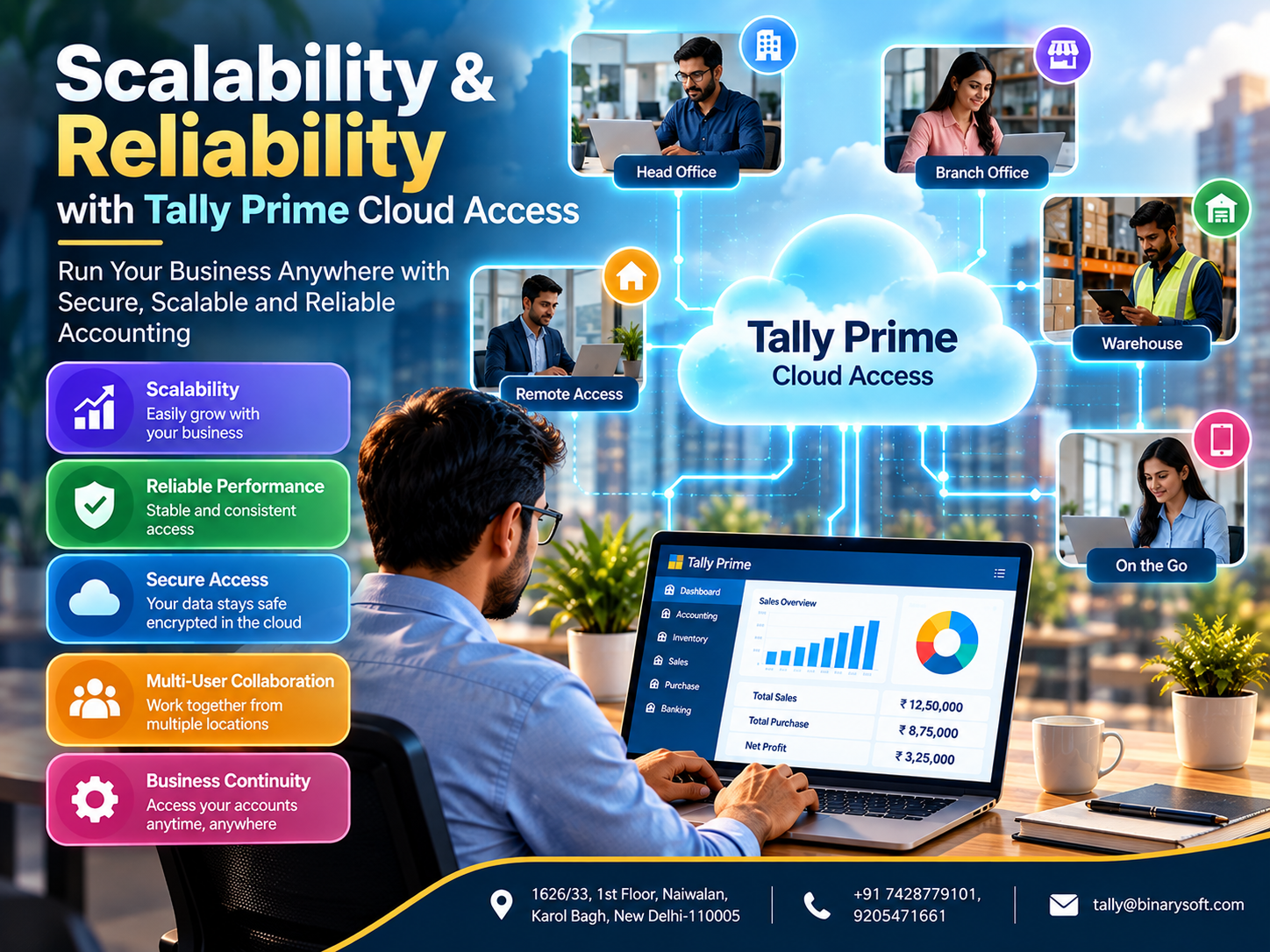
Tally Prime Cloud Access helps businesses combine Tally Prime's accounting capabilities with cloud-hosted virtual computing resources.
By providing a centrally accessible working environment, it can support authorised employees across different locations.
Understanding how scalability and reliability work together can help organisations prepare for growth while protecting important financial operations.
1. What Is Tally Prime Cloud Access?
Tally Prime Cloud Access is a hosted environment that allows businesses to use Tally Prime through supported remote-access methods.
Instead of depending entirely on an office computer, authorised users can connect to a virtual computing environment where Tally Prime and the relevant business data are maintained.
The service uses cloud infrastructure to provide computing resources, storage and remote accessibility.
Businesses can manage accounting activities while working from different locations, subject to their subscription, licensing and connectivity requirements.
Important Capabilities
Tally Prime Cloud Access can support:
-
Remote access to the accounting application.
-
Collaboration between authorised users.
-
Centralised access to company information.
-
Virtual computer management.
-
Cloud storage and backup arrangements.
-
Flexible infrastructure plans.
-
Access to accounting and inventory reports.
The availability of specific features depends on the selected plan, software version and deployment configuration.
Cloud Access is a hosting service; a valid Tally Prime software licence is required separately.
2. An Emotional Story: The Business Owner Who Refused to Let Technology Stop His Growth
Vikram operated a family-owned electrical equipment distribution business in Delhi.
His father had established the company nearly twenty-five years earlier.
The business began with a small warehouse, limited inventory and a handful of loyal customers.
After completing his education, Vikram joined the company with a determination to expand its operations.
He introduced new product categories, hired sales representatives and developed relationships with contractors across northern India.
Eventually, the business opened additional offices in Jaipur and Chandigarh.
Sales increased, but accounting operations became increasingly difficult.
The head office maintained the main accounting records.
Branch employees frequently contacted the accounts department to confirm outstanding payments, stock balances and customer transactions.
Whenever the office computer or network experienced problems, employees struggled to obtain updated information.
One afternoon, Vikram received an urgent call from a major customer.
The customer wanted immediate confirmation of available stock for a large project.
Unfortunately, the accounts team could not access the required records because the office system was experiencing technical difficulties.
Vikram knew the order could significantly improve the company's monthly revenue.
He repeatedly contacted his staff, hoping the system would become available.
The customer eventually placed the order with another supplier.
That evening, Vikram sat quietly in his office.
He remembered his father's advice that customer trust was the most valuable asset a business could build.
Losing the order was painful, but the greater disappointment was knowing that the company had failed to respond despite having the products available.
Vikram decided to modernise the accounting environment.
With professional assistance, he evaluated Tally Prime Cloud Access, reviewed the available infrastructure plans and arranged a controlled migration.
The company introduced appropriate user permissions, backup procedures and remote-access arrangements.
Employees across different offices could access authorised accounting information more conveniently.
Vikram also established procedures for monitoring connectivity and handling unexpected disruptions.
Over time, coordination between branches improved.
The experience taught him an important lesson:
Business growth should not be limited by technology that cannot support the organisation's changing needs.
This fictional story demonstrates why scalable and reliable accounting infrastructure matters to growing businesses.
3. What Does Scalability Mean in Cloud Accounting?
Scalability refers to the ability of a computing environment to accommodate increasing demand.
In business accounting, demand may increase because of additional employees, larger transaction volumes, more branches or expanding inventory records.
A scalable system allows organisations to adjust resources according to their requirements.
Vertical Scaling
Vertical scaling involves increasing the computing resources available to an existing system.
For example, a business may require additional memory, processing capacity or storage.
A suitable cloud plan may provide higher resource allocations.
Horizontal Scaling
Horizontal scaling involves adding computing instances or other infrastructure components to distribute workloads.
It is particularly relevant to cloud platforms serving large numbers of customers.
However, adding servers does not automatically mean that a single accounting application can distribute its workload across them.
Application architecture determines how resources can be used.
User Scalability
A growing business may need additional authorised users.
The selected Cloud Access plan and Tally Prime licence must support the intended number of users.
Data Scalability
Accounting records increase over time.
Businesses should evaluate storage requirements, backup capacity and expected data growth.
Operational Scalability
An organisation may introduce additional branches, warehouses or departments.
Its accounting procedures and infrastructure should support these changes without unnecessary duplication of records.
4. Why Scalability Matters for Growing Businesses
Supports Business Expansion
A scalable environment helps businesses plan for additional users and increasing workloads.
Reduces Infrastructure Replacement
Cloud plans may allow organisations to adjust resources without purchasing new office servers.
Improves Resource Planning
Businesses can evaluate their actual requirements before selecting higher-capacity infrastructure.
Supports Multiple Locations
Authorised employees can access centrally hosted information from different offices.
Helps Manage Increasing Data Volumes
Appropriate storage planning supports the growth of financial and inventory records.
Provides Greater Operational Flexibility
Businesses can review their infrastructure needs as transaction volumes and staffing requirements change.
Scalability is not unlimited. Available resources, plan restrictions, software architecture and licensing requirements must all be considered.
5. What Does Reliability Mean in Cloud Accounting?
Reliability describes a system's ability to perform its intended functions consistently under defined conditions.
For accounting applications, reliability is especially important because employees depend on accurate financial information.
A reliable environment should support consistent application access, dependable data storage and predictable operational behaviour.
Application Availability
Employees should be able to access the application during expected working periods.
Data Integrity
Financial records should remain accurate and protected against unintended modification or corruption.
Consistent Performance
The environment should provide acceptable responsiveness under normal workloads.
Backup and Recovery
Businesses should maintain procedures for restoring information after failures.
Fault Management
Infrastructure problems should be identified and addressed through established operational procedures.
Business Continuity
Organisations should prepare for network failures, infrastructure incidents and other disruptions.
No cloud environment can guarantee uninterrupted access under every circumstance.
Reliability depends on infrastructure design, operational management, network connectivity and recovery planning.
6. How Cloud Infrastructure Supports Reliable Business Operations
Cloud infrastructure provides computing resources that can be managed through virtualisation and centralised administration.
In a hosted accounting environment, virtual computers can provide users with access to applications without requiring equivalent computing resources at every office.
Virtual Computing Resources
Virtual computers provide processing capacity, memory and storage.
Centralised Management
Administrators can manage supported computing environments through centralised tools.
Infrastructure Monitoring
Cloud platforms can monitor resource consumption and operational events.
Resource Allocation
Computing resources can be allocated according to selected service plans.
Backup Storage
Cloud environments may provide dedicated storage for backup information.
Controlled Maintenance
Updates and maintenance can be performed through supported procedures.
These capabilities help businesses organise their technology infrastructure more efficiently.
However, the exact level of reliability depends on the service provider and the selected configuration.
7. Understanding Virtual Offices and Virtual Computers
A virtual office is a cloud-hosted environment that can contain computing resources allocated to an organisation.
Virtual computers operate within this environment and provide access to applications and business information.
For example, a company may have employees responsible for sales, purchasing and accounting.
Each authorised user can access the appropriate virtual computing environment according to the configured arrangement.
Shared business information can be maintained centrally.
This resembles an office network in which employees use separate computers to access common business records.
Advantages of Virtual Offices
Virtual offices can reduce dependence on a single physical workplace.
They support authorised access from multiple locations.
They also provide a structured environment for managing computing resources and user access.
Why Virtual Computer Management Matters
As businesses grow, the number of users and required computing resources may increase.
Effective virtual computer management helps organisations control access, allocate resources and monitor operational requirements.
8. How Tally Prime Helps Businesses Manage Accounting Operations in the Cloud
Tally Prime provides business management features that can be valuable in a cloud-hosted environment.
Sales and Purchase Accounting
Employees can record sales invoices, purchase transactions and related financial information.
Inventory Management
Businesses can maintain stock records, track inventory movements and review stock summaries.
Financial Reporting
Tally Prime provides reports such as the Balance Sheet, Profit and Loss Account, Cash Flow Statement and ledger statements.
GST-Related Accounting
Businesses can use supported GST invoicing and reporting capabilities according to applicable requirements.
Outstanding Management
Customer receivables and supplier payables can be reviewed through accounting reports.
Multi-User Collaboration
Suitable licensing and Cloud Access plans can support multiple authorised users working with shared company data.
Remote Financial Visibility
Business owners can access relevant information from supported locations and devices.
The benefit is not that cloud hosting changes the fundamental accounting logic.
Rather, it provides an alternative environment for accessing and managing the application.
9. Case Study One: A Wholesale Distributor Expands Across Three Cities
Illustrative case study
A wholesale distribution company operated from Delhi, Jaipur and Lucknow.
The company employed twenty-five people and managed thousands of inventory items.
The Challenge
The head office maintained the primary accounting records.
Branch employees frequently depended on telephone calls and spreadsheets to obtain updated financial information.
Management found it difficult to coordinate accounting activities efficiently.
The Solution
The company introduced a suitable Tally Prime Cloud Access arrangement.
Authorised employees received access according to their responsibilities.
The business also reviewed network connectivity, software licensing and backup procedures.
Illustrative Results
During a three-month evaluation, management estimated that routine financial information requests decreased by approximately 35%.
Employees spent less time exchanging spreadsheets.
The company also improved coordination between its sales and accounting departments.
Key Learning
Centralised access to accounting information can improve collaboration across multiple business locations.
10. Case Study Two: A Manufacturing Business Prepares for Rapid Growth
Illustrative case study
A manufacturing company experienced increasing demand for its products.
Its workforce expanded, and transaction volumes grew substantially.
The Challenge
The company's existing office infrastructure struggled during periods of heavy accounting activity.
Employees experienced delays when accessing shared information.
Management was concerned about future capacity requirements.
The Solution
The organisation evaluated a higher-capacity cloud environment suitable for its accounting workload.
It selected an appropriate Tally Prime deployment, reviewed multi-user licensing and established performance-monitoring procedures.
The company also introduced structured backup and recovery practices.
Illustrative Results
Management estimated a 25% reduction in administrative delays associated with accounting information access.
The IT team gained clearer visibility into infrastructure requirements.
Key Learning
Scalability requires coordinated planning across software licensing, computing resources, data management and business processes.
11. Security and Data Protection in Tally Prime Cloud Access
Financial records contain sensitive business information.
A cloud-hosted environment should therefore include appropriate security controls.
Authentication
User authentication helps restrict access to authorised individuals.
User Permissions
Employees should receive access according to their responsibilities.
Secure Connections
Remote communication should use appropriate security mechanisms.
Backup Protection
Backup information should be protected against unauthorised access.
Data Recovery
Businesses should understand how records can be restored after accidental deletion, corruption or infrastructure failure.
Employee Awareness
Users should receive guidance on password security, phishing risks and safe remote access.
Cloud hosting can provide useful security capabilities, but it does not eliminate every cybersecurity risk.
Businesses remain responsible for appropriate access management and operational controls.
12. How Remote Access Improves Business Collaboration
Remote access allows authorised employees to work with business applications without being physically present at the main office.
For example, a business owner travelling to meet customers may need to review outstanding balances.
An accountant working from another location may need to prepare financial reports.
A branch manager may need to examine inventory information.
A suitable hosted environment can support these activities.
Better Communication
Employees can work with centrally maintained information.
Reduced Dependence on Physical Offices
Certain accounting activities can continue from other locations when connectivity is available.
Improved Management Visibility
Business owners can review relevant financial information more conveniently.
Flexible Working Arrangements
Remote access can support distributed teams and authorised external accounting professionals.
However, internet availability and appropriate user permissions remain essential.
13. How to Choose the Right Tally Prime Cloud Access Plan
Businesses should evaluate their requirements before selecting a hosting plan.
Important considerations include the number of users, transaction volumes, storage needs and expected business growth.
User Requirements
Determine how many employees need access at the same time.
Computing Capacity
Review processor and memory allocations.
Storage
Estimate the space required for accounting data and related files.
Backup Requirements
Evaluate backup storage and restoration procedures.
Software Licensing
Confirm that the selected Tally Prime licence supports the intended usage.
Support
Understand the assistance available for setup, migration and technical problems.
Total Cost
Consider software licensing, hosting charges, applicable taxes and optional services.
A low-cost plan may be suitable for a small organisation, while a growing company may require greater computing resources.
The correct choice depends on actual business requirements rather than advertised capacity alone.
14. Common Challenges in Cloud Accounting
Internet Dependency
Remote access generally requires reliable connectivity.
Network Latency
Slow connections can affect the user experience.
Incorrect Resource Selection
Insufficient computing resources may result in poor performance.
Migration Errors
Improper data migration can create accounting inconsistencies.
User Access Problems
Incorrect permissions may prevent employees from completing their responsibilities.
Backup Misunderstandings
Businesses sometimes assume that backups automatically guarantee immediate recovery.
Recovery time and available restoration points depend on the actual backup arrangement.
These challenges can be reduced through careful planning, testing and professional implementation.
15. Best Practices for Reliable Tally Prime Cloud Operations
Businesses should establish a structured approach to cloud accounting.
Start by evaluating user requirements and expected transaction volumes.
Select a suitable hosting plan and verify licensing compatibility.
Maintain accurate accounting records before migration.
Create verified backups and test important restoration procedures.
Configure user permissions according to employee responsibilities.
Use secure authentication methods.
Monitor application performance and network connectivity.
Review storage consumption periodically.
Train employees to use the hosted environment correctly.
Finally, establish a clear support process for unexpected technical problems.
These practices help organisations use cloud infrastructure more effectively.
16. The Future of Scalable Cloud Accounting
As businesses expand across locations and digital sales channels, flexible accounting infrastructure will become increasingly important.
Cloud-hosted applications can help organisations manage distributed teams and changing computing requirements.
Improved infrastructure automation, monitoring and resource management may further support operational efficiency.
However, the foundations of dependable accounting will remain unchanged.
Businesses still need accurate transaction records, proper access controls, reliable backups and effective financial oversight.
Tally Prime Cloud Access provides an option for combining established accounting workflows with cloud-hosted accessibility.
The greatest value comes when businesses select appropriate infrastructure and maintain disciplined financial processes.
Conclusion
Scalability and reliability are essential foundations of modern business technology.
Scalability helps organisations accommodate additional users, transactions and operational requirements.
Reliability supports consistent access to important business applications and information.
Tally Prime Cloud Access combines familiar accounting capabilities with remotely accessible virtual computing infrastructure.
For growing businesses, this can support multi-location collaboration, flexible resource planning and more convenient access to financial records.
However, successful implementation requires careful evaluation of software licensing, cloud capacity, network connectivity, security and backup arrangements.
The right cloud accounting environment should not only support your business today. It should also provide the flexibility and dependability needed for tomorrow's growth.
Powered by Binarysoft Technologies
Authorized Tally Partner
Location: 1626/33, 1st Floor, Naiwalan, Karol Bagh, New Delhi – 110005, INDIA
Contact Us: +91 7428779101, 9205471661
Email: tally@binarysoft.com
Business Hours: 10:00 AM – 6:00 PM, Monday to Friday
Binarysoft Technologies helps businesses implement Tally Prime, evaluate suitable cloud accounting arrangements, improve inventory management and organise financial operations.
Frequently Asked Questions
What does scalability mean in cloud accounting?
Scalability refers to the ability of an accounting environment to accommodate increasing users, data volumes and computing requirements.
Why is reliability important for accounting software?
Reliability helps businesses maintain consistent access to financial information and supports dependable daily operations.
Can businesses increase cloud computing resources as they grow?
Available plans may provide different computing and storage capacities. Businesses should review upgrade options with their provider.
How can businesses get started with Tally Prime Cloud Access?
Businesses should evaluate their requirements, select appropriate licensing and hosting plans, prepare accounting data and complete a controlled setup with suitable technical assistance.
CA. T.R Venkat is a Chartered Accountant with extensive experience in accounting systems, GST compliance, and MSME advisory. He has worked closely with Indian traders and businesses on inventory control and accounting process improvement. His writing draws from real operational challenges faced by growing enterprises.