Call CA Tally HelpDesk
+91 9205471661,
7428779101
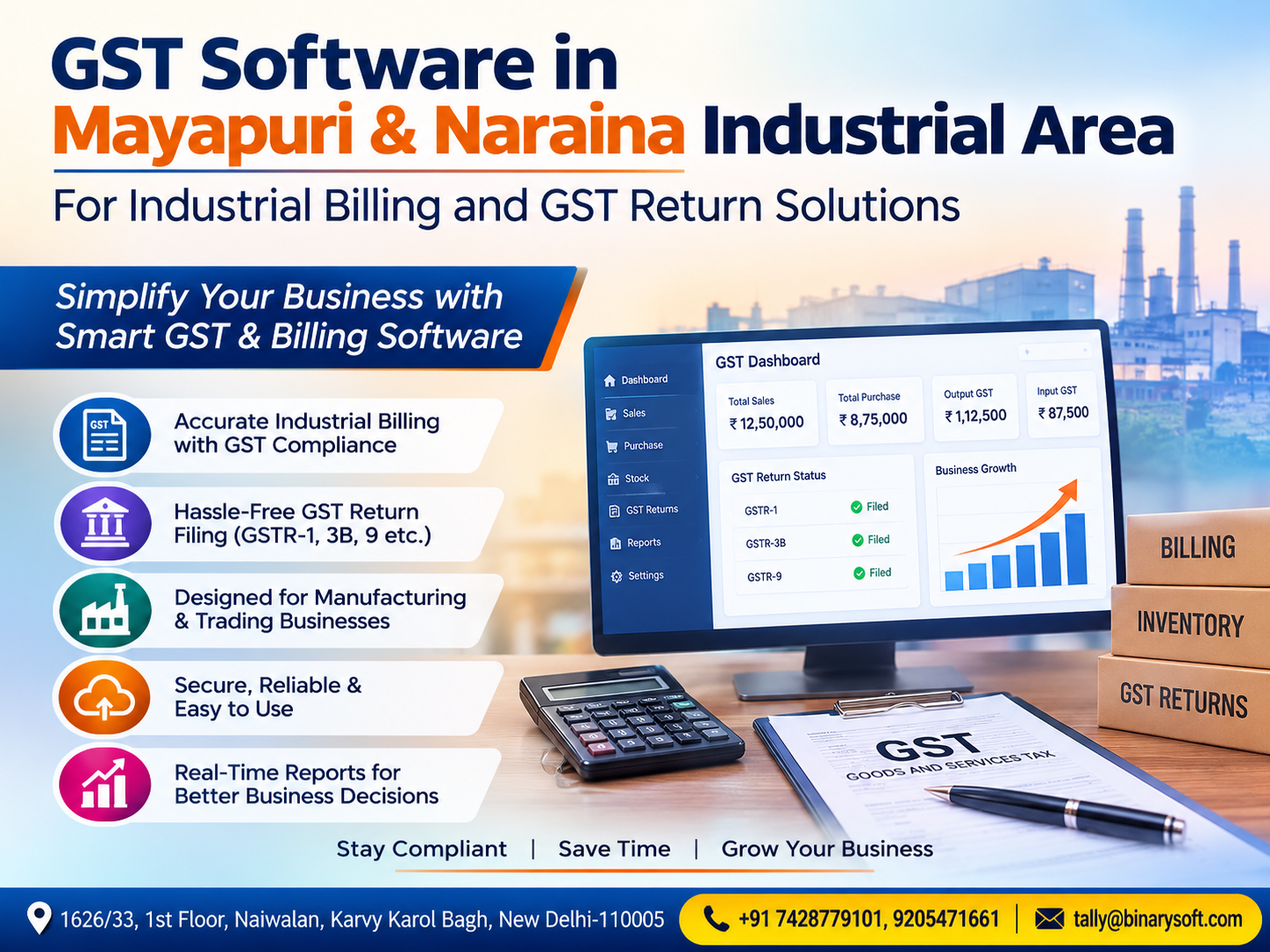
GST Software for Industrial Businesses in Delhi: What Has Changed in 2026?
In 2026, industrial businesses in Mayapuri and Naraina Industrial Area are handling far more than routine billing. Faster GST compliance, e-Invoicing, e-Way Bills, inventory movement, purchase reconciliation, outstanding payments and accurate tax reporting have made disconnected spreadsheets and manual accounting increasingly difficult to manage. Even a small error in GSTIN details, tax rates, place of supply or invoice data can create reconciliation problems and additional work when returns are prepared. For manufacturers, wholesalers, spare-parts dealers, engineering units and industrial suppliers, the pressure is even greater because every sale can affect stock, tax liability and receivables simultaneously. A well-configured GST accounting solution such as TallyPrime can bring these activities together. With professional implementation and support from Binarysoft Technologies, businesses in Mayapuri and Naraina can create invoices faster, maintain inventory more accurately, prepare GST data efficiently and gain clearer visibility into their day-to-day finances.
Why Mayapuri and Naraina Industrial Businesses Need Better GST Software
Mayapuri and Naraina are among Delhi's well-known industrial and commercial areas. Businesses operating in these locations may deal with manufacturing, machinery, automotive components, metal products, electrical goods, industrial equipment, spare parts, packaging materials, repair services, fabrication and wholesale distribution.
Unlike a small business with only a few invoices each day, an industrial enterprise can have a more complicated transaction cycle.
A typical transaction may involve a purchase order, goods receipt, supplier invoice, inventory movement, production or processing, sales order, tax invoice, dispatch, e-Way Bill, payment follow-up and GST reporting.
Managing these activities separately creates unnecessary duplication.
Modern GST and accounting software helps connect these transactions so that business owners and accounting teams can spend less time manually compiling information and more time reviewing the business.
TallyPrime for GST Billing and Accounting
TallyPrime is designed to support accounting, invoicing, inventory management and taxation requirements within an integrated business environment.
For a business in Mayapuri Industrial Area or Naraina Industrial Area, this can mean that when a GST sales invoice is entered, the same transaction can simultaneously update the customer's account, relevant sales ledger, applicable tax ledgers, inventory quantities and outstanding receivables.
Instead of maintaining separate records for billing, accounts and stock, businesses can work with connected financial information.
This is particularly valuable for industrial businesses handling hundreds or thousands of products and transactions.
Fast and Professional GST Billing
Industrial customers generally expect invoices to be accurate and professionally prepared.
Businesses can configure their billing system according to their operational requirements and maintain information such as:
- Customer and supplier details
- GSTIN
- HSN/SAC information
- Item descriptions
- Quantity and rate
- Discounts
- CGST, SGST and IGST
- Place of supply
- Payment terms
- Outstanding balances
- Inventory information
- Transport and dispatch details where required
Once the relevant masters and GST configuration are correctly established, routine invoicing becomes considerably easier.
This reduces repetitive calculations and helps accounting teams maintain consistent transaction records.
A Mayapuri Business Owner's Story: When One Busy Month Changed the System
Consider the example of a fictional auto-parts distributor operating from Mayapuri.
For years, the owner had relied on a familiar process. The sales team prepared bills, stock quantities were maintained separately, and several GST-related details were checked later by the accountant.
The arrangement seemed manageable until business began growing.
One month, a major customer urgently requested a large consignment. The goods were ready, but the team discovered differences between the physical stock, their internal stock sheet and the quantities shown in accounting records.
Everyone started searching.
The store employee checked registers. The accountant checked invoices. The sales executive searched old spreadsheets. The owner kept calling each person because the customer was waiting.
The order eventually went out, but the owner remembered something more important than the delayed dispatch: nobody could immediately tell him which number was correct.
That evening, he decided that growth could no longer depend on scattered records.
After moving toward an integrated accounting and inventory workflow, his biggest benefit was not simply faster invoice printing. It was confidence.
When a customer called, his team could check the account. When purchasing was planned, stock information was easier to review. When GST data had to be prepared, transactions were already recorded systematically.
For an industrial business, that confidence can be extremely valuable.
GST Return Preparation Made More Systematic
GST compliance should not become an end-of-period exercise where accounting staff suddenly begin collecting missing information.
A better approach is to record transactions correctly from the beginning.
When GST transactions are properly entered, businesses can review their tax-related information throughout the period and identify records that require attention before return preparation.
This can help reduce last-minute pressure.
Businesses can use accounting reports to review sales, purchases, taxes and transaction details and coordinate more efficiently with their accountant or GST professional.
The objective is simple: maintain cleaner books throughout the month instead of trying to repair incomplete records at filing time.
Better Management of GSTR-1 Related Sales Data
For businesses making regular taxable supplies, sales transaction accuracy is particularly important.
GST software can help maintain structured invoice-level information needed for GST reporting, including customer GSTIN, invoice number, invoice date, taxable value, tax components and place-of-supply information.
Correct data entry remains essential. Software does not eliminate the need for verification, but it can make errors easier to identify and correct before information is used for compliance purposes.
For Mayapuri and Naraina businesses processing significant invoice volumes, this can save substantial administrative effort.
Purchase and Input Tax Credit Reconciliation
Purchases are equally important.
Industrial businesses may purchase raw materials, components, machinery parts, consumables, packaging products and services from multiple suppliers.
If supplier invoices are missing or incorrectly recorded, the accounting team can face difficulties during reconciliation.
Maintaining organized purchase records makes it easier to compare books with GST-related information and investigate discrepancies.
Instead of discovering problems months later, businesses can establish a regular reconciliation process.
e-Invoicing Support for Applicable Businesses
Where e-Invoicing requirements apply to a business under current GST rules, integration with the accounting workflow can significantly reduce repetitive work.
Rather than preparing an invoice in one system and repeatedly entering the same information elsewhere, businesses can adopt a more connected process.
This can help reduce manual data entry and improve consistency between accounting records and compliance documents.
Businesses should always check current government requirements and applicability criteria because GST and e-Invoicing rules can change.
e-Way Bill Management for Goods Movement
Movement of industrial goods frequently requires careful documentation.
Businesses in Mayapuri and Naraina may dispatch products throughout Delhi-NCR as well as to customers in Haryana, Uttar Pradesh, Rajasthan, Punjab and other states.
Where an e-Way Bill is applicable, accurate invoice and transportation information becomes important.
An integrated workflow can make it easier to use transaction data for dispatch-related compliance rather than repeatedly entering the same information.
For businesses handling frequent goods movement, even small reductions in repetitive data entry can add up to significant time savings.
Inventory Management for Industrial Businesses
GST compliance is only one part of industrial accounting.
Inventory can be equally critical.
A business may maintain hundreds or thousands of items, including raw materials, finished products, components, accessories, spare parts and consumables.
TallyPrime can help businesses maintain inventory records alongside accounting transactions.
Depending on configuration and business requirements, companies can organize stock using items, groups, units and locations or godowns.
This provides management with better visibility into stock movement.
Know What Is Available Before Promising the Customer
One of the most common industrial business problems occurs when the sales team promises material that is not actually available in sufficient quantity.
Integrated inventory information can reduce this risk.
Before confirming an order, the team can review relevant stock information and coordinate procurement where necessary.
This is particularly useful for spare-parts and machinery businesses where hundreds of similar-looking products may have different specifications or item codes.
Multiple Godown and Location Management
Some businesses operate from more than one storage location.
For example, an enterprise may maintain a showroom or office in Naraina while keeping additional inventory at another warehouse.
Properly configured inventory software can help maintain location-wise stock records.
Management can then understand where inventory is available instead of looking only at a combined quantity.
This supports better stock transfers, procurement decisions and order planning.
Receivables and Outstanding Payment Management
Industrial sales frequently involve credit.
A customer may receive material today and pay after 15, 30, 45 or 60 days depending on agreed terms.
When dozens or hundreds of customers purchase on credit, manual outstanding tracking becomes difficult.
Accounting software allows businesses to review receivables and customer balances more systematically.
Management can identify outstanding amounts and follow up accordingly.
Better receivable visibility can also improve cash-flow planning because sales revenue has limited value if payments remain uncollected for long periods.
Payables and Supplier Management
The same principle applies to suppliers.
Businesses need to know how much is payable, to whom it is payable and which obligations are approaching their due dates.
A structured accounting system provides clearer visibility into supplier balances.
This can help purchasing and finance teams coordinate payments without relying entirely on spreadsheets, paper files or individual memory.
GST Software for Manufacturers
Manufacturing businesses have additional requirements because raw materials may be converted into finished products.
A properly configured business accounting and inventory system can help track material movement and maintain better visibility over manufacturing-related transactions.
The exact configuration should depend on the production process.
A fabrication unit, auto-component manufacturer, packaging manufacturer and electrical-equipment producer may all require different inventory structures.
This is why implementation matters as much as the software itself.
GST Software for Wholesalers and Distributors
Wholesalers operating in Naraina or Mayapuri frequently handle high transaction volumes.
They may require:
- Rapid GST invoicing
- Customer-wise outstanding tracking
- Item-wise inventory
- Purchase management
- Sales analysis
- GST reporting
- Multiple price or discount structures
- Godown management
- Order-related information
- Credit control
A centralized accounting environment helps keep these activities connected.
Business Reports for Better Decision-Making
Business software should not only help prepare invoices. It should help management understand what is happening.
Owners can use accounting and business reports to review areas such as sales, purchases, receivables, payables, stock and profitability.
For example, management may want to know:
Which customers owe the most money?
Which products are selling quickly?
Which stock items require attention?
How much was sold during the month?
What are the current supplier liabilities?
What is the financial position of the business?
Having timely information can make these questions easier to answer.
Reduce Dependence on Multiple Excel Files
Excel remains useful for many business activities, but excessive dependence on separate spreadsheets can create problems.
Imagine maintaining one file for sales, another for stock, another for collections, another for GST calculations and another for supplier payments.
A single transaction may need to be entered several times.
Every duplicate entry creates another opportunity for mismatch.
An integrated accounting platform reduces the need to recreate the same core transaction across multiple disconnected records.
Data Security and Regular Backup
Accounting data is one of a business's most important digital assets.
Losing years of customer balances, purchase records, stock information and financial transactions can severely disrupt operations.
Businesses should therefore establish proper backup procedures and control access to accounting data.
Backup copies should also be periodically verified rather than assuming that a backup process is working.
Businesses using cloud or remote-access arrangements should additionally review access permissions and security practices.
Why Proper TallyPrime Implementation Matters
Purchasing software is only the first step.
Incorrect configuration can create unnecessary complications later.
Businesses should carefully configure relevant areas such as company information, GST details, ledgers, stock groups, stock items, units, HSN/SAC information, tax classifications, godowns, invoice formats and user access according to their actual requirements.
A well-planned implementation makes daily work easier.
A poorly planned implementation can result in duplicate masters, inconsistent item names and unreliable reports.
TallyPrime Support in Mayapuri and Naraina Industrial Area
Businesses looking for TallyPrime and GST accounting assistance can work with Binarysoft Technologies for software licensing, implementation and related support.
The objective should not simply be to install software.
The system should be configured around the company's practical workflow so that accounting, GST billing, inventory and business reporting work together effectively.
Whether the organization is a small trading unit or an established industrial enterprise, the solution can be planned according to transaction volume, users and operational requirements.
Who Can Use This GST and Billing Solution?
The solution can be suitable for many types of businesses operating in and around Mayapuri and Naraina Industrial Area, including manufacturers, wholesalers, distributors, engineering companies, auto-parts dealers, machinery suppliers, electrical traders, metal businesses, fabrication units, packaging companies, spare-parts businesses and industrial service providers.
The appropriate configuration will depend on each organization's accounting and operational requirements.
Benefits of an Integrated GST Accounting System
For industrial businesses, the major benefit is integration.
Instead of viewing billing, accounting, GST and inventory as completely separate activities, businesses can create a connected workflow.
This can lead to faster billing, more organized transaction records, better stock visibility, easier outstanding tracking, improved reporting and more efficient preparation of GST-related data.
It also gives management a clearer picture of the business without waiting until the end of the month for multiple spreadsheets to be combined.
Powered by Binarysoft Technologies
Binarysoft Technologies
Authorized Tally Partner
For businesses looking for TallyPrime licensing, GST billing solutions, implementation, configuration and support in Mayapuri, Naraina Industrial Area and other parts of Delhi-NCR:
Location:
1626/33, 1st Floor, Naiwalan, Karol Bagh, New Delhi – 110005, INDIA
Contact us:
+91 7428779101, 9205471661
Email us:
tally@binarysoft.com
Business Hours:
10:00 AM – 6:00 PM, Monday to Friday
Conclusion
Industrial businesses in Mayapuri and Naraina Industrial Area need more than software that simply generates invoices. They need a system capable of connecting GST billing, accounting, inventory, purchases, receivables, payables and management reporting.
As transaction volumes increase, manual processes and disconnected spreadsheets become increasingly difficult to control. A properly implemented TallyPrime environment can help businesses maintain more organized records, monitor stock, prepare GST-related data, manage customer outstanding amounts and obtain timely financial information.
For manufacturers, wholesalers, distributors and industrial suppliers, the real advantage is having business information available in one connected accounting environment.
Binarysoft Technologies, an Authorized Tally Partner, can assist businesses with TallyPrime licensing, implementation, configuration and support according to their operational requirements.
Frequently Asked Questions
Which GST software is suitable for businesses in Mayapuri Industrial Area?
TallyPrime can be considered by manufacturers, wholesalers, traders, distributors and industrial suppliers requiring integrated accounting, GST billing and inventory management. The exact setup should be based on the company's workflow and compliance requirements.
Can TallyPrime handle GST billing?
Yes. TallyPrime supports GST-related accounting and invoicing functionality. Correct GST configuration, tax details and transaction entry are important for accurate records.
CA. Rishubh Talrejaa specializes in GST, business accounting, and compliance advisory for growing enterprises. With experience in handling real-time transactional data and audits, he writes practical insights on inventory control, taxation, and digital transformation for Indian businesses operating in competitive markets.