Call CA Tally HelpDesk
+91 9205471661,
7428779101
Why Connected Accounting Is Becoming Essential for Businesses in 2026
Running a business in 2026 requires more than recording sales, purchases and expenses. Business owners must manage GST compliance, track payments, monitor inventory, communicate with customers, reconcile bank transactions and make financial decisions without unnecessary delays.
Traditional accounting processes often involve switching between spreadsheets, banking portals, government websites and accounting applications. This fragmented approach increases manual work, creates opportunities for errors and makes financial information difficult to access.
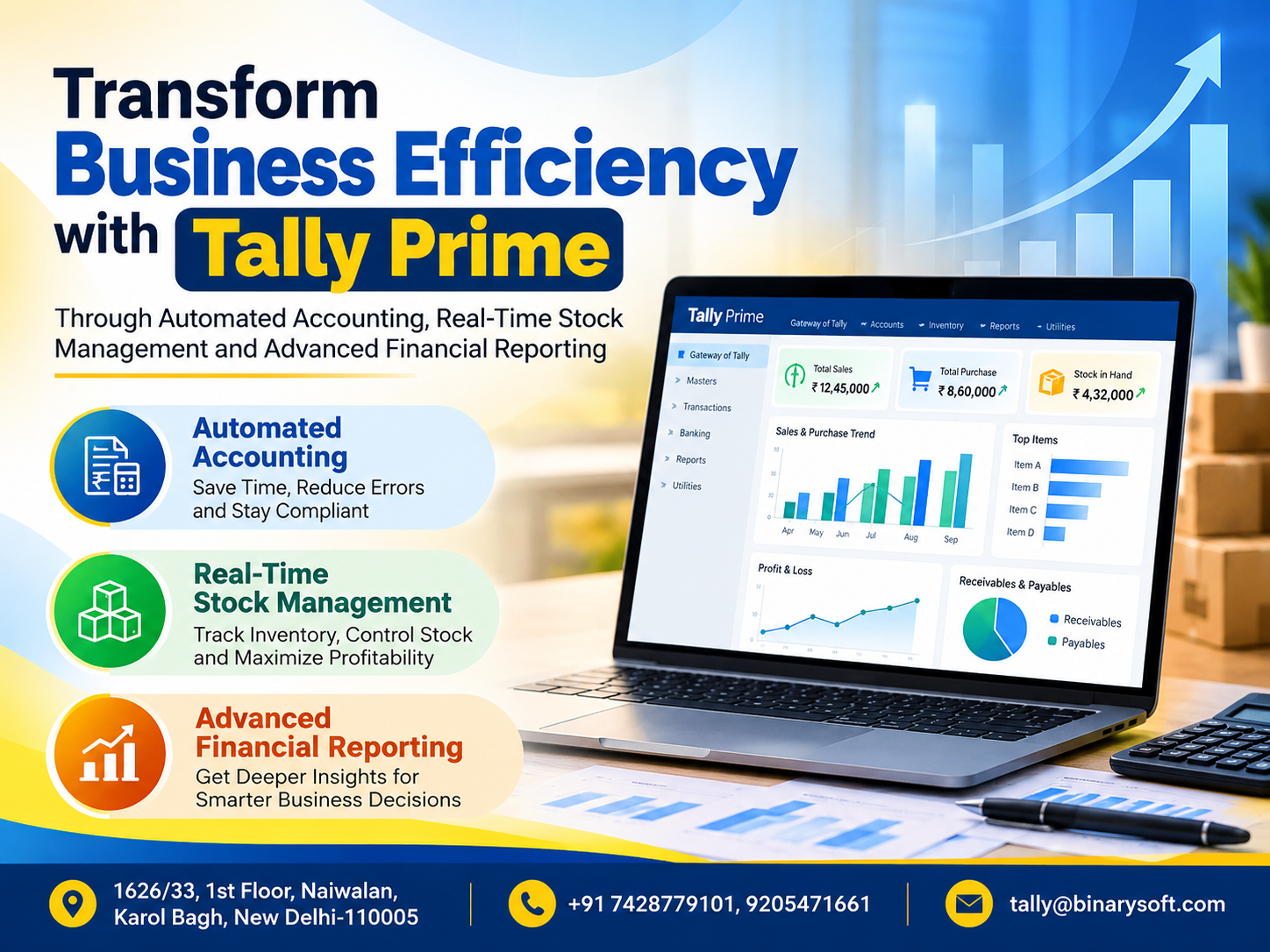
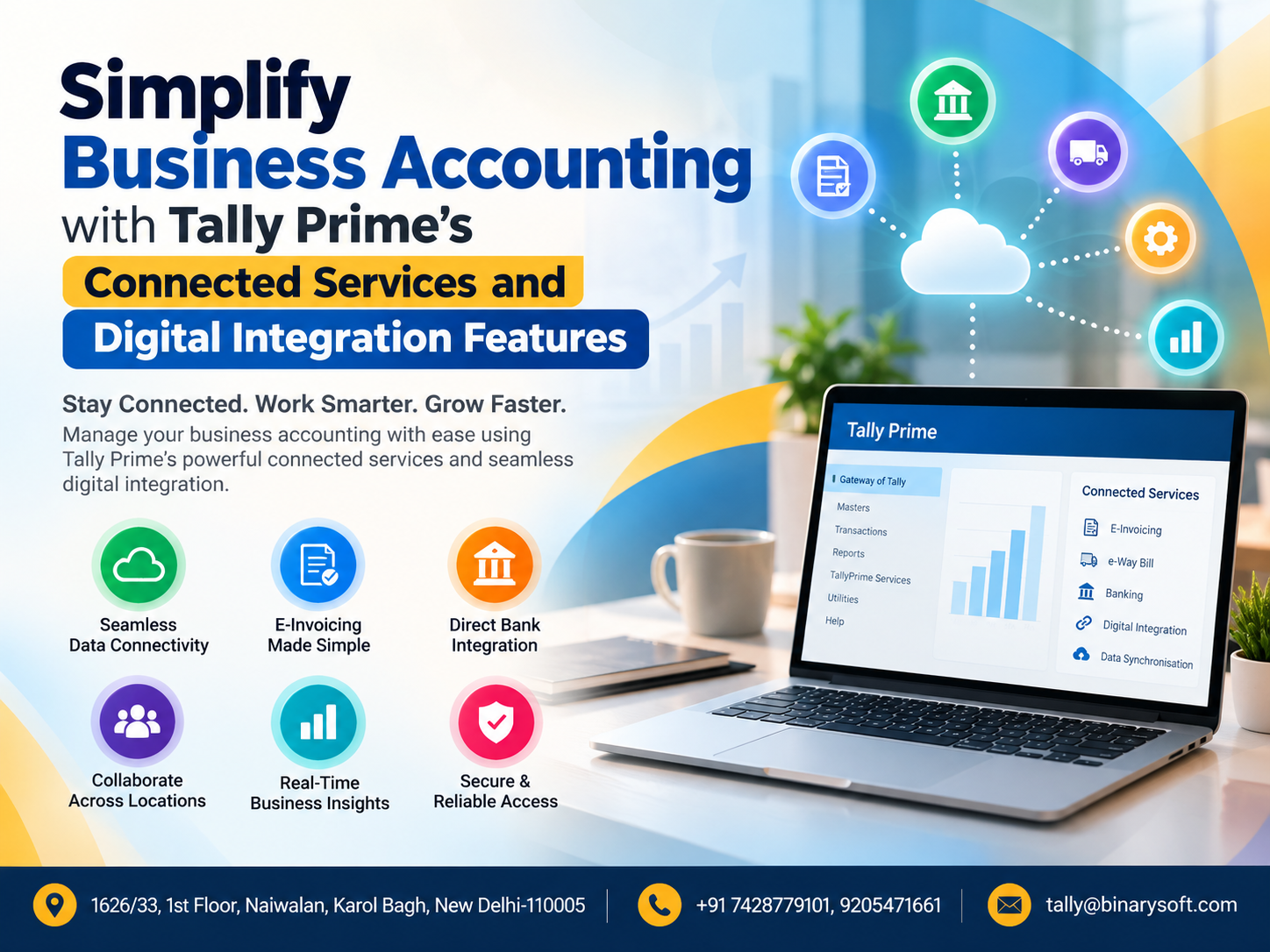
Tally Prime’s connected services and digital integration capabilities help businesses bring important accounting activities into a more organized and efficient workflow.
From GST-related activities and banking reconciliation to digital document sharing and financial reporting, Tally Prime helps businesses reduce repetitive tasks and improve accounting accuracy.
For small businesses, retailers, distributors, manufacturers and professional service providers, connected accounting can make daily operations easier while supporting better financial control.
The real advantage is not simply faster accounting. It is the confidence that comes from having reliable business information available when important decisions must be made.
1. The Emotional Story: When Accounting Pressure Almost Destroyed a Family Business
For nearly fifteen years, Rajesh had managed a wholesale electrical goods business in Delhi.
His father had started the business with limited savings, and Rajesh had worked tirelessly to expand it. Over time, the company developed relationships with contractors, retailers and distributors across the city.
But as the business grew, its accounting became increasingly complicated.
Sales invoices were prepared throughout the day. Customer payments arrived through different banking channels. Purchase information was maintained separately, while GST-related activities required additional verification.
Every evening, Rajesh stayed at the office to review outstanding payments and reconcile financial records.
His family often waited for him at dinner.
One evening, his daughter asked, “Papa, why are you always working even after the shop closes?”
Rajesh smiled, but he had no answer.
A few days later, a major customer complained about an incorrect outstanding balance. Rajesh discovered that a payment had been received but not properly adjusted against the customer's invoice.
The mistake created confusion and temporarily affected an important business relationship.
That incident became a turning point.
Rajesh decided to reorganize his accounting operations using Tally Prime and a more connected digital workflow.
His accountant began maintaining customer-wise outstanding balances, using bank reconciliation features, reviewing GST information and sharing invoices digitally.
Gradually, repetitive work decreased.
Instead of searching through multiple spreadsheets, Rajesh could review important financial reports directly.
The biggest change was not technological.
It was personal.
One evening, he closed his office on time and reached home before dinner.
His daughter was surprised.
Rajesh realized that better accounting was not only helping his business. It was giving him more time for the people who mattered most.
This fictional but realistic story reflects the pressures experienced by many Indian entrepreneurs who need better control over increasingly complex business operations.
2. What Are Connected Services in Tally Prime?
Connected services are capabilities that help accounting software interact with supported external systems, online services and digital business processes.
Rather than handling every activity independently, businesses can use connected features to simplify selected operations.
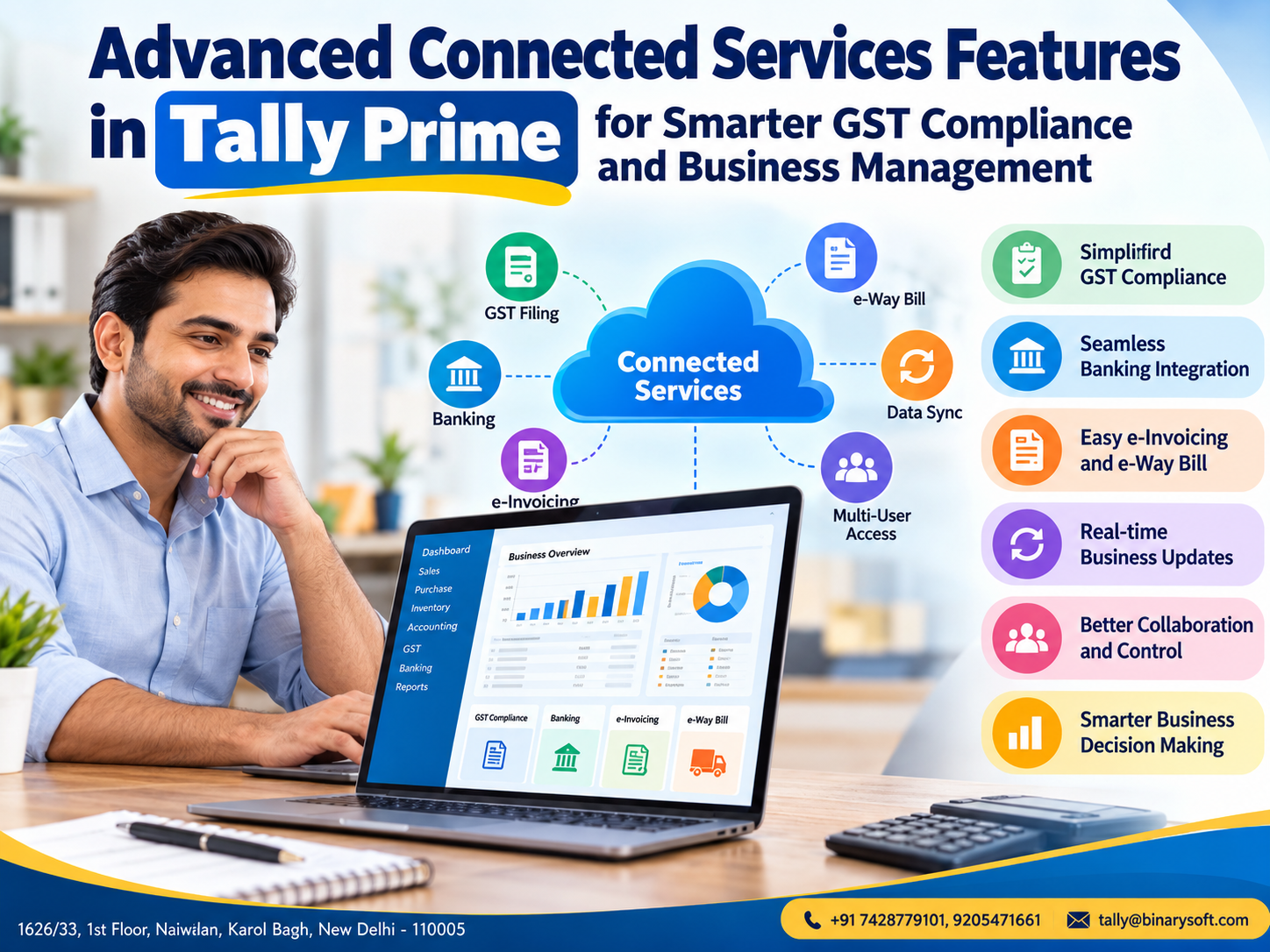
Tally Prime supports several useful connected and digital workflows, including:
-
Connected GST-related activities and return preparation.
-
Banking integration and bank reconciliation.
-
Digital invoice and document sharing.
-
E-invoicing and e-Way Bill workflows for eligible businesses.
-
Data exchange through supported import and export facilities.
-
Remote access and connected business reporting.
-
Integration with supported applications and business systems.
-
Online software services and license management.
The availability of individual features depends on the Tally Prime release, active subscriptions, service configuration, user permissions and applicable statutory requirements.
The purpose of connected accounting is to reduce unnecessary manual intervention while maintaining reliable financial records.
When properly configured, these capabilities help businesses build a more efficient accounting environment.
3. Simplify GST Compliance with Connected GST Features
GST compliance is an important responsibility for registered Indian businesses.
Organizations must maintain accurate transaction records, verify tax information, reconcile purchase details and prepare applicable GST returns.
When these activities are performed manually, businesses may face delays, mismatches and unnecessary accounting pressure.
How Tally Prime Helps
Tally Prime provides GST-related features that can simplify compliance activities.
Businesses can use supported functionality to:
-
Maintain GST-compliant sales and purchase records.
-
Configure applicable GST rates and tax classifications.
-
Validate GST-related transaction information.
-
Prepare GST reports and return data.
-
Review differences between accounting records and available GST information.
-
Use supported connected services for GST data retrieval and filing workflows.
-
Identify transactions requiring correction before return submission.
Practical Example
Consider a trading company that processes hundreds of purchase invoices every month.
Previously, its accountant manually compared purchase records with GST information.
This required significant time and increased the possibility of overlooking mismatches.
With an organized Tally Prime workflow, the accountant can review purchase transactions, compare relevant GST data where supported and investigate differences more efficiently.
The result is improved visibility and better preparation for GST compliance.
Important: Connected GST features assist with compliance, but businesses should still verify return information, eligibility for input tax credit and applicable statutory requirements before filing.
4. Improve Banking Efficiency Through Digital Integration
Banking is one of the most time-consuming areas of business accounting.
Companies receive payments through bank transfers, cheques and digital payment channels while making payments to suppliers, employees and service providers.
Matching these transactions with accounting records can become difficult when volumes increase.
Banking Features in Tally Prime
Tally Prime offers banking capabilities that help businesses maintain accurate financial records.
Depending on the supported bank and software configuration, businesses can use features such as:
Bank Reconciliation: Compare recorded transactions with bank statement information and identify unreconciled entries.
Bank Statement Import: Import supported bank statement formats to simplify transaction matching and reconciliation.
Payment Management: Record supplier payments and maintain an organized payment history.
Bank Ledger Reporting: Review bank balances, receipts and payments through accounting reports.
Cash Flow Visibility: Understand expected receipts and payment obligations using relevant financial information.
Business Benefits
Connected banking workflows help reduce manual checking, improve transaction visibility and identify differences earlier.
For businesses managing multiple bank accounts, these improvements can save valuable accounting time.
However, the exact level of banking connectivity varies by bank and available Tally Prime functionality.
5. Make Digital Invoicing Faster and More Professional
Invoices are more than payment requests.
They represent a company's professionalism, accuracy and customer experience.
Incorrect invoices can delay payments, create disputes and damage customer confidence.
Tally Prime helps businesses prepare structured invoices using information already maintained in their accounting system.
Important Invoicing Capabilities
Businesses can:
-
Create sales invoices using customer and item details.
-
Apply configured GST rates and applicable tax information.
-
Maintain invoice numbering.
-
Record discounts and additional charges.
-
Customize invoice formats within supported capabilities.
-
Generate digital invoice documents.
-
Share invoices through supported communication workflows.
-
Track customer balances and outstanding amounts.
Digital Invoice Sharing
Digital sharing helps businesses communicate transaction information more quickly.
Instead of printing every invoice, businesses can generate electronic copies and share them with customers.
Supported email and messaging integrations may further simplify document distribution.
For organizations processing large invoice volumes, this can reduce paperwork and administrative effort.
E-Invoicing Integration
Eligible businesses can use supported Tally Prime e-invoicing functionality to assist with generating and managing required e-invoice information.
This helps maintain a more structured connection between accounting records and applicable e-invoicing processes.
Businesses must verify their statutory eligibility and requirements independently.
6. Connect Accounting with Inventory Management
Accounting and inventory are closely connected.
A business may report strong sales but still experience financial difficulties because of excess stock, unavailable products or poor purchasing decisions.
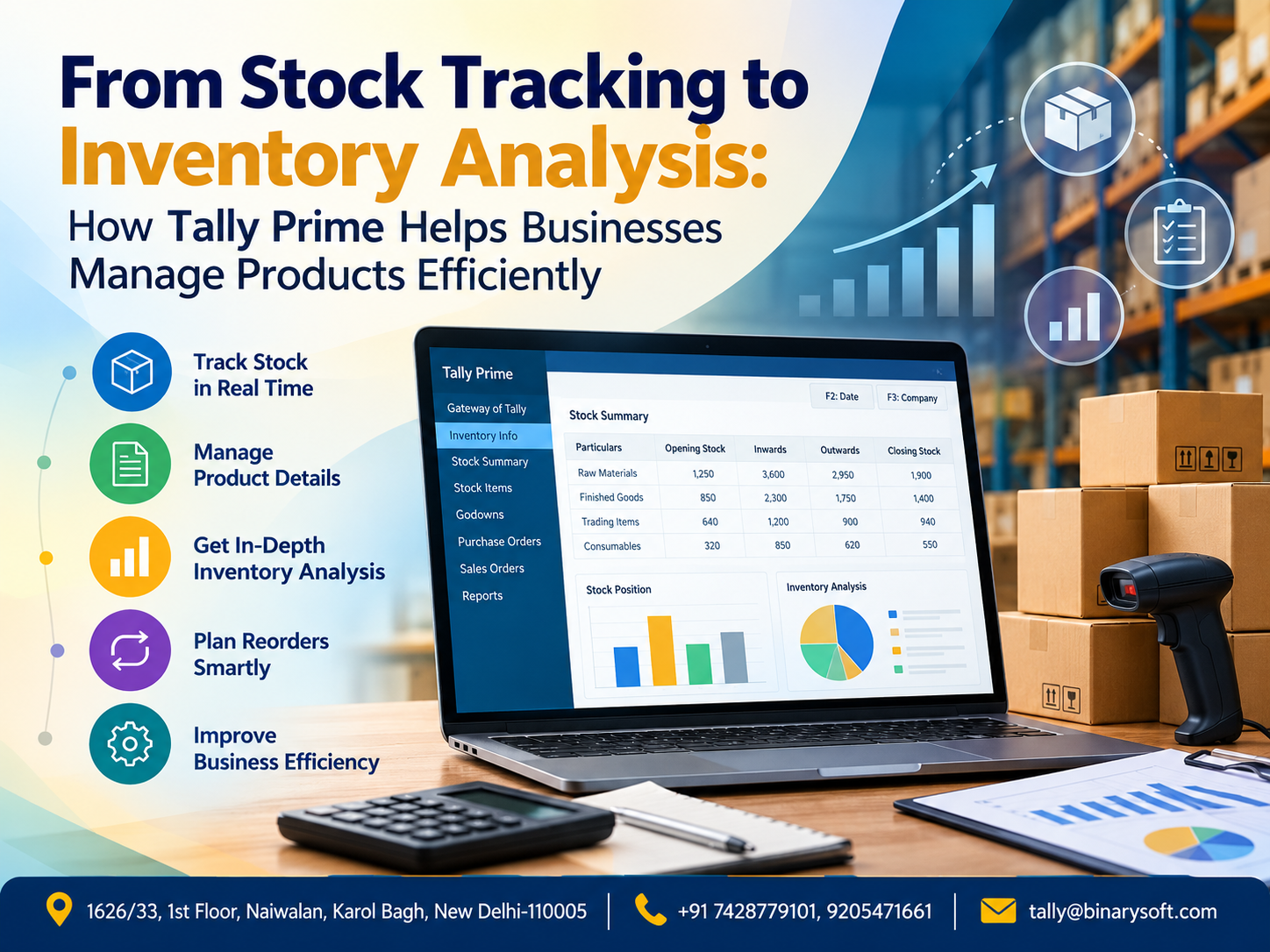
Tally Prime combines accounting and inventory information within the same business environment.
How This Helps
Businesses can maintain:
-
Stock item masters.
-
Stock groups and categories.
-
Units of measurement.
-
Godown or location-wise inventory.
-
Purchase and sales transactions.
-
Stock movement reports.
-
Inventory valuation.
-
Item-wise profitability information.
Example
A hardware distributor receives an urgent order for 200 units of a particular product.
Without reliable inventory information, the sales team may confirm the order before checking stock availability.
This creates delivery problems and customer dissatisfaction.
With properly maintained inventory records in Tally Prime, the team can review available stock before committing to delivery.
The business can also identify slow-moving items and plan future purchases more carefully.
Connecting inventory information with accounting records helps businesses improve operational control and reduce avoidable financial surprises.
7. Case Study One: How a Wholesale Distributor Improved Accounting Accuracy
Business Background
A medium-sized electrical goods distributor in Delhi handled approximately 450 sales invoices every month.
The company supplied products to retailers, contractors and commercial establishments.
Its accounting team relied heavily on spreadsheets for bank reconciliation and customer payment tracking.
Challenges
The company experienced several operational difficulties:
-
Delays in updating customer payments.
-
Differences between bank records and accounting entries.
-
Time-consuming GST-related verification.
-
Difficulty identifying overdue invoices.
-
Excessive manual reporting.
The business owner often required additional explanations before making financial decisions.
Solution Implemented
The company reorganized its accounting processes using Tally Prime.
Its team introduced standardized customer ledgers, bill-wise accounting, regular bank reconciliation and systematic GST reporting.
Employees also began generating digital invoices and reviewing outstanding reports more frequently.
Illustrative Results
In this hypothetical case, after three months of disciplined implementation:
-
Monthly reconciliation effort decreased from approximately 18 hours to 7 hours.
-
Customer payment disputes became less frequent.
-
Outstanding invoices were identified earlier.
-
Financial reporting became more consistent.
-
The owner gained better visibility into working capital.
These figures are illustrative and are not verified customer performance results.
Key Learning
The improvement came from combining accounting software capabilities with better internal processes.
Technology became effective because the company maintained accurate records and followed consistent accounting practices.
8. Case Study Two: Digital Integration for a Growing Manufacturing Business
Business Background
A small manufacturing company in Faridabad produced packaging materials for industrial customers.
The organization purchased raw materials, maintained production records, generated sales invoices and managed supplier payments.
As orders increased, the company struggled to coordinate accounting and inventory activities.
Major Problems
Its management faced difficulties understanding actual material consumption, pending supplier payments and product profitability.
The accounting team also spent considerable time preparing financial reports.
Different departments maintained separate spreadsheets, creating inconsistencies.
Digital Accounting Transformation
The company introduced a structured Tally Prime workflow.
The implementation focused on:
-
Centralized accounting records.
-
Raw material and finished goods inventory.
-
Purchase and sales tracking.
-
Supplier outstanding reports.
-
Bank reconciliation.
-
GST-related reporting.
-
Cost analysis and financial statements.
Where appropriate, production-related inventory records were also configured to support material consumption tracking.
Illustrative Business Outcomes
After adopting consistent accounting procedures, the fictional company experienced improved reporting discipline.
Management could identify high-value inventory items, review supplier liabilities and understand operational costs more clearly.
The accounting team spent less time combining spreadsheet information.
The company also improved coordination between its purchasing, production and finance functions.
Key Learning
Digital integration is most valuable when business processes work together.
A connected accounting environment helps management understand the financial impact of operational decisions.
9. Use Tally Prime for Better Credit and Cash Flow Management
Sales growth does not automatically guarantee financial stability.
A company may generate substantial revenue while struggling to pay suppliers because customers delay payments.
This makes credit management essential.
Tally Prime helps businesses monitor receivables and payables through accounting reports.
Important Features
Bill-Wise Outstanding Tracking: Maintain invoice-level details of customer and supplier balances.
Receivables Reports: Identify customers with pending payments.
Payables Reports: Review upcoming supplier obligations.
Ageing Analysis: Understand how long invoices have remained outstanding.
Cash Flow Reports: Examine cash inflows and outflows.
Credit Period Management: Maintain agreed payment terms and review overdue balances.
Practical Application
Suppose a business has ₹25 lakh in outstanding customer invoices.
Without proper ageing information, the owner may not know which customers require immediate follow-up.
By reviewing receivables reports, the business can prioritize overdue accounts and improve collection planning.
This helps reduce uncertainty and supports better working capital decisions.
10. Access Business Information Beyond the Office
Modern businesses increasingly operate across multiple locations.
Owners may need to review reports while travelling, meeting customers or working away from their main office.
Tally Prime supports remote and connected access capabilities that can help authorized users review relevant business information.
Depending on configuration, licensing and service availability, businesses may use supported remote access facilities or authorized hosting arrangements.
Benefits of Remote Accounting Access
Remote access can help businesses:
-
Review important financial information.
-
Monitor customer outstanding balances.
-
Check sales and purchase reports.
-
Coordinate with authorized accountants.
-
Support multi-location business operations.
-
Reduce dependence on a single physical office.
Tally Prime on Cloud
Businesses seeking broader location flexibility may consider running Tally Prime through a suitable cloud-hosted environment.
A properly configured cloud setup can provide authorized access to the accounting application from supported locations and devices.
Cloud hosting is a separate deployment arrangement and should not be confused with every built-in connected service.
Security, backup policies, hosting reliability and access permissions must be evaluated before implementation.
11. Simplify Multi-Branch Accounting with Data Synchronization
Businesses operating across multiple branches often face challenges in consolidating financial information.
Each location may maintain separate sales, purchase and inventory records.
Tally Prime supports data synchronization capabilities that help exchange information between configured business locations.
Benefits of Synchronization
Businesses can consolidate selected accounting information, improve reporting consistency and reduce repetitive data transfers.
For example, a distributor operating in Delhi, Jaipur and Chandigarh can establish a structured process for exchanging branch information with its head office.
Management can then review consolidated information for better business planning.
Synchronization requires appropriate configuration, compatible company structures and suitable controls to prevent duplicate or inconsistent transactions.
12. Reduce Manual Work with Digital Automation
Manual data entry consumes valuable time.
It can also introduce mistakes when information is copied repeatedly between documents and accounting systems.
Tally Prime offers import capabilities and supported digital automation features that help simplify selected accounting tasks.
Practical Applications
Businesses can import supported transaction information, exchange data with compatible applications and use configured integrations to reduce repetitive activities.
Supported document-processing capabilities may also help convert information from invoices and other documents into accounting-ready entries.
However, automatically prepared transactions should always be reviewed before acceptance.
Why Automation Matters
Automation helps accountants focus more attention on financial analysis, exception handling and business planning.
Instead of spending the entire day entering transactions, accounting professionals can dedicate more time to reviewing the accuracy and financial implications of business records.
13. How to Start Using Tally Prime Connected Services
Businesses can implement connected accounting through a structured process.
Step 1: Review Existing Accounting Processes
Identify activities involving repeated data entry, delayed reconciliation or unnecessary manual reporting.
Step 2: Update Tally Prime
Install a suitable supported release and verify the availability of required features and subscriptions.
Step 3: Configure Company Information
Review company details, GST registrations, banking ledgers, customer records and accounting settings.
Step 4: Enable Relevant Connected Services
Configure the required GST, banking, remote access or digital communication facilities.
For Connected GST, authorized users may need to enable API access through the GST portal and configure the relevant GST credentials.
Step 5: Establish User Permissions
Provide employees with access appropriate to their responsibilities.
Step 6: Test Digital Workflows
Verify sample invoices, reconciliation results, data imports and applicable online services before wider implementation.
Step 7: Train Employees
Ensure accountants and other authorized employees understand the configured processes.
Step 8: Monitor Performance
Regularly review errors, outstanding balances, reconciliation status and financial reports.
A phased implementation usually makes it easier to identify problems and maintain business continuity.
14. Protect Financial Information with Better Security Practices
Digital connectivity makes accounting more convenient, but financial information must remain protected.
Businesses should establish appropriate safeguards before enabling remote access or external integrations.
Important practices include maintaining strong passwords, restricting administrative access, reviewing user permissions and keeping software updated.
Regular backups are equally important.
Organizations should also test their recovery procedures and maintain suitable protection against unauthorized access.
Where supported, secure cloud backup services can provide an additional option for protecting accounting records.
Connected accounting works best when convenience is supported by reliable security and disciplined financial controls.
15. Why Connected Accounting Is Important for Business Growth
Connected accounting provides benefits beyond reducing paperwork.
It helps business owners understand their financial position more clearly.
Accurate reports support better decisions about purchasing, customer credit, supplier payments and operational expansion.
Digital invoicing can improve customer communication, while regular reconciliation helps maintain confidence in financial records.
For growing businesses, connected workflows can also reduce dependence on isolated spreadsheets and individual employees.
Most importantly, reliable accounting information helps management respond to problems before they become serious.
The future of business accounting is not simply about recording transactions faster.
It is about making financial information more accessible, useful and dependable.
Conclusion: Build a Smarter Business with Tally Prime Connected Services
Business accounting is becoming increasingly digital, connected and information-driven.
Organizations that continue relying entirely on disconnected processes may experience unnecessary delays, repeated work and limited financial visibility.
Tally Prime’s connected services and digital integration features provide practical ways to simplify accounting, GST-related activities, banking, invoicing, inventory management and financial reporting.
Whether a business operates from one location or manages several branches, connected accounting can support greater efficiency and improved financial control.
Successful implementation requires accurate data, suitable configuration, employee training and regular review.
For Indian businesses preparing for future growth, investing in organized digital accounting processes can create lasting operational advantages.
Get Professional Tally Prime Assistance
Powered by Binarysoft Technologies
Authorized Tally Partner
Location: 1626/33, 1st Floor, Naiwalan, Karol Bagh, New Delhi – 110005, INDIA
Contact us: +91 7428779101, 9205471661
Email us: tally@binarysoft.com
Business Hours: 10:00 AM – 6:00 PM, Monday to Friday
Binarysoft Technologies assists businesses with Tally Prime implementation, configuration, training, accounting workflow improvements and related technical support.
Frequently Asked Questions
What are connected services in Tally Prime?
Connected services are features that help businesses access supported online facilities, exchange information and simplify activities such as GST compliance, banking, digital communication and remote reporting.
How does Tally Prime simplify GST compliance?
Tally Prime helps maintain GST-related transaction records, prepare reports, identify inconsistencies and use supported connected GST workflows for reconciliation and return-related activities.
Can Tally Prime connect with bank accounts?
Yes. Supported Connected Banking functionality allows eligible users to access selected banking services within Tally Prime. Availability depends on the bank, account type, software release and required configuration.
Can businesses generate e-invoices using Tally Prime?
Yes. Eligible businesses can use supported e-invoicing features to generate and manage e-invoice information in accordance with applicable GST requirements.
CA. Advait Chitale advises businesses on taxation, audit, and financial controls. He is passionate about helping organizations adopt technology-driven accounting solutions that enhance productivity and ensure regulatory compliance.