Call CA Tally HelpDesk
+91 9205471661,
7428779101
Improve Stock Accuracy, Reduce Inventory Costs, Prevent Shortages and Strengthen Business Profitability with TallyPrime
Inventory is one of the most valuable assets of any business. Whether you operate a retail store, wholesale distribution company, manufacturing unit, automobile spare parts business or trading enterprise, maintaining accurate stock records is essential for smooth operations and financial stability.
Every product stored in a warehouse represents money invested by the business. When inventory is poorly managed, companies may experience unnecessary purchases, stock shortages, damaged goods, delayed deliveries and reduced profitability.
Many business owners face a common problem: their sales are increasing, but their cash flow remains under pressure.
The reason is often hidden in inventory.
Excess stock blocks working capital, while insufficient stock results in missed sales opportunities. Manual stock registers and disconnected spreadsheets make it difficult to maintain accurate information.
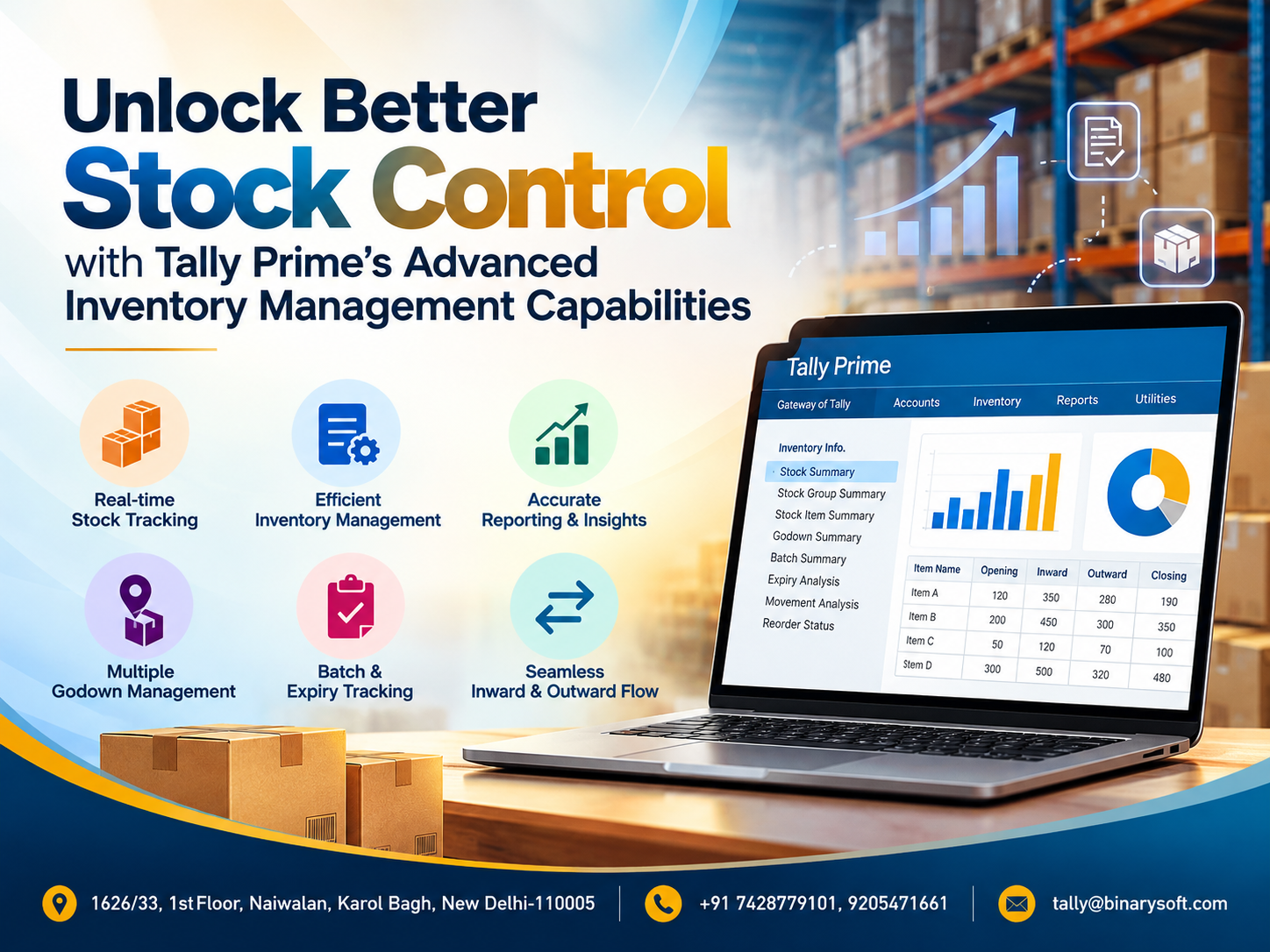
TallyPrime's advanced inventory management capabilities help businesses organize stock records, monitor inventory movements, manage multiple locations and connect inventory transactions with accounting.
With appropriate configuration and disciplined stock recording, businesses can gain better visibility into available quantities, inventory values, purchase requirements and product performance.
This comprehensive guide explains how TallyPrime supports inventory management, improves stock control and helps businesses make informed purchasing and selling decisions.
It also includes a relatable business story, two illustrative case studies and practical recommendations for improving inventory efficiency.
1. The Story of a Business Owner Who Lost Customers Despite Having a Full Warehouse
When Inventory Became a Financial Burden
For twelve years, Amit had operated a successful electrical goods distribution business in Delhi.
He started with a small shop and gradually expanded into wholesale distribution.
His warehouse was filled with electrical switches, cables, LED lights, fans and other products.
From the outside, his business appeared successful.
Customers visited regularly, suppliers offered credit facilities, and monthly sales were growing.
However, Amit was facing an unexpected financial crisis.
One afternoon, a long-standing customer requested 200 units of a popular electrical switch.
Amit confidently accepted the order because his stock register showed 350 units available.
But when his warehouse employee checked the shelves, only 80 units were found.
The remaining quantity had already been sold, transferred or incorrectly recorded.
The customer cancelled the order and purchased from another distributor.
That evening, Amit sat alone in his office, reviewing unpaid supplier invoices.
He had invested lakhs of rupees in inventory, yet he could not fulfil an important customer order.
Meanwhile, several slow-moving products had remained unsold for months.
His warehouse was full, but his business was struggling.
The Decision That Changed His Inventory Management
Amit realized that the problem was not insufficient stock.
It was insufficient control over stock.
He decided to organize his inventory records using TallyPrime.
His accountant created structured stock groups, product masters, units of measurement and separate warehouse locations.
Purchase and sales transactions were recorded consistently, while stock movements were documented through appropriate inventory vouchers.
Amit began reviewing stock summaries, product movement and inventory valuation regularly.
Gradually, he gained a clearer understanding of which products were selling quickly and which were blocking working capital.
He could make purchasing decisions based on recorded inventory information instead of assumptions.
Most importantly, he regained confidence when promising deliveries to customers.
The lesson was simple: business growth depends not only on how much inventory you own, but also on how effectively you manage it.
This is an illustrative story inspired by common inventory challenges faced by Indian businesses.
2. What Is Inventory Management and Why Is It Important?
Inventory management is the process of recording, monitoring, organizing and controlling goods throughout their business lifecycle.
It includes purchasing products, receiving materials, storing goods, transferring inventory, recording sales and monitoring remaining stock.
Effective inventory management helps businesses maintain sufficient products to meet demand without investing unnecessarily in excess stock.
Common Inventory Management Challenges
Businesses frequently experience:
-
Differences between physical stock and accounting records.
-
Excessive investment in slow-moving products.
-
Unexpected shortages of popular items.
-
Difficulty managing multiple warehouses.
-
Incorrect stock valuation.
-
Delayed purchase planning.
-
Poor visibility into product profitability.
-
Inaccurate recording of damaged or returned goods.
These problems can directly affect customer satisfaction, operating expenses and cash flow.
An organized inventory system helps management identify potential issues before they become expensive.
3. How TallyPrime Helps Businesses Manage Inventory
TallyPrime combines accounting and inventory management capabilities within a business management application.
This integration helps businesses record inventory-related financial transactions without maintaining completely separate accounting and stock systems.
For example, when a business records a properly configured purchase invoice, the transaction can update both inventory quantities and the relevant accounting records.
Similarly, sales transactions can affect stock balances and financial ledgers.
Major Inventory Management Capabilities
TallyPrime supports:
-
Stock groups and stock categories.
-
Stock items and units of measurement.
-
Multiple godowns or storage locations.
-
Batch-wise inventory tracking.
-
Purchase and sales inventory vouchers.
-
Stock transfers and adjustments.
-
Inventory valuation.
-
Reorder level management.
-
Manufacturing and consumption records.
-
Inventory reports and stock analysis.
These capabilities can be configured according to the size and operational requirements of the business.
4. Organize Products with Stock Groups and Categories
A growing business may manage hundreds or thousands of products.
Without proper classification, identifying products and analyzing stock becomes difficult.
Stock Groups
TallyPrime allows businesses to organize similar products under stock groups.
For example, an electrical distributor may create:
Electrical Products
-
LED Lights
-
Electrical Switches
-
Cables and Wires
-
Ceiling Fans
This structure makes inventory information easier to review.
Stock Categories
Stock categories provide an additional method of classifying products across different stock groups.
For example, products may be categorized according to brand, material type or another business requirement.
Stock Item Masters
Each product can have its own stock item master containing relevant information such as product name, unit of measurement and applicable inventory details.
A well-designed inventory structure reduces confusion and improves reporting accuracy.
Businesses should establish consistent product naming conventions before creating large numbers of stock items.
5. Manage Multiple Warehouses and Business Locations
Many businesses maintain inventory at several locations.
A wholesale company may operate a central warehouse, regional distribution centres and retail outlets.
Without location-wise stock records, management may struggle to identify where products are available.
Godown Management in TallyPrime
TallyPrime supports multiple godowns for tracking stock at different locations.
For example:
| Location | Inventory Purpose |
|---|
| Main Warehouse |
Bulk inventory storage |
| Retail Store |
Customer sales |
| Distribution Centre |
Regional order fulfilment |
| Service Centre |
Spare parts inventory |
Businesses can record transfers between godowns using appropriate inventory vouchers.
This helps maintain visibility into stock movement.
Business Benefits
Location-wise inventory tracking can reduce unnecessary purchases and improve coordination between warehouses.
For example, if one branch has excess stock while another faces a shortage, management can consider transferring available inventory instead of purchasing additional goods.
Accurate location-wise reporting depends on recording transfers and receipts promptly.
6. Batch-Wise Inventory Tracking for Better Product Control
Batch tracking is particularly useful for businesses dealing with pharmaceuticals, packaged foods, cosmetics, chemicals and other products requiring batch identification.
TallyPrime supports batch-wise inventory records.
Businesses can maintain relevant batch details and track stock quantities associated with individual batches.
Why Batch Tracking Matters
Batch-wise records help businesses identify products belonging to specific purchase or production batches.
They can also support expiry-related monitoring where applicable.
For example, a food distributor may receive the same product in several batches with different expiry dates.
Proper batch recording makes it easier to identify stock requiring attention.
However, businesses must establish suitable procedures for physical stock rotation and expiry checks.
Batch tracking alone does not guarantee that products will be dispatched in the correct order.
7. Improve Purchase Planning with Reorder Levels
Purchasing decisions have a direct impact on inventory investment.
Ordering too much stock increases storage costs and blocks working capital.
Ordering too little creates shortages and may delay customer deliveries.
How Reorder Levels Help
TallyPrime supports reorder level and minimum order quantity information for inventory planning.
Businesses can use these details to identify products that may require replenishment.
Practical Example
A hardware distributor sells approximately 300 units of a popular product every month.
The supplier generally requires ten days for delivery.
Management can establish a suitable reorder level based on expected demand, delivery time and desired safety stock.
When inventory approaches that level, the purchasing team can review replenishment requirements.
Benefits
Reorder planning helps businesses:
-
Reduce unexpected stock shortages.
-
Improve purchasing discipline.
-
Maintain suitable stock availability.
-
Avoid unnecessary emergency purchases.
-
Use working capital more efficiently.
Reorder levels should be reviewed periodically because demand and supplier lead times can change.
8. Manufacturing Inventory Management with TallyPrime
Manufacturing businesses require more detailed inventory control because raw materials are converted into finished products.
TallyPrime supports manufacturing-related inventory processes through Bills of Materials, Stock Journals and Manufacturing Journals.
Bill of Materials (BOM)
A Bill of Materials defines the components and quantities required to manufacture a finished product.
For example, a furniture manufacturer may require wooden panels, screws, hinges and handles to produce a cabinet.
By maintaining a BOM, the business can establish standard material requirements.
Manufacturing Journal
Manufacturing Journals help record raw material consumption and finished goods production.
They can also account for relevant production costs, by-products and scrap.
Benefits for Manufacturers
These capabilities help businesses monitor material consumption, maintain finished goods records and understand production costs.
Accurate manufacturing records can also support pricing decisions and profitability analysis.
9. Stock Valuation and Financial Accuracy
Inventory valuation influences financial reporting and business profitability.
Incorrect valuation can distort closing stock figures, cost of goods sold and reported profits.
TallyPrime supports different inventory valuation methods, including FIFO and average-cost approaches.
Businesses should select an appropriate method based on their accounting requirements and apply it consistently.
Why Accurate Valuation Matters
Reliable stock valuation helps businesses understand the financial value of goods held in warehouses.
It also supports more meaningful gross profit analysis.
For example, purchasing costs may increase significantly during the year.
An appropriate valuation method helps determine how those costs are reflected in inventory records and financial statements.
Businesses should review valuation policies with their accountants to ensure compliance with applicable accounting standards.
10. Identify Slow-Moving and Non-Moving Stock
Slow-moving inventory is a common reason businesses experience cash flow problems.
Products may remain unsold because customer preferences change, newer models become available or purchasing quantities exceed actual demand.
Inventory Movement Analysis
TallyPrime provides inventory reports that help businesses analyze stock movement.
Management can review which products experience regular transactions and which remain inactive.
Stock Ageing Analysis
Stock ageing information helps identify inventory that has remained in stock for extended periods.
Businesses can use this information to consider discounts, promotional campaigns, supplier returns or purchasing adjustments.
For example, an automobile spare parts distributor may discover that older vehicle components have remained unsold for several months.
Instead of continuing to purchase those items, management can review demand and reduce future orders.
Effective inventory control means investing in products customers actually need, rather than simply maintaining large quantities of stock.
11. Maintain Stock Accuracy with Physical Verification
Even well-managed businesses experience inventory differences.
These may result from damaged goods, incorrect entries, unrecorded transfers, theft or counting errors.
Regular physical stock verification helps identify discrepancies.
Physical Stock Vouchers
TallyPrime supports Physical Stock vouchers for recording verified stock quantities.
Businesses can compare actual quantities with system records and make appropriate adjustments.
Recommended Verification Practices
High-value products should be counted more frequently.
Fast-moving inventory may require regular cycle counts.
Damaged and returned products should be identified separately.
Stock adjustments should be reviewed and authorized by responsible personnel.
These practices help improve the reliability of inventory reports.
12. Case Study 1: Wholesale Distributor Improves Stock Availability
Business Background
A wholesale electrical goods distributor in Delhi managed more than 1,500 products.
The company supplied electrical accessories to retailers and contractors.
Its inventory records were maintained through spreadsheets and manual registers.
Business Challenges
The company frequently experienced shortages of popular products while maintaining excessive quantities of slow-moving items.
Warehouse employees struggled to identify available stock accurately.
Purchase decisions were often based on estimates rather than actual inventory requirements.
Solution Implemented
The company organized its inventory using TallyPrime.
Stock groups were created for different product categories.
Separate godowns were configured for bulk storage and dispatch operations.
Reorder levels were established for selected fast-moving products.
Management began reviewing Stock Summary and Movement Analysis reports regularly.
Business Results
The improved system helped employees identify stock availability more efficiently.
Purchasing decisions became more structured.
Management gained better visibility into slow-moving inventory and could review unnecessary purchases.
The company also established regular physical verification procedures.
Key Learning: Accurate inventory records and disciplined purchasing can improve customer service while reducing unnecessary stock investment.
This is an illustrative case study showing how a wholesale business could use TallyPrime.
13. Case Study 2: Manufacturing Company Strengthens Raw Material Control
Business Background
A small furniture manufacturing company produced office desks, cabinets and storage units.
The business purchased wood, metal fittings, adhesives and packaging materials from several suppliers.
Major Challenges
Raw material consumption was recorded manually.
Management struggled to estimate production costs accurately.
Unexpected material shortages occasionally delayed customer orders.
The company also had limited visibility into unused materials and production wastage.
Solution Implemented
The manufacturer introduced structured inventory accounting in TallyPrime.
Bills of Materials were prepared for standard products.
Manufacturing Journals were used to record material consumption and finished goods production.
Separate inventory locations were maintained for raw materials and finished goods.
Regular stock verification was introduced.
Business Results
The company gained better visibility into material requirements and consumption.
Production planning became more organized.
Management could investigate unusual material usage and review product costs more effectively.
The improved records also supported more informed purchasing and selling decisions.
Key Learning: Connecting raw material records with manufacturing transactions helps businesses understand production costs and improve inventory discipline.
This case study is illustrative and does not represent a verified customer engagement.
14. Improve Cash Flow Through Better Inventory Control
Inventory management and cash flow are closely connected.
Every unnecessary purchase reduces the cash available for other business expenses.
Excessive inventory may create financial pressure even when sales are growing.
Reduce Unnecessary Purchases
Inventory reports help businesses identify products already available in sufficient quantities.
Improve Working Capital Utilization
Reducing slow-moving stock can release funds for faster-selling products and essential operating expenses.
Prevent Lost Sales
Maintaining appropriate reorder levels can reduce avoidable shortages.
Strengthen Supplier Planning
Accurate purchasing information helps businesses coordinate orders and payment schedules.
Improve Profitability
Better inventory control can reduce storage costs, wastage and unnecessary stock accumulation.
Businesses should regularly evaluate inventory turnover, stock ageing and purchasing patterns.
15. How to Implement Advanced Inventory Management in TallyPrime
A successful inventory management system requires proper planning.
Step 1: Review Existing Inventory
Identify all products, quantities, storage locations and current stock valuation records.
Step 2: Create Stock Groups
Organize products according to business requirements.
Step 3: Configure Stock Items
Create accurate product masters with appropriate units of measurement.
Step 4: Set Up Godowns
Define warehouses, retail outlets and other inventory locations.
Step 5: Enable Relevant Features
Configure batch tracking, reorder levels and manufacturing-related features where required.
Step 6: Record Transactions Consistently
Ensure purchases, sales, transfers and adjustments are entered promptly.
Step 7: Conduct Physical Verification
Compare actual stock with accounting records and investigate discrepancies.
Step 8: Review Inventory Reports
Analyze stock quantities, valuation, movement and ageing regularly.
Step 9: Train Employees
Provide suitable training to accounting, purchasing and warehouse personnel.
Step 10: Monitor Performance
Establish periodic reviews of stock accuracy, shortages, excess inventory and inventory turnover.
These steps help businesses develop a more reliable inventory management process.
16. Why Choose Binarysoft Technologies for TallyPrime Inventory Management?
Implementing inventory management software involves more than creating product records.
Businesses must understand how inventory transactions affect purchasing, sales, accounting and profitability.
Binarysoft Technologies, an Authorized Tally Partner, provides Tally-related solutions and services for businesses seeking improved accounting and inventory management.
Businesses can discuss requirements such as inventory configuration, stock classification, multiple godowns, batch management and TallyPrime on Cloud.
A suitable implementation approach should consider the company's industry, product range, transaction volume and reporting requirements.
For businesses operating across multiple locations, a properly configured cloud-hosted environment may also improve access to centrally maintained accounting and inventory records.
17. Conclusion: Transform Inventory into a Competitive Business Advantage
Inventory management is not simply about counting products.
It is about maintaining the right goods, in the right quantities, at the right locations, while controlling costs and protecting business profitability.
Poor inventory management can result in lost sales, unnecessary purchases, blocked working capital and dissatisfied customers.
TallyPrime's advanced inventory management capabilities help businesses organize stock records, monitor inventory movements, manage multiple warehouses, track batches, analyze stock ageing and connect inventory transactions with accounting.
Manufacturing businesses can also benefit from Bills of Materials and production-related inventory records.
However, software delivers the greatest value when supported by accurate data entry, regular stock verification and disciplined purchasing practices.
Whether you manage a retail store, wholesale distribution company, manufacturing unit or trading business, improving inventory visibility can support stronger financial decisions and sustainable growth.
Better stock control creates better cash flow, improved customer confidence and a stronger foundation for business success.
Get Started with TallyPrime Inventory Management
Powered by Binarysoft Technologies
Authorized Tally Partner
Location: 1626/33, 1st Floor, Naiwalan, Karol Bagh, New Delhi – 110005, INDIA
Contact Us: +91 7428779101, 9205471661
Email: tally@binarysoft.com
Business Hours: 10:00 AM – 6:00 PM, Monday to Friday
Contact Binarysoft Technologies to discuss TallyPrime inventory management and suitable cloud hosting solutions for your business.
Frequently Asked Questions
What is inventory management in TallyPrime?
Inventory management in TallyPrime involves recording and monitoring stock items, purchases, sales, stock transfers, inventory valuation and related business transactions.
Can TallyPrime manage inventory across multiple warehouses?
Yes. TallyPrime supports multiple godowns, allowing businesses to track inventory quantities and movements across different storage locations.
CA. Yuvan Rajagopal specializes in accounting advisory, statutory compliance, and financial consulting. He writes extensively on business automation, inventory management, and accounting best practices.