Call CA Tally HelpDesk
+91 9205471661,
7428779101
Introduction: Why GST Management Has Become More Important for Indian Businesses
In 2026, managing Goods and Services Tax is no longer simply about calculating tax on sales invoices. Indian businesses must pay closer attention to invoice accuracy, input tax credit eligibility, supplier compliance, electronic reporting and timely return filing. A small mismatch between purchase records and GST portal information can create additional work, delay eligible tax credits and affect working capital.
For retailers, wholesalers, manufacturers, distributors and service providers, these challenges become more complicated as transaction volumes increase. Manual spreadsheets and disconnected accounting records can make GST compliance stressful, particularly near return deadlines.
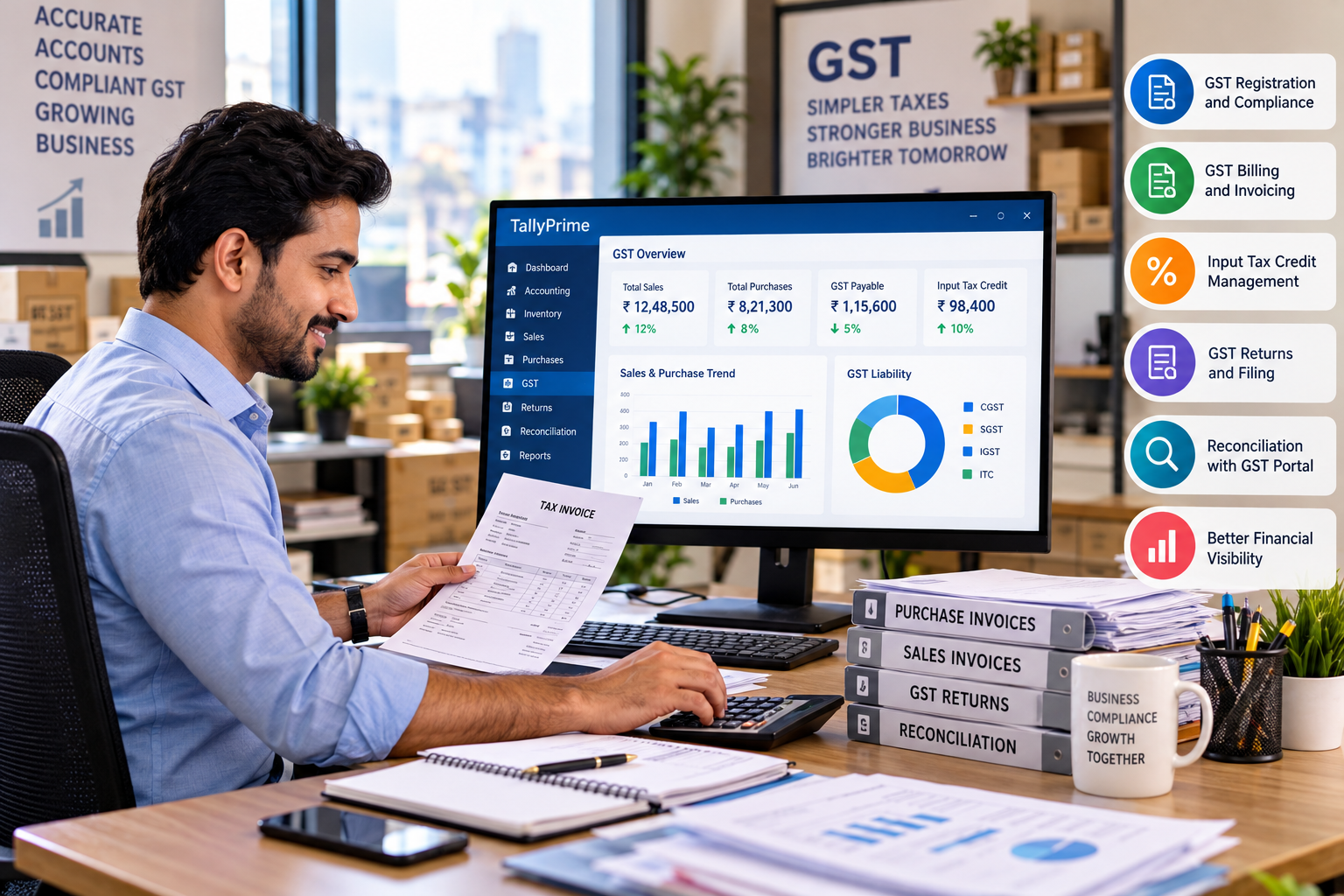
The encouraging development is that modern accounting systems can bring invoicing, inventory, tax calculations and reconciliation into a more organized workflow. With TallyPrime, businesses can maintain GST-ready transactions, identify discrepancies and prepare accounting information with greater confidence. Better GST management means fewer avoidable mistakes, clearer financial visibility and more time to focus on customers and business growth.
1. What Is GST and How Does It Work in India?
Goods and Services Tax (GST) is an indirect tax levied on the supply of goods and services in India. It replaced several earlier indirect taxes and introduced a destination-based taxation system.
Under GST, tax generally applies to the supply of goods or services, subject to exemptions, applicable rates and other statutory provisions.
The major objectives of GST include simplifying indirect taxation, improving transparency, reducing cascading taxes and establishing a more consistent framework for business taxation.
Main types of GST
|
GST Type
|
Description
|
|---|
|
CGST
|
Central Goods and Services Tax on applicable intra-state supplies
|
|
SGST
|
State Goods and Services Tax on applicable intra-state supplies
|
|
UTGST
|
Union Territory GST on applicable supplies in relevant Union Territories
|
|
IGST
|
Integrated GST generally applicable to inter-state supplies and imports
|
For example, a registered business in Delhi selling taxable goods to another business in Delhi generally charges CGST and SGST. When it sells goods to a customer in Maharashtra, IGST generally applies.
The correct tax treatment depends on the place-of-supply rules, nature of the transaction and applicable GST provisions.
2. Understanding GST Registration and Business Responsibilities
GST registration enables eligible businesses to collect GST, issue tax invoices and claim input tax credit subject to applicable conditions.
Registration requirements depend on factors such as annual aggregate turnover, nature of supplies, state or Union Territory, and whether compulsory registration provisions apply.
Common turnover thresholds are ₹40 lakh for eligible suppliers exclusively dealing in goods in many states and ₹20 lakh for many service providers, with lower thresholds and exceptions in specified cases. These are not universal limits.
Some businesses may require registration regardless of turnover.
Important responsibilities after registration
A GST-registered business should maintain accurate sales and purchase records, issue compliant invoices, apply appropriate tax rates, monitor input tax credit, file applicable returns and preserve records for the required period.
Businesses should also ensure that GSTIN details, customer classifications and product tax information are properly maintained.
How TallyPrime helps
TallyPrime allows businesses to configure GST information at the company level, maintain GSTIN details in customer and supplier ledgers, and define tax classifications for goods and services.
Once properly configured, these details support consistent transaction recording and tax calculation.
3. GST Billing and Tax Invoice Management
GST-compliant invoicing is one of the most important daily responsibilities for registered businesses.
A tax invoice typically includes the supplier's GSTIN, invoice number, invoice date, customer information where required, description of goods or services, HSN or SAC classification as applicable, taxable value, GST rate and tax amount.
Additional requirements may apply depending on the transaction and business category.
Example of GST calculation
Suppose a wholesaler sells taxable goods worth ₹50,000 within Delhi at an assumed GST rate of 18%.
|
Particulars
|
Amount
|
|---|
|
Taxable value
|
₹50,000
|
|
CGST at 9%
|
₹4,500
|
|
SGST at 9%
|
₹4,500
|
|
Total invoice value
|
₹59,000
|
The same taxable value on a qualifying inter-state transaction would generally attract IGST of ₹9,000, resulting in the same total invoice value.
The 18% rate is illustrative; the actual rate must be determined from the applicable classification and current notifications.
Using TallyPrime for GST invoicing
Businesses can create sales vouchers, select customers and inventory items, and apply the appropriate GST treatment.
TallyPrime can calculate taxes based on configured masters and transaction details, reducing repetitive manual calculations.
It also supports invoice customization and printing, helping businesses present transaction information professionally.
4. Input Tax Credit: Why Accurate Purchase Records Matter
Input Tax Credit (ITC) is an important component of GST because it allows eligible registered businesses to offset qualifying GST paid on purchases against their output tax liability.
For example, suppose a distributor has an output GST liability of ₹45,000 and eligible ITC of ₹28,000.
The remaining liability before considering other adjustments would be ₹17,000.
However, ITC cannot be claimed merely because GST appears on a purchase invoice.
Eligibility depends on statutory conditions, including receipt of goods or services, possession of prescribed documentation, applicable supplier reporting requirements, return filing and restrictions on blocked credits.
Common ITC challenges
Businesses frequently encounter purchase invoices missing from GSTR-2B, incorrect GSTINs, differences in taxable values, duplicate purchase entries, ineligible expenses and supplier reporting delays.
Such discrepancies can complicate return preparation and temporarily affect cash availability.
How TallyPrime supports ITC management
TallyPrime can maintain purchase transactions with supplier GSTINs, invoice details, taxable amounts and GST components.
Supported GST reconciliation features can help businesses compare accounting records with downloaded GST information, identify mismatches and review potentially eligible credits.
This improves the quality of records used for tax decisions, although final ITC eligibility must still be assessed under GST law.
5. GST Returns and Their Importance
GST returns report information such as outward supplies, tax liability, eligible input tax credit and tax payments.
The forms and filing frequency depend on the taxpayer's registration type and applicable scheme.
Common GST returns
|
Return
|
Primary purpose
|
|---|
|
GSTR-1
|
Reporting details of outward supplies
|
|
GSTR-3B
|
Summary declaration of tax liability, ITC and payment
|
|
GSTR-2B
|
Auto-drafted ITC statement used for reconciliation
|
|
GSTR-9
|
Annual return for taxpayers to whom it applies
|
|
GSTR-4
|
Annual return for applicable composition taxpayers
|
Businesses under the QRMP scheme follow specific quarterly return arrangements with monthly payment requirements as applicable.
Return deadlines and exemptions should always be checked against current official notifications.
Role of TallyPrime in return preparation
TallyPrime provides GST-related reports based on recorded transactions.
Businesses can review return information, inspect transaction exceptions, correct accounting mistakes and prepare data for supported filing workflows.
In supported versions and configurations, connected GST capabilities can assist with downloading information, reconciliation and return-related activities.
6. GST Reconciliation: Connecting Books with Portal Records
GST reconciliation is the process of comparing accounting records with information reported or reflected on the GST portal.
It helps identify missing invoices, duplicate entries, differences in taxable values, incorrect tax amounts and supplier-related mismatches.
Reconciliation should not be treated as an activity performed only at the end of the financial year.
A regular monthly review can reduce the workload before return deadlines.
Practical reconciliation process
-
Verify that sales and purchase vouchers are entered correctly.
-
Review supplier and customer GSTIN details.
-
Obtain relevant GST portal information.
-
Compare invoice numbers, dates, taxable values and tax amounts.
-
Investigate missing or mismatched transactions.
-
Correct books or coordinate with suppliers as appropriate.
-
Review eligible ITC and return summaries before filing.
With TallyPrime, businesses can organize their books and use supported reconciliation reports to investigate discrepancies more efficiently.
7. Emotional Story: The Business Owner Who Nearly Lost Control of His Cash Flow
Rajesh operated a family-owned electrical goods distribution business in Delhi. His father had started the shop decades earlier, and Rajesh wanted to expand it into a reliable wholesale enterprise.
The business was growing, but its accounting processes had not kept pace.
Sales invoices were prepared using different spreadsheets, purchase bills were stored in folders, and GST records were reconciled only when return deadlines approached.
One evening, Rajesh received a call from his accountant about purchase invoices that were not appearing in the expected GST records.
Several supplier entries needed verification. At the same time, customers had delayed payments and new stock purchases were due.
Rajesh sat in his office long after the market had closed, looking at invoices and wondering how a profitable business could feel so financially uncertain.
His greatest concern was not merely an accounting discrepancy. He worried about paying employees on time and maintaining the business his father had built.
He eventually decided to organize sales, purchases, inventory and GST records in one accounting system.
After implementing a structured TallyPrime workflow, the team began recording transactions daily, checking outstanding invoices and reviewing GST discrepancies more regularly.
The improvement was gradual, but meaningful.
Instead of discovering problems at the last moment, Rajesh could discuss them with his accountant earlier.
He also gained a clearer understanding of which customers owed money, which suppliers required follow-up and how much cash was available for future purchases.
This is an illustrative story based on common small-business challenges.
The lesson is simple: accurate accounting does more than support tax compliance. It can restore the confidence that business owners need to make decisions.
8. Case Study 1: How a Wholesale Distributor Improved GST Accuracy and Inventory Visibility
Illustrative case study: Wholesale distribution business, Delhi
Business background
A medium-sized electrical equipment distributor managed approximately 1,200 inventory items and supplied goods to retailers across Delhi, Haryana and Uttar Pradesh.
Its accounting team relied on spreadsheets for sales, separate records for stock movements and manual preparation of GST summaries.
Challenges faced
The business experienced incorrect GST classifications, delayed purchase entries, inconsistent stock balances and difficulties reconciling supplier invoices.
During busy periods, accountants spent considerable time identifying discrepancies instead of supporting business operations.
Solution using TallyPrime
The company introduced a structured accounting process using TallyPrime.
Customer and supplier ledgers were updated with GST information. Inventory masters were standardized, purchase and sales vouchers were recorded daily, and GST reports were reviewed periodically.
The accounts team also established a monthly process for examining purchase invoices against available GST portal information.
Illustrative business results
After three months, the business observed the following improvements in this example:
-
Monthly GST review preparation reduced from approximately three working days to one.
-
Inventory discrepancies became easier to investigate.
-
Duplicate invoice entry risks were reduced.
-
Management gained better visibility into receivables and payables.
-
Accountants spent less time collecting information from disconnected files.
Key takeaway: A well-maintained accounting system can improve GST compliance and business efficiency simultaneously. Actual outcomes depend on transaction volumes, configuration and employee practices.
9. Case Study 2: How a Service Provider Organized GST Returns and Customer Payments
Illustrative case study: Professional services company, Gurugram
Business background
A growing consulting firm provided technology and administrative services to corporate clients across India.
As the customer base expanded, the finance team struggled to manage recurring invoices, advance receipts, GST calculations and customer outstanding balances.
Challenges faced
Some invoices were entered late, customer payments were difficult to match with outstanding bills, and GST return preparation required extensive manual verification.
Management also lacked a convenient way to review monthly revenue and unpaid invoices.
Solution using TallyPrime
The company organized customer ledgers, configured applicable GST rates and began maintaining invoices through TallyPrime.
Bill-wise tracking helped accountants monitor receivables, while GST reports provided a more structured view of taxable transactions.
Regular bank reconciliation and monthly review procedures helped the finance team identify missing entries earlier.
Illustrative business results
The example business achieved faster invoice preparation, more consistent customer records and better visibility into outstanding payments.
Its finance team could prepare GST information with fewer manual consolidations, while management gained more useful information for cash-flow planning.
Key takeaway: GST accounting software becomes more valuable when tax compliance, invoicing and receivables management operate together.
10. How TallyPrime Helps Businesses Manage GST More Efficiently
TallyPrime combines accounting, invoicing, inventory management and GST-related reporting in a single business management environment.
This is particularly useful for organizations handling multiple suppliers, customers, tax rates and product categories.
GST configuration and master management
Businesses can maintain company GST details, party GSTINs, registration types, state information and tax classifications.
Correct master configuration helps reduce repetitive data entry and supports consistent accounting treatment.
Purchase and sales accounting
TallyPrime supports recording taxable sales, purchases, debit notes, credit notes and other relevant transactions.
Properly configured vouchers help businesses maintain an organized audit trail and prepare GST information.
Inventory and HSN/SAC management
Businesses dealing in physical goods can connect inventory records with accounting transactions.
Stock items can be maintained with relevant tax classifications and HSN information, helping reduce differences between commercial invoices and accounting records.
GST reports and exception identification
GST-related reports allow users to review transaction information, tax values and potential exceptions.
Accountants can examine incorrect or incomplete records before preparing returns.
Connected GST capabilities
Depending on the installed release, subscription eligibility and configuration, TallyPrime supports connected GST activities such as downloading relevant portal information, reconciliation and supported return filing workflows.
Users should confirm feature availability for their particular release.
Financial and outstanding reports
Beyond GST, TallyPrime provides reports for sales, purchases, outstanding receivables, payables, inventory and financial performance.
These reports help business owners understand how taxation and operating activities affect working capital.
11. Practical Steps to Set Up GST Accounting in TallyPrime
A business implementing TallyPrime can follow a structured process.
Step 1: Create the company
Enter the company name, address, state, financial year and other essential business details.
Step 2: Enable GST
Open the relevant company features and statutory configuration settings, enable GST and enter the applicable registration information.
Step 3: Configure ledgers
Create or update customer, supplier, purchase, sales and tax ledgers. Verify GSTINs, states and registration types.
Step 4: Set up inventory
For businesses maintaining stock, create stock groups, units and stock items with appropriate HSN and tax details.
Step 5: Record transactions
Enter purchase invoices, sales invoices, credit notes, debit notes and other applicable vouchers.
Step 6: Review GST reports
Examine tax calculations, incomplete information and transaction exceptions.
Step 7: Reconcile GST information
Compare accounting records with available GST portal statements and investigate differences.
Step 8: Prepare and file returns
Review the applicable return information, verify eligible ITC and complete filing through supported processes.
Step 9: Maintain regular backups
Establish secure backups, appropriate user permissions and periodic data verification.
12. Common GST Mistakes Businesses Should Avoid
Even businesses using accounting software can encounter compliance problems if their records are incomplete or incorrect.
Common mistakes include applying an incorrect GST rate, entering an invalid GSTIN, selecting the wrong place of supply, recording duplicate purchase invoices and claiming ineligible ITC.
Businesses should also avoid ignoring credit notes, failing to reconcile supplier information and postponing GST reviews until the filing deadline.
Another frequent mistake is assuming that software-generated tax calculations automatically guarantee legal compliance.
Accounting software calculates and reports information based on configured rules and recorded transactions. Businesses remain responsible for verifying their tax treatment and statutory obligations.
A monthly internal checklist, periodic accountant review and employee training can significantly improve record quality.
13. GST, Cash Flow and Business Growth: The Bigger Connection
GST management has a direct relationship with cash flow.
A business may report strong sales but still experience financial pressure if customers delay payments, eligible ITC is not available when expected or accounting discrepancies require additional verification.
Accurate books allow business owners to distinguish tax liabilities from operating cash and plan payments more effectively.
For example, a wholesaler purchasing inventory before a seasonal sales period must consider supplier payments, customer credit periods, GST obligations and working capital requirements.
TallyPrime helps organize this information through accounting and outstanding reports.
When financial records are reviewed regularly, management can make better decisions about customer credit, supplier payments, stock purchases and future expansion.
GST compliance should therefore be viewed as part of overall financial management rather than an isolated statutory activity.
14. Best Practices for GST Compliance in 2026
Businesses can strengthen their GST processes by following a few practical principles.
Maintain complete and accurate invoices from the beginning of each transaction. Verify GSTINs and tax classifications before posting entries. Record purchase invoices promptly and review supplier reporting regularly.
Reconcile relevant GST information every month, even where a quarterly filing arrangement applies.
Monitor official notifications for changes in rates, filing requirements, e-invoicing applicability and other compliance obligations.
Train accounting employees whenever business processes or software features change.
Finally, maintain reliable backups and restrict sensitive accounting functions to authorized users.
A disciplined accounting routine often delivers greater long-term value than attempting to correct months of incomplete records immediately before a deadline.
15. The Future of GST Accounting and Digital Compliance
GST administration continues to become more digitally integrated.
Electronic invoices, electronic waybills, automated validations and portal-based reconciliation are increasingly important in the compliance environment.
For growing businesses, this makes accurate transaction-level accounting essential.
Companies that organize their financial data can respond more effectively to new reporting requirements, changing transaction volumes and management information needs.
TallyPrime can serve as an important part of this digital accounting foundation by bringing routine financial transactions and GST-related information into an organized workflow.
However, businesses should continue monitoring statutory updates and verifying that their software processes remain aligned with applicable requirements.
Conclusion
GST compliance is an essential responsibility for Indian businesses, but it does not have to remain a recurring source of confusion and operational pressure.
Understanding GST registration, invoicing, input tax credit, return filing and reconciliation helps businesses avoid preventable mistakes and maintain reliable financial records.
TallyPrime supports these activities by connecting accounting transactions, inventory records, GST calculations, reports and supported reconciliation workflows.
The greatest benefit comes from combining suitable software with accurate data entry, regular review and informed tax decisions.
For retailers, wholesalers, manufacturers, distributors and service providers, effective GST management can improve financial visibility, reduce administrative work and support sustainable business growth.
Powered by Binarysoft Technologies
Authorized Tally Partner
Location: 1626/33, 1st Floor, Naiwalan, Karol Bagh, New Delhi – 110005, INDIA
Contact us: +91 7428779101, 9205471661
Email us: tally@binarysoft.com
Business Hours: 10:00 AM – 6:00 PM, Monday to Friday
Frequently Asked Questions
Does TallyPrime support GST return preparation?
Yes. TallyPrime provides GST-related reports and supported return preparation workflows. Connected filing functionality depends on the software release and applicable configuration. 4. What is input tax credit under GST?
How can businesses reduce GST reconciliation errors?
Businesses should maintain accurate purchase records, verify supplier GSTINs, reconcile invoices with relevant portal statements and investigate mismatches regularly.
Why should businesses choose a structured GST accounting system?
A structured system reduces dependence on disconnected records, improves transaction visibility, supports compliance reviews and helps management make better financial decisions.
Can TallyPrime manage transactions involving different GST rates?
Yes. Businesses can configure applicable GST rates and classifications for relevant goods and services. Correct configuration and verification remain essential.
CA. Arnav Kankaria focuses on accounting automation, GST reconciliations, and financial record management. He helps businesses streamline routine accounting activities while maintaining reliable records for reporting and review.