Call CA Tally HelpDesk
+91 9205471661,
7428779101
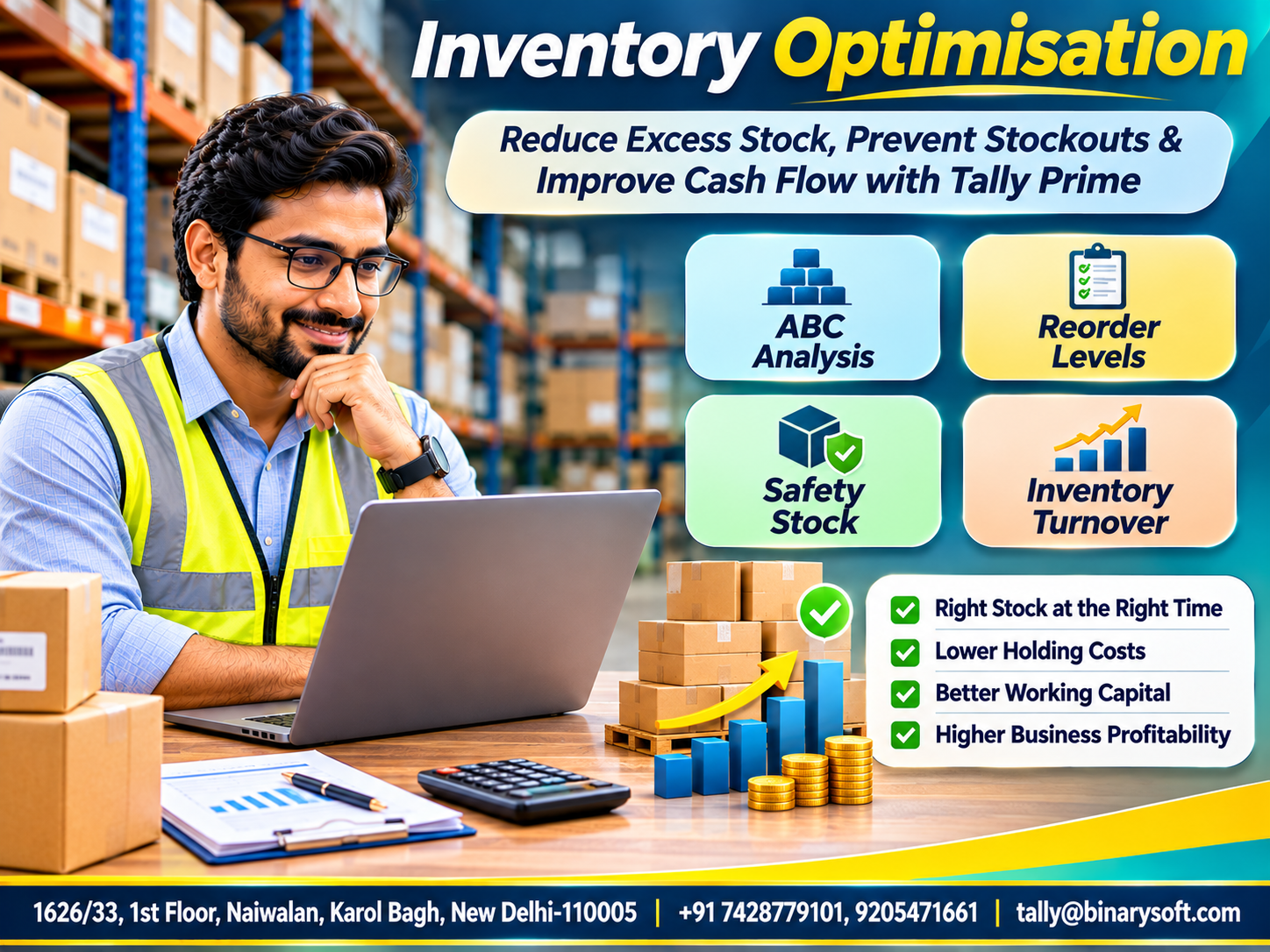
Introduction: Why Inventory Optimisation Matters for Business Success
Imagine running a growing wholesale business with a warehouse full of products. Every shelf is occupied, purchase orders arrive regularly, and employees remain busy throughout the day.
Yet your business faces a serious problem.
Some products remain unsold for months, while popular items frequently run out of stock. Customers complain about unavailable products, and valuable working capital remains invested in slow-moving inventory.
This situation highlights the importance of inventory optimisation.
Inventory optimisation is the process of maintaining appropriate inventory quantities while balancing customer demand, purchasing costs, storage expenses and supply-chain risks.
It helps businesses avoid excessive stock investment without creating unnecessary shortages.
For Indian retailers, wholesalers, manufacturers and distributors, effective inventory optimisation can improve cash flow, operational efficiency and customer satisfaction.
Tally Prime supports this process through inventory records, stock reports, reorder information and purchasing workflows.
Understanding how to use these capabilities can help businesses make more informed inventory decisions.
1. What Is Inventory Optimisation?
Inventory optimisation is a systematic approach to determining how much inventory a business should maintain and when additional stock should be purchased.
Its objective is to balance product availability with the costs of holding inventory.
A business maintaining too much stock may face increased storage expenses, damage, obsolescence and restricted cash flow.
A business maintaining too little stock may experience lost sales, production interruptions and dissatisfied customers.
Inventory optimisation helps management find a practical balance.
For example, an electrical accessories distributor may maintain higher stock levels for frequently purchased switches while limiting inventory of rarely requested products.
The appropriate quantities depend on demand, supplier reliability, purchasing costs and business priorities.
Inventory optimisation is therefore an ongoing process rather than a one-time calculation.
2. Why Is Inventory Optimisation Important?
Inventory is often one of the largest investments made by trading and manufacturing businesses.
Poor inventory decisions can affect profitability and working capital.
Reduces Excess Inventory
Businesses can identify products that are being purchased faster than they are sold.
Prevents Stockouts
Appropriate replenishment planning helps maintain availability of important products.
Improves Cash Flow
Reducing unnecessary inventory investment can release funds for operating expenses and business growth.
Lowers Holding Costs
Better stock planning can reduce storage, insurance, handling and deterioration costs.
Improves Customer Satisfaction
Reliable product availability supports customer relationships.
Supports Better Purchasing
Businesses can plan orders using sales trends and supplier information.
Improves Operational Efficiency
Clear inventory records help employees manage stock more effectively.
These benefits make inventory optimisation valuable for businesses of different sizes.
3. Inventory Optimisation vs Inventory Management
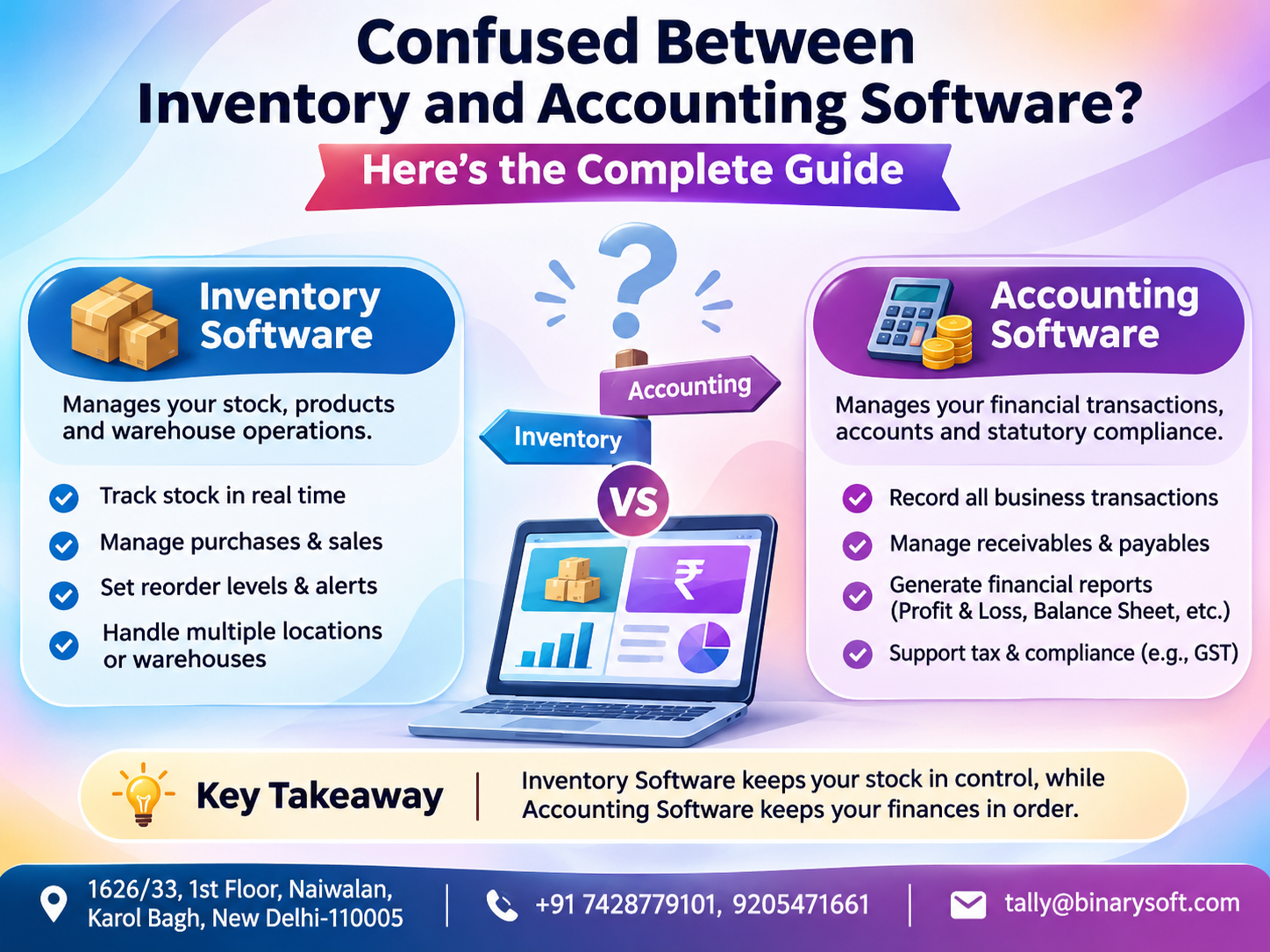
Inventory management and inventory optimisation are closely related but serve different purposes.
Inventory management involves recording, storing, moving and controlling stock.
Inventory optimisation focuses on determining the most appropriate stock quantities and replenishment decisions.
For example, inventory management tells a retailer that 500 units are available.
Inventory optimisation helps determine whether maintaining 500 units is sensible based on expected demand and supplier delivery times.
Both functions are necessary.
Accurate inventory management provides the information required for meaningful optimisation.
Without reliable stock records, even sophisticated optimisation calculations may produce poor decisions.
4. Key Components of Inventory Optimisation
Several factors influence inventory requirements.
Customer Demand: The quantity customers are expected to purchase.
Supplier Lead Time: The time required to receive replenishment stock.
Safety Stock: Additional inventory maintained to protect against uncertainty.
Reorder Point: The inventory position at which replenishment should be considered.
Order Quantity: The amount purchased during each replenishment cycle.
Inventory Holding Cost: Expenses associated with storing and maintaining stock.
Ordering Cost: Costs incurred when placing and receiving purchase orders.
Service Level: The desired level of product availability.
Businesses should consider these factors together rather than optimizing each one independently.
5. Understanding the Economic Order Quantity Method
Economic Order Quantity, commonly called EOQ, helps estimate an order quantity that balances ordering and inventory holding costs under simplified assumptions.
The formula is:
EOQ = √(2DS ÷ H)
Where:
D = Annual demand in units.
S = Ordering cost per order.
H = Annual holding cost per unit.
Suppose a business has:
Annual demand = 12,000 units.
Ordering cost = ₹500 per order.
Annual holding cost = ₹20 per unit.
EOQ = √(2 × 12,000 × 500 ÷ 20)
EOQ = √600,000
EOQ ≈ 775 units.
The business may use this figure as an initial reference when evaluating purchase quantities.
Actual decisions should also consider supplier minimum order quantities, discounts, storage limitations and demand uncertainty.
6. How Reorder Levels Help Optimise Inventory
A reorder point indicates when replenishment should be initiated.
A simplified formula is:
Reorder Point = Average Daily Demand × Supplier Lead Time + Safety Stock
Suppose a retailer sells 25 units daily.
Supplier lead time is six days.
Safety stock is 50 units.
Reorder point:
(25 × 6) + 50 = 200 units.
When the relevant inventory position reaches approximately 200 units, replenishment should be reviewed.
Inventory position should consider available stock, outstanding orders and committed demand.
Businesses should adjust reorder points when sales patterns or supplier performance change.
7. What Is Safety Stock?
Safety stock is additional inventory maintained to reduce the risk of shortages caused by uncertain demand or delivery delays.
For example, a business may normally sell 100 units during its supplier's delivery period.
However, demand occasionally rises unexpectedly.
Maintaining a suitable buffer can help protect customer service.
The appropriate safety stock level depends on demand variability, lead-time reliability and desired product availability.
Excessive safety stock increases inventory investment.
Insufficient safety stock increases the risk of shortages.
Businesses should therefore review safety stock periodically.
8. ABC Analysis for Inventory Optimisation
ABC analysis classifies inventory according to its relative importance, often using annual consumption value.
Annual consumption value is generally calculated as:
Annual Quantity Consumed × Unit Cost
Inventory is then ranked according to this value.
Category A
High-value items representing a significant proportion of total inventory consumption value.
These items generally require closer monitoring.
Category B
Moderately important items requiring regular review.
Category C
Lower-value items that may be managed using simpler controls.
For example, a distributor may classify expensive electrical equipment as Category A and inexpensive accessories as Category C.
ABC analysis helps businesses prioritize management attention.
However, low-value products that are essential for customer service may still require careful monitoring.
9. An Emotional Story: The Business Owner Who Discovered That a Full Warehouse Was Not Success
Sanjay owned a family-run hardware distribution business in Delhi.
His father had established the company with a small rented shop and a commitment to dependable customer service.
Over time, Sanjay expanded operations and rented a larger warehouse.
He believed that maintaining large quantities of stock would help the company serve every customer immediately.
Whenever suppliers offered discounts, he purchased additional products.
The warehouse gradually filled with cartons.
However, some items remained unsold for months.
At the same time, popular products occasionally became unavailable.
One afternoon, a long-standing customer requested an urgent delivery of electrical fittings.
Despite the crowded warehouse, Sanjay discovered that the required items were out of stock.
The customer purchased them elsewhere.
That evening, Sanjay reviewed his financial position.
A significant amount of money was invested in products that were not selling.
He worried about paying suppliers, supporting employees and meeting his family's expenses.
His father noticed his concern and asked what had happened.
Sanjay explained that the warehouse was full, yet the business was struggling with cash flow.
His father quietly replied:
“A successful business does not need the most stock. It needs the right stock.”
The next morning, Sanjay began reviewing inventory records with his accountant.
They identified fast-moving, slow-moving and high-value products.
The team introduced reorder levels and more disciplined purchasing procedures.
Sanjay also began reviewing stock movement reports before placing large orders.
Over time, purchasing decisions became more consistent.
Unnecessary stock accumulation declined, and the team paid greater attention to product availability.
Several months later, Sanjay's father visited the warehouse.
He noticed that the shelves were better organized and that employees could explain which products required replenishment.
Sanjay smiled and said the business was finally learning to manage inventory according to demand rather than fear.
For Sanjay, inventory optimisation became more than a financial strategy. It became a way to protect his father's legacy and create a more secure future for his family.
This fictional story illustrates the importance of responsible inventory planning.
10. How Tally Prime Helps with Inventory Optimisation
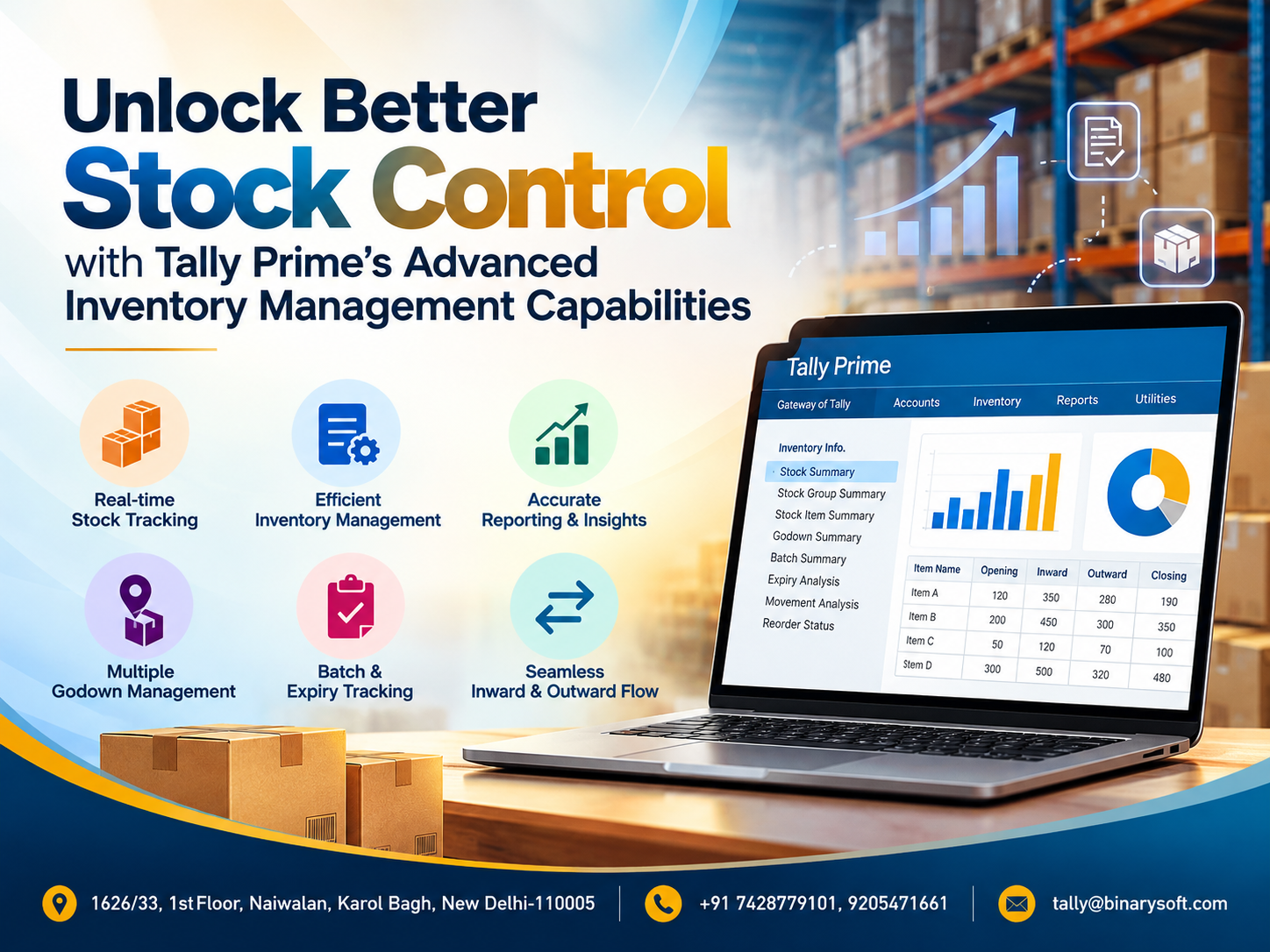
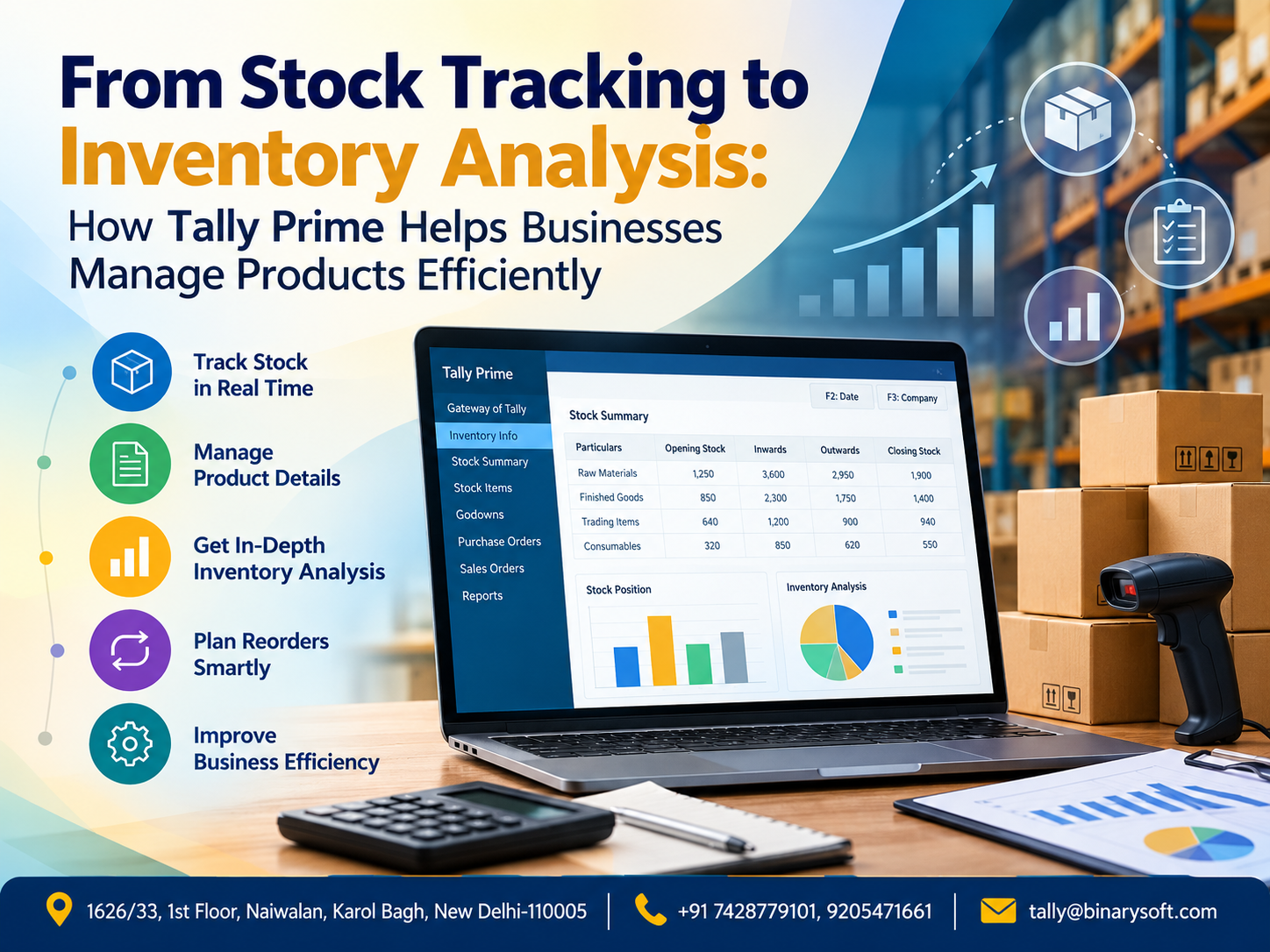
Tally Prime provides inventory management capabilities that support stock analysis and replenishment planning.
Stock Item Management
Businesses can create stock items with appropriate names, units and classifications.
Stock Groups and Categories
Products can be organized for easier reporting and analysis.
Stock Summary
The Stock Summary provides information about inventory quantities and values.
Reorder Levels
Supported inventory features help businesses maintain reorder information for suitable stock items.
Purchase Orders
Purchase order records support procurement planning.
Godown Management
Businesses can monitor inventory across configured storage locations.
Stock Movement Reports
Relevant inventory reports help identify product movement patterns.
These capabilities provide useful information for optimisation.
Advanced forecasting or automated optimisation calculations may require additional analysis or integrations.
11. How to Optimise Inventory Using Tally Prime
Businesses can establish a structured inventory review process.
Step 1: Maintain Accurate Stock Masters
Create clear stock item names and appropriate units of measurement.
Step 2: Record Transactions Promptly
Ensure purchases, sales, returns and relevant stock movements are recorded correctly.
Step 3: Review the Stock Summary
Identify current stock quantities and values.
Step 4: Analyse Stock Movement
Review which products sell frequently and which remain unsold.
Step 5: Classify Inventory
Use available data to perform ABC or other useful inventory classifications.
Step 6: Review Supplier Lead Times
Estimate how long replenishment normally takes.
Step 7: Set Reorder Information
Maintain suitable reorder levels and quantities where supported.
Step 8: Review Purchase Orders
Consider outstanding orders before placing additional purchases.
Step 9: Reconcile Inventory
Compare recorded quantities with physical stock.
Step 10: Monitor Results
Review inventory turnover, stock availability and working capital regularly.
Exact features and navigation depend on the Tally Prime release and configuration.
12. Understanding Inventory Turnover
Inventory turnover measures how frequently inventory is sold or consumed during a period.
The formula is:
Inventory Turnover Ratio = Cost of Goods Sold ÷ Average Inventory Value
Suppose annual cost of goods sold is ₹30 lakh.
Average inventory value is ₹6 lakh.
Inventory turnover:
₹30 lakh ÷ ₹6 lakh = 5 times.
This indicates that the business turns over its average inventory approximately five times annually.
A higher ratio may indicate faster inventory movement.
However, excessively high turnover can sometimes reflect insufficient stock.
Businesses should interpret turnover alongside product availability and industry characteristics.
13. Case Study One: Inventory Optimisation for an Electronics Distributor
Illustrative Case Study
Business Background
An electronics distributor supplies chargers, cables, adapters and computer accessories.
The Challenge
Frequently purchased products sometimes become unavailable, while less popular items accumulate.
The Approach
Management reviews sales and stock movement information in Tally Prime.
Products are classified according to demand and inventory value.
Reorder levels are established for important items.
Supplier delivery times are incorporated into purchasing decisions.
Expected Outcome
The business can improve purchasing discipline and reduce unnecessary stock accumulation.
Business Lesson
Inventory optimisation requires both reliable sales information and regular replenishment reviews.
14. Case Study Two: Inventory Optimisation for a Garment Wholesaler
Illustrative Case Study
Business Background
A garment wholesaler supplies clothing to retailers across several markets.
The Challenge
Seasonal demand creates excess stock in some product categories and shortages in others.
The Approach
The company reviews historical sales by category and season.
Tally Prime is used to maintain stock and sales records.
Management compares expected demand with available inventory before placing orders.
Slow-moving products receive additional attention.
Expected Outcome
The wholesaler can make more informed purchasing decisions and improve visibility into inventory investment.
Business Lesson
Seasonal inventory optimisation requires consistent data analysis and awareness of changing customer preferences.
Both case studies are illustrative rather than verified customer results.
15. Common Inventory Optimisation Challenges
Businesses may face several difficulties.
Inaccurate Inventory Records: Incorrect quantities undermine replenishment decisions.
Unpredictable Demand: Customer requirements can change unexpectedly.
Supplier Delays: Delivery disruptions may cause shortages.
Excessive Bulk Purchasing: Discounts may encourage unnecessary inventory accumulation.
Poor Product Classification: Management may focus on the wrong products.
Limited Forecasting Information: New products may lack historical sales data.
Seasonal Fluctuations: Demand can change significantly during festivals and other periods.
Businesses should review their assumptions regularly rather than relying on fixed inventory rules.
16. How Inventory Optimisation Improves Cash Flow
Inventory represents money invested in goods that have not yet been sold or consumed.
Excess inventory can restrict funds needed for rent, salaries and business expansion.
For example, suppose a business reduces unnecessary inventory purchases by ₹2 lakh.
That amount may become available for other operating requirements, depending on payment terms and existing obligations.
However, reducing inventory indiscriminately can create shortages and lost sales.
The objective is to release avoidable working capital while maintaining suitable product availability.
Businesses should evaluate inventory decisions alongside supplier credit terms and customer demand.
17. Inventory Optimisation and Demand Forecasting
Demand forecasting estimates future customer requirements.
Inventory optimisation uses those estimates alongside other information to determine suitable stock levels.
For example, a retailer may forecast monthly demand of 500 units.
Management must then consider existing stock, supplier lead time, safety stock and outstanding orders.
Forecasting and optimisation work together.
A reliable forecast can improve replenishment decisions.
However, forecasts are estimates rather than guarantees.
Businesses should compare actual demand with forecasts and adjust inventory policies when necessary.
18. Best Practices for Effective Inventory Optimisation
Businesses can improve stock control through consistent procedures.
Maintain accurate inventory records.
Classify products according to value and movement.
Review sales trends regularly.
Monitor supplier delivery performance.
Establish suitable reorder points.
Maintain appropriate safety stock.
Avoid unnecessary bulk purchases.
Investigate slow-moving inventory.
Review outstanding purchase orders.
Conduct physical stock verification.
Monitor inventory turnover and stock availability.
Coordinate purchasing, sales and warehouse teams.
These practices support more disciplined inventory decisions.
19. Key Performance Indicators for Inventory Optimisation
Businesses should monitor relevant performance indicators.
Inventory Turnover
Measures how frequently inventory is sold or consumed.
Stockout Frequency
Shows how often customer demand cannot be fulfilled because stock is unavailable.
Inventory Holding Cost
Measures expenses associated with maintaining inventory.
Slow-Moving Stock
Identifies products with limited sales or consumption over a defined period.
Forecast Accuracy
Compares expected demand with actual demand.
Supplier Lead Time
Measures the time required to receive replenishment stock.
No single indicator provides a complete picture.
Businesses should review several measures together.
20. The Future of Inventory Optimisation
Digital accounting and inventory systems are making stock information easier to access.
Businesses are exploring automated replenishment, inventory analytics, demand forecasting and integrated warehouse workflows.
These tools may improve planning when supported by accurate records.
However, technology cannot compensate for incorrect stock quantities or poor purchasing policies.
For Tally Prime users, inventory reports, purchase orders and reorder information provide a practical foundation for stock optimisation.
Businesses with complex requirements may evaluate specialized planning tools or suitable integrations.
The goal remains straightforward: maintain enough inventory to serve customers without investing unnecessarily in excess stock.
Conclusion
Inventory optimisation helps businesses maintain appropriate stock levels while controlling inventory costs and protecting working capital.
Techniques such as ABC analysis, Economic Order Quantity, reorder points, safety stock and inventory turnover analysis provide practical ways to improve stock planning.
Tally Prime supports inventory optimisation through stock records, purchase orders, reorder information and inventory reports.
However, reliable results depend on accurate transaction recording, realistic demand estimates and regular management review.
Businesses should avoid both excessive stock accumulation and unnecessary inventory shortages.
Successful inventory optimisation is not about keeping the warehouse completely full or nearly empty. It is about maintaining the right stock to meet customer needs while supporting sustainable business growth.
Powered by Binarysoft Technologies
Authorized Tally Partner
Binarysoft Technologies helps businesses improve accounting and inventory management through Tally Prime implementation, configuration, customization, technical support and cloud-based accounting solutions.
Our services support retailers, wholesalers, manufacturers and distributors seeking better stock control, purchasing efficiency and working capital management.
Location:
1626/33, 1st Floor, Naiwalan, Karol Bagh, New Delhi – 110005, INDIA
Contact Us:
+91 7428779101, 9205471661
Email:
tally@binarysoft.com
Business Hours:
10:00 AM – 6:00 PM, Monday to Friday
Frequently Asked Questions
How does ABC analysis help inventory management?
ABC analysis classifies inventory according to relative importance, helping businesses prioritize monitoring and control.
How does inventory optimisation improve cash flow?
It can reduce unnecessary stock investment, making more working capital available for other business requirements.
What is the EOQ formula?
EOQ = √(2DS ÷ H), where D is annual demand, S is ordering cost per order and H is annual holding cost per unit.
Can Tally Prime help with inventory optimisation?
Yes. Tally Prime provides stock records, inventory reports, reorder information and purchase order features that support stock planning.
CA. Aarav Bhandari specializes in GST compliance, accounting systems, and business advisory services. He regularly writes about tax updates, accounting automation, and financial best practices to help businesses improve efficiency and maintain statutory compliance.