Call CA Tally HelpDesk
+91 9205471661,
7428779101
Introduction: Why Modern Businesses Need Smarter Communication Between Applications
Imagine a growing business that processes hundreds of customer orders every day.
Whenever a customer places an order, several activities must take place.
The sales department needs confirmation, inventory information must be checked, the warehouse needs dispatch instructions and the finance department must prepare the necessary accounting records.
Traditionally, these operations may depend on direct communication between different applications.
As business operations expand, managing these connections becomes increasingly complicated.
A temporary failure in one application can delay several other processes.
This is where the Publish-Subscribe Model, commonly called the Pub/Sub model, becomes valuable.
Instead of requiring every application to communicate directly with another, Pub/Sub architecture allows systems to publish events that interested applications can receive and process.
Amazon Web Services provides messaging technologies that help businesses implement this approach.
Services such as Amazon Simple Notification Service (SNS), Amazon Simple Queue Service (SQS) and Amazon EventBridge support different forms of event-driven communication.
For organisations using Tally Prime, understanding these technologies can provide useful insights into how external business applications, inventory platforms, customer portals and accounting workflows can communicate more efficiently.
The objective is not simply faster communication.
It is to build business systems that remain dependable as operations become more complex.
1. What Is the Publish-Subscribe Model?
The Publish-Subscribe model is a messaging architecture in which applications communicate through events or messages.
The application generating a message is called the publisher.
Applications interested in receiving particular messages are called subscribers.
A messaging service or broker coordinates communication between publishers and subscribers.
For example, an online sales application may publish an event whenever a customer places an order.
Different applications can respond to that event.
The inventory system may check stock availability.
The warehouse application may begin preparing dispatch information.
The customer communication system may send an order acknowledgement.
The accounting integration service may prepare transaction information for subsequent verification.
The publisher does not need to communicate individually with every receiving application.
This separation is known as loose coupling.
Loose coupling allows applications to evolve independently and can reduce the impact of changes across interconnected systems.
2. An Emotional Story: The Order That Nearly Cost a Business Its Reputation
Rohit owned a growing home appliances distribution business in New Delhi.
He had started his company with a small rented shop and limited savings.
Over the years, his dedication helped him build relationships with hundreds of customers.
Eventually, he expanded into online sales.
Business increased rapidly, especially during the festive season.
However, his technology systems were not prepared for the growing workload.
One evening, a major customer placed an urgent order for electrical appliances required for a new commercial property.
The order was important because the customer had promised delivery before the property's inauguration.
Rohit's online application recorded the order successfully.
Unfortunately, the warehouse system did not receive the information.
The sales department assumed the warehouse had already started preparing the shipment.
The warehouse team believed no order had been received.
By the next morning, the customer was demanding an explanation.
Rohit felt helpless.
He had worked for years to establish a reputation for dependable service.
Now, a communication failure between two applications threatened that reputation.
The customer eventually accepted a revised delivery schedule, but Rohit knew something had to change.
He consulted a technology specialist who recommended redesigning the communication between his business applications.
Instead of relying entirely on direct connections, the new architecture used event notifications and message queues.
Whenever an order was confirmed, the sales application published an event.
Relevant systems received the information through configured messaging services.
Temporary failures could be handled through retries and monitored queues.
Rohit's team also introduced procedures for checking unsuccessful transactions and reconciling records.
Over time, communication between departments became more dependable.
The experience taught Rohit an important lesson:
A business does not lose customer trust only because of poor products. Sometimes, disconnected technology can damage relationships built over many years.
This fictional story illustrates why reliable event-driven communication matters.
3. How the Publish-Subscribe Model Works
A typical Pub/Sub architecture includes several important components.
Publisher
The publisher is the application or service that generates an event.
For example, an order management application may publish an OrderConfirmed event.
Message Broker
The message broker receives events and coordinates their delivery.
AWS provides several managed services that support different messaging patterns.
Topic or Event Bus
A topic or event bus provides a logical destination through which messages can be routed.
Subscribers receive relevant messages according to configured subscriptions or rules.
Subscriber
A subscriber is an application or service that receives and processes messages.
Event Processing
Subscribers perform actions based on the received information.
For example, an inventory application may update an order's reservation status after processing an order-confirmation event.
Error Handling
Reliable systems must account for unsuccessful processing.
Retries, dead-letter queues, monitoring and duplicate-message handling help improve operational dependability.
Example Workflow
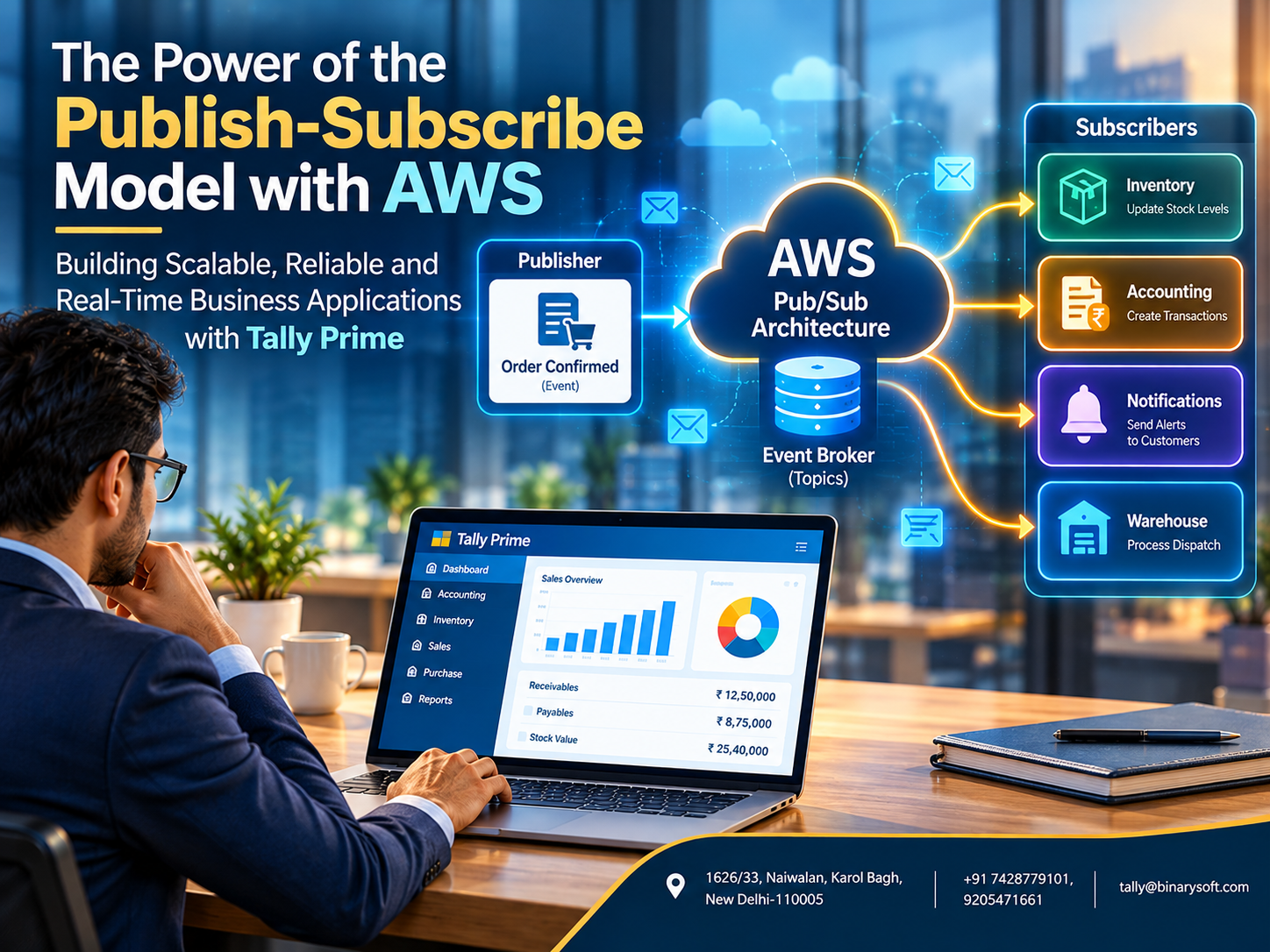
A customer confirms an online order.
The application publishes an event.
AWS messaging services route the event to interested applications.
The inventory service checks availability.
The warehouse service receives fulfilment instructions.
The notification service prepares customer communication.
The accounting integration service creates a transaction-processing request.
Each service performs its assigned activity.
This architecture reduces the need for direct connections between every application.
4. Understanding AWS Services Used in Pub/Sub Architecture
AWS offers several services that support event-driven communication.
Amazon Simple Notification Service (SNS)
Amazon SNS is a managed messaging service that supports publish-subscribe communication.
Applications can publish messages to SNS topics.
Configured subscribers can receive notifications through supported delivery mechanisms.
SNS is particularly useful when one event needs to reach multiple destinations.
Amazon Simple Queue Service (SQS)
Amazon SQS is a managed message queue service.
It allows applications to exchange messages asynchronously.
Messages remain available for processing according to the queue's configuration and retention policies.
SQS is useful when receiving applications need to process work independently of the publishing application.
Amazon EventBridge
Amazon EventBridge is a managed event-routing service.
It enables applications to route events according to configurable rules.
EventBridge is useful for integrating applications, AWS services and supported external systems.
AWS Lambda
AWS Lambda runs code in response to supported triggers without requiring businesses to manage traditional application servers.
For example, a Lambda function can process an event, validate information and send it to another authorised service.
Amazon CloudWatch
Amazon CloudWatch provides monitoring capabilities for AWS resources and applications.
Businesses can use it to observe messaging activity, processing failures and operational performance.
These services can be combined to build event-driven systems.
However, SNS, SQS and EventBridge are not interchangeable. Each provides different capabilities, delivery mechanisms and configuration options.
5. Major Benefits of the Pub/Sub Model
Improved Scalability
Publishers and subscribers can scale according to their workloads.
New subscribers can be introduced without necessarily modifying the original publisher.
Loose Coupling
Applications communicate through messages instead of maintaining direct connections with every dependent service.
Asynchronous Processing
Publishers can continue their operations without waiting for every subscriber to finish processing.
Better Fault Isolation
A temporary subscriber failure does not necessarily require the publishing application to stop.
Durable queues and appropriate retry mechanisms can help protect pending work.
Easier Application Expansion
Businesses can add new processing services when requirements change.
Real-Time Event Communication
Pub/Sub systems can deliver events promptly, supporting responsive workflows.
However, delivery latency varies according to the service, network and processing workload.
Operational Flexibility
Different applications can process the same business event for different purposes.
For example, an order event may support inventory verification, customer notifications and financial processing.
6. Publish-Subscribe vs Traditional Communication Architecture
Traditional application integration often relies on direct communication between systems.
For example, an order management application may call the inventory application directly and wait for a response.
In Pub/Sub architecture, the order application publishes an event that interested subscribers can process.
| Feature | Traditional Direct Communication | Publish-Subscribe Architecture |
|---|
| Communication |
Direct application-to-application |
Through topics or event brokers |
| Dependency |
Applications may depend closely on each other |
Applications can remain loosely coupled |
| Scalability |
Additional connections may increase complexity |
Subscribers can be added more independently |
| Processing |
Often synchronous |
Commonly asynchronous |
| Fault handling |
A failure may affect the calling application |
Queues and retries can isolate certain failures |
| Business applications |
Simple integrations and immediate requests |
Event notifications and distributed workflows |
Both approaches have advantages.
Direct communication is often appropriate when an application requires an immediate response.
Pub/Sub architecture is particularly useful when several independent systems need to react to the same event.
Many modern applications combine both approaches.
7. How Tally Prime Can Work with AWS Pub/Sub Architecture
Tally Prime provides accounting, invoicing, inventory management, GST-related functionality and financial reporting.
Businesses may want to connect these activities with external applications such as e-commerce platforms, warehouse systems or customer portals.
AWS Pub/Sub services can support communication between these external applications.
However, Tally Prime does not automatically provide a built-in AWS Pub/Sub integration. Such workflows require appropriate integration development, supported Tally Prime data-exchange mechanisms and secure configuration.
Automated Sales Information Processing
An e-commerce platform can publish an event whenever an order is confirmed.
An AWS-based integration service can receive the event and prepare the necessary sales information.
After validation, the information may be transferred to Tally Prime using an appropriate supported integration method.
Inventory Coordination
A warehouse management application can publish stock movement events.
An integration service can process these events and prepare corresponding inventory information for Tally Prime.
Businesses must ensure that records are reconciled correctly and that duplicate messages do not create duplicate stock transactions.
Customer Payment Notifications
A payment gateway can generate an event when a payment is completed.
A subscriber can verify the payment details and initiate an authorised accounting workflow.
The integration must verify payment status securely rather than relying solely on an untrusted notification.
Purchase Order Processing
A procurement application can publish purchase-order events.
Relevant subscribers can initiate supplier communication, inventory planning or accounting preparation.
Financial Reporting Workflows
An authorised integration may export selected accounting information for processing by external reporting applications.
AWS services can coordinate subsequent processing and notifications.
GST-Related Processes
External applications can use messaging workflows to coordinate document processing or compliance-related tasks.
However, tax calculations and filings must be verified according to applicable regulations.
The main benefit is that AWS can coordinate communication between connected applications while Tally Prime remains an important system for maintaining financial and inventory records.
8. Example: Building an AWS Pub/Sub Workflow Around Tally Prime
Consider a distribution company that sells products through an online store.
The company uses Tally Prime for accounting and inventory management.
A possible event-driven integration can operate as follows.
Step 1: Customer Order
A customer places an order through the company's online platform.
Step 2: Event Publication
The online application publishes an OrderConfirmed event to an AWS messaging service.
Step 3: Message Distribution
The event is routed to relevant subscribers.
Step 4: Inventory Processing
An inventory service checks stock availability and records the order's fulfilment requirements.
Step 5: Accounting Integration
An accounting integration service validates order information and prepares an authorised transaction for Tally Prime.
Step 6: Customer Notification
A notification service sends an order acknowledgement through an approved communication channel.
Step 7: Reconciliation
The business verifies that the relevant accounting, inventory and order records are consistent.
Step 8: Monitoring
Failed messages are investigated and reprocessed when appropriate.
This design can improve coordination without requiring the online application to directly manage every downstream process.
Importantly, the integration must handle duplicate events, delayed messages, validation failures and transaction reconciliation.
9. Case Study 1: How an E-Commerce Business Improved Order Processing
Illustrative case study
A growing online electronics retailer processed approximately 800 orders daily.
The company used separate applications for order management, inventory tracking and customer communication.
The Challenge
During promotional campaigns, the business experienced delays in transferring information between applications.
Occasionally, order notifications were missed when connected services became temporarily unavailable.
Employees spent considerable time manually checking order status.
The Solution
The company introduced an event-driven architecture using AWS messaging services.
Order events were published to a central messaging system.
Inventory, customer communication and accounting integration services processed the relevant messages independently.
Amazon SQS queues helped retain pending work during temporary processing failures.
The company also introduced monitoring and reconciliation procedures.
Role of Tally Prime
Tally Prime continued to maintain the company's accounting records.
An authorised integration service prepared validated sales information for the accounting team.
Illustrative Results
After implementation, the company estimated that manual order-status reconciliation work decreased by approximately 40%.
Employees spent less time investigating missed notifications.
Order processing became more organised during busy periods.
Key Learning
Event-driven communication can improve coordination between business applications, but reliable accounting still requires validation, reconciliation and appropriate controls.
10. Case Study 2: How a Manufacturing Company Improved Inventory Communication
Illustrative case study
A manufacturing company operated two production facilities and three warehouses.
It used different applications for production planning, warehouse management and accounting.
The Challenge
Inventory movements were not always communicated promptly between systems.
This sometimes caused delays in purchase planning and production scheduling.
The Solution
The company implemented AWS-based event messaging.
Warehouse applications published stock movement events.
Inventory processing services received these events and updated the relevant operational systems.
An accounting integration workflow prepared information for subsequent verification and recording.
Role of Tally Prime
Tally Prime maintained accounting and inventory-related records according to the company's established procedures.
Employees reviewed exceptions and reconciled differences between operational and accounting information.
Illustrative Results
The company estimated that administrative delays associated with inventory communication decreased by approximately 30%.
Management gained clearer visibility into processing failures and outstanding reconciliation tasks.
Key Learning
Reliable event communication can improve operational coordination, especially when businesses maintain multiple warehouses or applications.
11. Important Challenges of AWS Pub/Sub Architecture
Although Pub/Sub architecture provides flexibility, it introduces technical considerations.
Duplicate Message Processing
Some messaging configurations provide at-least-once delivery, meaning a message may be delivered more than once.
Applications should implement idempotent processing to prevent duplicate business transactions.
Message Ordering
Events may not always arrive in the order in which they were generated.
Businesses requiring strict ordering should evaluate suitable messaging configurations and application controls.
Temporary Processing Failures
Subscribers may become unavailable.
Retries and dead-letter queues can help manage unsuccessful processing.
Monitoring Complexity
Distributed applications can be harder to troubleshoot because processing occurs across several services.
Data Security
Events may contain sensitive business information.
Access policies, encryption and secure authentication are important.
Integration Costs
AWS messaging services have usage-based pricing characteristics.
Actual costs depend on the services used, message volumes, data transfer and other applicable charges.
Eventual Consistency
Different systems may not reflect the same business event immediately.
Businesses must account for processing delays and establish reconciliation procedures.
12. Best Practices for Reliable Pub/Sub Systems
Businesses should begin by identifying the events that genuinely require distribution.
For example, OrderConfirmed, PaymentVerified and StockMovementRecorded may be useful business events.
Event names and message formats should remain consistent.
Applications should validate incoming messages before processing them.
Sensitive financial information should be protected through appropriate access restrictions.
Businesses should configure monitoring and alerts for failed processing.
Dead-letter queues should be reviewed regularly.
Subscribers should be designed to handle repeated messages safely.
Where financial transactions are involved, systems should maintain audit information and reconciliation controls.
Before integrating AWS with Tally Prime, organisations should evaluate software compatibility, supported integration methods and data-security requirements.
13. AWS Pub/Sub Architecture and Cloud-Based Business Management
Cloud-based messaging can help organisations connect applications operating across different locations.
For example, a company may operate an online store, warehouse platform, customer portal and accounting system.
AWS messaging services can coordinate selected events between these systems.
However, cloud messaging does not automatically make every application compatible with every other application.
Integration services are still required to transform data, enforce business rules and handle errors.
For businesses using Tally Prime in a hosted or remote-access environment, integration design should also consider connectivity, security, licensing and supported deployment methods.
A well-designed architecture separates communication responsibilities from financial recordkeeping.
This allows each system to perform the tasks for which it is intended.
14. The Future of Event-Driven Business Automation
As businesses adopt more digital applications, event-driven architecture is becoming increasingly relevant.
Organisations want information to move between applications without unnecessary manual intervention.
Artificial intelligence, analytics platforms, customer applications and financial systems can all participate in event-driven workflows.
For example, an AI-based analytics service may subscribe to authorised sales events and identify unusual purchasing patterns.
A notification service may alert management when specific conditions occur.
An inventory planning application may analyse demand information and recommend replenishment.
Nevertheless, businesses should ensure that important financial decisions remain subject to appropriate controls.
The future of connected business systems will depend not only on automation but also on reliability, transparency and accountability.
Conclusion
The Publish-Subscribe model provides a flexible approach to communication between modern applications.
By separating publishers from subscribers, businesses can reduce direct dependencies and coordinate event-driven activities more effectively.
AWS services such as Amazon SNS, Amazon SQS and Amazon EventBridge provide building blocks for implementing these architectures.
For businesses using Tally Prime, AWS messaging can support carefully designed integrations with online stores, warehouse applications, payment systems and other business platforms.
The most successful implementations combine reliable event delivery with secure integration, accurate accounting records and regular reconciliation.
Connected applications can help businesses work faster, but dependable communication and accurate financial information are what make automation truly valuable.
Powered by Binarysoft Technologies
Authorized Tally Partner
Location: 1626/33, 1st Floor, Naiwalan, Karol Bagh, New Delhi – 110005, INDIA
Contact Us: +91 7428779101, 9205471661
Email: tally@binarysoft.com
Business Hours: 10:00 AM – 6:00 PM, Monday to Friday
Binarysoft Technologies helps businesses implement Tally Prime, organise accounting workflows, improve inventory management and evaluate business software solutions.
Frequently Asked Questions
How can Pub/Sub architecture improve inventory management?
It can help distribute inventory-related events between connected applications, reducing dependence on manual communication.
Is AWS Pub/Sub suitable for small businesses?
It can be suitable when a business needs multiple applications to exchange events reliably. Costs and implementation complexity should be evaluated
Does Tally Prime have built-in AWS SNS integration?
A native, automatically configured AWS SNS integration should not be assumed. Businesses should evaluate available Tally Prime integration capabilities and compatible external solutions.
Can AWS Pub/Sub architecture be integrated with Tally Prime?
Yes, a custom integration may connect AWS messaging workflows with Tally Prime through supported data-exchange mechanisms. Such integration requires technical development and validation.
CA. Ronav Maheshwari works with small and mid-sized businesses on accounting processes, GST compliance, and financial reporting. His focus is on simplifying routine accounting workflows and helping business owners maintain accurate and audit-ready records.