Call CA Tally HelpDesk
+91 9205471661,
7428779101
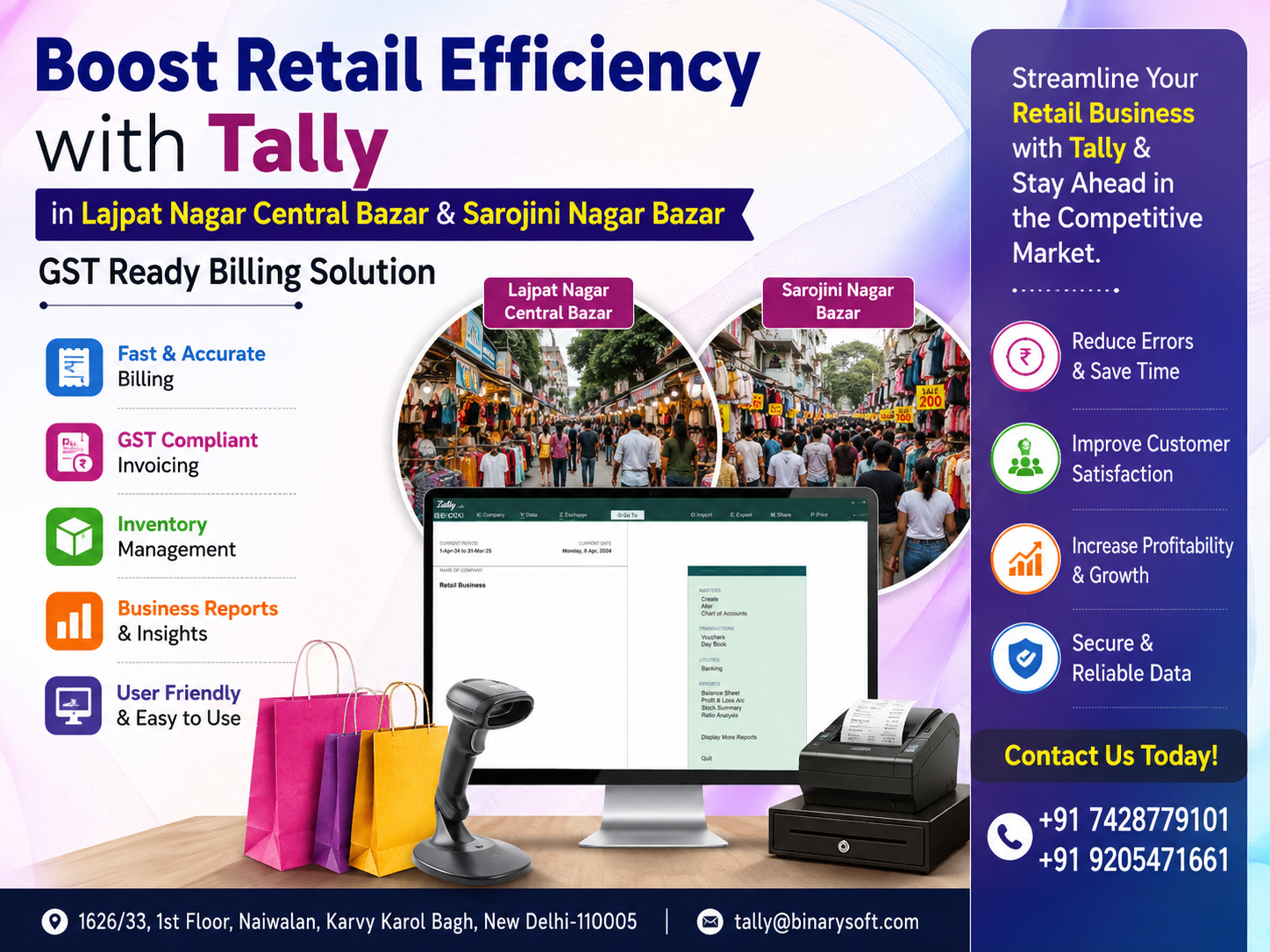
What Changed in 2026: Why Delhi Retailers Need Faster, Smarter Billing
Retail business in 2026 is becoming faster, more digital and increasingly dependent on accurate financial data. For shop owners and growing businesses in Lajpat Nagar Central Bazar and Sarojini Nagar Bazar, managing hundreds of daily transactions, GST-ready invoices, inventory movement, customer payments and supplier balances through disconnected systems can create unnecessary pressure. Customers expect quick billing, owners want real-time stock visibility, and businesses need reliable records for GST compliance and financial decision-making. This is where TallyPrime can make a practical difference. By bringing billing, accounting, GST, inventory and business reports into one integrated system, retailers can reduce repetitive work and gain better control over daily operations. Instead of waiting until the end of the day to understand sales or stock positions, businesses can maintain structured records as transactions happen and focus more attention on customers, margins and growth.
Retail Business in Lajpat Nagar and Sarojini Nagar Is Changing
Lajpat Nagar Central Market and Sarojini Nagar Market are among Delhi's well-known shopping destinations. From garments and footwear to accessories, home products, cosmetics and lifestyle merchandise, retailers in these markets operate in a highly competitive environment.
For many retailers, business is no longer limited to a customer walking into a shop, purchasing an item and paying cash. Today's transactions may involve UPI, cards, bank transfers, credit customers, online enquiries, delivery orders and multiple suppliers.
At the same time, retailers need to keep track of:
- Daily sales and purchases
- GST-ready invoices
- Product-wise stock
- Supplier outstanding balances
- Customer receivables
- Cash and bank transactions
- Expenses
- Product profitability
- GST-related records
- Returns and adjustments
- Business reports
- Outstanding payments
When these activities are maintained separately in registers, spreadsheets or multiple applications, getting one clear picture of the business becomes difficult.
A GST-ready accounting and billing solution such as TallyPrime can help centralize these activities.
Why Retail Efficiency Matters More in 2026
A busy retail store can process a significant number of transactions during peak hours. Even a small delay in preparing an invoice can create a queue at the billing counter.
But billing speed is only one part of retail efficiency.
Imagine a store completing 150 transactions during a busy day. If the billing system records sales but the inventory records are maintained separately, employees may need to update stock manually.
This creates additional work and increases the possibility of differences between physical and recorded stock.
An integrated system helps create a connected workflow:
Sale → Invoice → Stock Update → Accounting Entry → GST Records → Business Reports
Instead of recording the same transaction multiple times, businesses can maintain more organized records through a single system.
A Busy Evening That Changed One Retailer's Thinking
It was a crowded weekend evening in a garment shop near Lajpat Nagar Central Market.
Customers were waiting near the billing desk. One employee was checking prices, another was searching for stock information, and the owner was trying to confirm whether a particular design was actually available.
The billing register showed one figure.
The spreadsheet showed another.
And the employee responsible for the stock register had already left for the day.
A customer who had spent nearly twenty minutes selecting several items finally asked, "Can you please tell me whether the other size is available?"
Nobody could answer confidently.
The customer waited for a few minutes and eventually left without completing the purchase.
For the owner, losing one sale was frustrating. But the bigger concern came later that evening.
He realised the problem was not demand. Customers were coming into the store.
The problem was information.
Sales, inventory and accounting records were not connected.
Over the following weeks, the business started reorganizing its billing and inventory processes using integrated accounting software. Product records were structured properly, billing became connected with inventory, and the owner could review sales and stock information without depending entirely on handwritten registers.
The biggest change was not simply faster billing.
It was confidence.
When a customer asked whether an item was available, the team had better information to answer.
When the owner wanted to understand outstanding supplier payments, records were easier to review.
And when business became busy again, the team could focus more on serving customers rather than searching through registers.
For a retail business, that operational confidence can be extremely valuable.
What Is TallyPrime for Retail Businesses?
Tally Solutions' TallyPrime is business management software designed to support accounting, invoicing, inventory, taxation and reporting requirements.
For retailers, it can serve as a central system where transactions are recorded and subsequently reflected across relevant business records.
Instead of maintaining separate tools for accounting, stock and invoicing, retailers can build a more integrated workflow.
GST-Ready Billing for Retail Stores
GST is an important part of billing and accounting for registered businesses.
A structured billing solution can help businesses maintain relevant GST information while preparing invoices.
Depending on the business configuration and applicable requirements, retailers can maintain details such as:
- GSTIN
- HSN/SAC information
- Tax rates
- CGST
- SGST
- IGST
- Taxable values
- Invoice numbers
- Customer and supplier details
The advantage is that accounting and taxation-related information can be captured alongside the transaction rather than reconstructed later from disconnected records.
Businesses should still ensure that their GST configuration, classifications and tax treatment are appropriate for their particular transactions.
Faster Billing During Peak Shopping Hours
Speed matters enormously in markets such as Lajpat Nagar and Sarojini Nagar.
Customers usually do not want to spend unnecessary time waiting at a billing counter after completing their shopping.
A well-configured TallyPrime environment can help employees prepare invoices efficiently using predefined product, ledger and taxation information.
The workflow becomes more systematic:
Select customer → Select items → Enter quantity → Verify rate → Apply relevant taxes → Generate invoice.
When masters and inventory records are configured correctly, repetitive data entry can be reduced.
This is particularly valuable for businesses handling frequent transactions.
Inventory Management for Retail Businesses
Inventory is one of the biggest investments for many retailers.
A garment retailer may carry hundreds of designs, sizes and varieties. A footwear shop may maintain different sizes and models. An electronics or accessories retailer may deal with numerous SKUs.
Without systematic inventory records, retailers may encounter two common problems:
Overstocking: Too much money remains tied up in slow-moving merchandise.
Understocking: Popular products become unavailable exactly when customers want them.
TallyPrime can help businesses maintain stock-related information so owners can better understand what is available and how inventory is moving.
Stock Groups and Categories
Organized inventory starts with organized product masters.
For example, a garment business could structure products into groups such as:
Men's Wear
Women's Wear
Kids' Wear
Winter Collection
Summer Collection
Accessories
Subgroups can further organize merchandise.
A structured inventory system makes it easier to review product movement and understand which categories contribute to sales.
Know What Is Selling
Retailers frequently ask:
"Which products are selling fastest?"
"Which items have been lying in the shop for too long?"
"Which category generates more business?"
"What stock should I reorder?"
When sales and inventory information is properly maintained, business reports can provide useful insights.
Instead of purchasing stock entirely on instinct, retailers can combine their market experience with recorded business information.
Better Purchase Management
Retail efficiency is not only about selling products.
Purchasing decisions have a major impact on margins and cash flow.
Retail businesses may purchase merchandise from manufacturers, wholesalers, distributors or other suppliers.
Maintaining purchase transactions systematically can help businesses understand:
- Supplier-wise purchases
- Purchase values
- Pending payments
- Product quantities received
- Inventory additions
- Applicable tax information
This gives owners better visibility into the purchasing side of their business.
Supplier Outstanding Management
A retailer may work with dozens of suppliers.
Some require immediate payment, while others provide credit periods.
When supplier outstanding information is maintained systematically, businesses can review pending liabilities more easily.
This can help owners plan cash flow and avoid overlooking important supplier payments.
Customer Receivable Tracking
Some retailers and wholesalers provide goods on credit to regular customers, corporate buyers or resellers.
Managing these receivables through notebooks or informal messages can become difficult.
An accounting system helps businesses maintain customer ledgers and review outstanding balances.
This provides a clearer answer to a simple but critical question:
How much money is still due to the business?
Cash, UPI and Bank Transactions
Retail payment methods have changed significantly.
A customer may pay using:
- Cash
- UPI
- Debit card
- Credit card
- Bank transfer
- Other supported payment arrangements
Maintaining payment records properly is important because sales figures alone do not tell an owner where the money actually went.
Structured accounting allows businesses to record and classify receipts according to the appropriate accounts and payment modes.
Better Control Over Daily Expenses
Retail businesses incur numerous expenses beyond merchandise purchases.
These may include:
- Shop rent
- Electricity
- Staff expenses
- Transportation
- Packaging
- Repairs
- Internet
- Marketing
- Delivery charges
- Office expenses
If small expenses are not recorded consistently, owners may overestimate actual profitability.
Maintaining expenses systematically provides a more complete picture of business performance.
Sales Returns and Purchase Returns
Returns are common in retail.
Customers may return or exchange products because of size, colour, defects or other reasons. Businesses may also return damaged or incorrect merchandise to suppliers.
These transactions need to be recorded properly so that inventory and accounting information remain aligned.
A structured accounting system makes these adjustments easier to track than relying exclusively on handwritten corrections.
Understanding Retail Profitability
High sales do not automatically mean high profits.
A store may achieve strong turnover but still struggle because of:
- Low margins
- Excess inventory
- High operating expenses
- Customer outstanding balances
- Supplier liabilities
- Slow-moving merchandise
- Uncontrolled discounts
Business reports can help owners understand financial performance more clearly.
This allows management to move beyond the question:
"How much did we sell?"
toward the more important question:
"How is the business actually performing?"
Real-Time Business Visibility
Retailers traditionally waited until the end of a month or financial period to review accounts.
Digital accounting changes this approach.
When transactions are entered regularly and correctly, management can review updated business information much sooner.
Depending on maintained records, this may include:
- Sales
- Purchases
- Stock
- Receivables
- Payables
- Cash
- Bank balances
- Expenses
- Profit and loss information
Faster access to information supports faster decision-making.
TallyPrime for Garment Retailers
Garment businesses in Lajpat Nagar and Sarojini Nagar often deal with large product ranges.
Products may differ by:
- Brand
- Design
- Size
- Colour
- Material
- Season
- Price range
An organized inventory structure can help garment retailers maintain more useful product information and track movement systematically.
TallyPrime for Footwear Businesses
Footwear retailers have similar inventory challenges because a single model may exist in several sizes and variants.
Inventory records can help businesses understand availability and plan replenishment more effectively.
TallyPrime for Electronics and Accessories Retailers
Electronics and accessory retailers often manage products from multiple brands and suppliers.
Accurate purchase, sales and inventory records are particularly important because product values can vary considerably.
Accounting software can provide a central record of these transactions.
TallyPrime for Cosmetics and Lifestyle Stores
Cosmetics retailers may manage hundreds of products with different brands, variants and pricing structures.
Maintaining well-organized stock masters can simplify billing and inventory review.
From Single Store to Growing Retail Business
A system that works for a small shop should ideally continue supporting the business as operations expand.
A retailer may start with one location and eventually add:
- More employees
- More product categories
- Additional counters
- Additional locations
- Larger supplier networks
- More transactions
This is why businesses should think beyond today's billing requirement when choosing an accounting solution.
Why Manual Billing Can Become a Growth Barrier
Manual systems may appear simple when transaction volumes are low.
But as the business grows, the amount of information also grows.
More customers mean more invoices.
More products mean more stock records.
More suppliers mean more payable accounts.
More transactions mean more reconciliation.
Eventually, employees spend increasing amounts of time maintaining records rather than using those records to manage the business.
Digital accounting can help address this operational bottleneck.
Reduce Duplicate Data Entry
One of the biggest sources of inefficiency is entering the same information repeatedly.
For example:
First prepare the bill.
Then update stock.
Then update the customer ledger.
Then update the sales register.
Then prepare accounting information.
An integrated accounting workflow can reduce unnecessary duplication because a properly recorded transaction can update related records within the system.
Improve Accuracy Through Better Processes
Software does not automatically eliminate every error.
Incorrect data entered into any system can still produce incorrect results.
The real benefit comes from combining software with disciplined processes.
Businesses should establish clear procedures for:
- Creating masters
- Selecting tax rates
- Recording purchases
- Recording sales
- Handling returns
- Entering expenses
- Reconciling accounts
- Taking backups
- Reviewing reports
When employees follow consistent procedures, the quality of business information improves.
Better Decision-Making for Retail Owners
Retailers make decisions every day.
Should we reorder this product?
Should we increase stock before the festive season?
Which supplier gives better value?
Which category generates more revenue?
How much money is outstanding?
Are expenses increasing?
Do we have enough cash for upcoming supplier payments?
Reliable accounting and inventory records help owners answer these questions using business data rather than assumptions alone.
Retail Management During Festival and Sale Seasons
Delhi retail markets become particularly busy during festive periods, wedding seasons and promotional sales.
Transaction volumes may rise sharply.
During these periods, weak billing and inventory processes become much more noticeable.
Businesses can prepare in advance by:
- Reviewing stock levels
- Organizing product masters
- Checking pricing
- Reviewing tax configuration
- Training billing staff
- Testing invoice formats
- Checking backups
- Reviewing outstanding accounts
Preparation helps the business handle higher transaction volumes more smoothly.
Business Reports That Matter to Retailers
Retailers should not treat accounting software only as a bill-printing machine.
The reports generated from properly maintained transactions can be equally valuable.
Depending on configuration and data, owners can review information related to sales, purchases, inventory, outstanding accounts, cash, banks and profitability.
The purpose of these reports is not simply recordkeeping.
They can support better business decisions.
GST Compliance and Organized Records
GST-related responsibilities make systematic recordkeeping increasingly important.
Businesses need accurate transaction details, appropriate classifications and consistent accounting records.
TallyPrime can support GST-related accounting and invoicing workflows when configured according to the requirements of the business.
Because tax rules and compliance requirements can change, businesses should periodically review their software configuration and consult qualified tax professionals where necessary.
Data Backup Is Essential
Business accounting data can represent years of transactions.
Losing that data because of hardware failure, accidental deletion or inadequate backup practices can severely disrupt operations.
Retailers should establish a regular backup policy.
Important practices include:
- Regular backups
- Multiple backup copies where appropriate
- Restricted access
- Periodic restoration testing
- Secure storage
- Updated software and systems
A billing solution should be supported by a strong data-management process.
Why Proper Tally Implementation Matters
Installing accounting software is only the first step.
The quality of implementation determines how effectively a business can use it.
A retailer should consider:
- Business requirements
- Product structure
- Ledger structure
- GST configuration
- Inventory configuration
- Invoice requirements
- User workflow
- Reports required by management
- Backup requirements
- Staff training
A well-planned implementation can make daily operations significantly easier.
Staff Training Can Make the Difference
Even powerful software provides limited value if employees do not know how to use it correctly.
Billing staff should understand the tasks relevant to their role.
Accounts employees may require deeper knowledge of ledgers, taxation, reconciliation and reporting.
Owners should know how to review the reports necessary for decision-making.
Role-based training can therefore be more effective than trying to teach every employee every feature.
Why Local Support Matters for Delhi Retailers
When billing is central to daily business operations, delays can be costly.
A retailer cannot always wait several days to resolve an operational problem.
Businesses may require assistance with:
- TallyPrime installation
- Configuration
- GST setup
- Inventory setup
- Invoice customization
- Data migration
- Training
- Troubleshooting
- Upgrades
- Business workflow configuration
Access to professional support can help businesses resolve issues and use their software more effectively.
Binarysoft Technologies – Tally Solutions for Delhi Businesses
Binarysoft Technologies provides Tally-related solutions and support for businesses looking to improve accounting, billing, GST and inventory management.
As an Authorized Tally Partner, Binarysoft Technologies can assist businesses in understanding suitable Tally solutions according to their operational requirements.
Retail businesses in and around Lajpat Nagar, Sarojini Nagar, Karol Bagh and other Delhi commercial areas can seek assistance for implementation, configuration, training and support requirements.
Moving from Billing Software to Business Management
The most important shift for a retailer is understanding that modern accounting software can be more than an invoice-generation tool.
Billing creates the transaction.
But the same transaction can also contribute to:
Accounting
It records financial activity.
Inventory
It reflects product movement.
Taxation
It maintains relevant transaction-level tax information.
Outstanding Management
It contributes to receivable or payable records where applicable.
Reporting
It provides data for business analysis.
This connected approach can transform billing from an administrative task into a valuable source of business information.
How Lajpat Nagar Retailers Can Benefit
Businesses in Lajpat Nagar Central Market often operate in a fast-moving retail environment where competition is intense and customers have numerous choices.
Efficient billing can reduce waiting time.
Organized inventory can improve stock visibility.
Structured accounting can provide better financial control.
GST-ready transaction records can simplify compliance-related accounting processes.
Business reports can help owners understand performance.
Together, these improvements can create a more organized retail operation.
How Sarojini Nagar Retailers Can Benefit
Sarojini Nagar Market is known for high customer movement and value-oriented shopping.
Retailers working in such an environment often need to process transactions quickly while maintaining control over stock and pricing.
A properly implemented accounting and inventory solution can help businesses handle daily transactions systematically without losing visibility into their financial records.
Preparing Your Retail Business for the Future
Retail technology will continue to evolve.
Customers are becoming more comfortable with digital payments, businesses are increasingly dependent on electronic records, and owners expect faster access to financial information.
The businesses that benefit most from digital transformation are not necessarily those that install the most software.
They are the businesses that build better processes around technology.
For retailers, that means creating an integrated system for:
Billing → Inventory → Accounting → GST → Payments → Reporting → Decision-making.
That is where business software begins delivering long-term operational value.
Conclusion
Retail success in Lajpat Nagar Central Bazar and Sarojini Nagar Bazar depends on more than attracting customers. Behind every successful shop is a system that can handle billing, inventory, purchasing, payments, expenses and financial records accurately and efficiently.
In 2026, relying heavily on disconnected registers and spreadsheets can make it increasingly difficult to manage a growing retail operation. A GST-ready billing and accounting solution such as TallyPrime can help retailers centralize important business processes and maintain more organized records.
From faster billing and structured inventory management to supplier outstanding tracking, customer receivables and business reporting, an integrated system can give owners greater visibility into their operations.
The objective should not simply be to computerize billing.
It should be to create a retail management process where every transaction contributes to better information, better control and better decisions.
For retailers planning to implement, upgrade or improve their TallyPrime environment, professional configuration and training can help ensure that the software is aligned with actual business requirements.
Frequently Asked Questions
Is TallyPrime suitable for retail shops in Lajpat Nagar and Sarojini Nagar?
Yes. TallyPrime can support accounting, billing, inventory, taxation and reporting workflows for different types of retail businesses when appropriately configured.
Can TallyPrime be used for GST-ready billing?
Yes. TallyPrime supports GST-related accounting and invoicing functionality. Businesses should ensure their GST settings, tax rates, HSN/SAC information and transaction treatment are configured correctly.
CA. Harshit Gaurwaadi is a practicing Chartered Accountant with hands-on experience in accounting systems, GST compliance, and MSME advisory. He regularly works with small and mid-sized businesses to streamline inventory, billing, and statutory processes using modern accounting software. His articles focus on practical, ground-level challenges faced by Indian traders and professionals.