Call CA Tally HelpDesk
+91 9205471661,
7428779101
What Changed in 2026: Local Businesses Need Faster Control Over Stock and Accounts
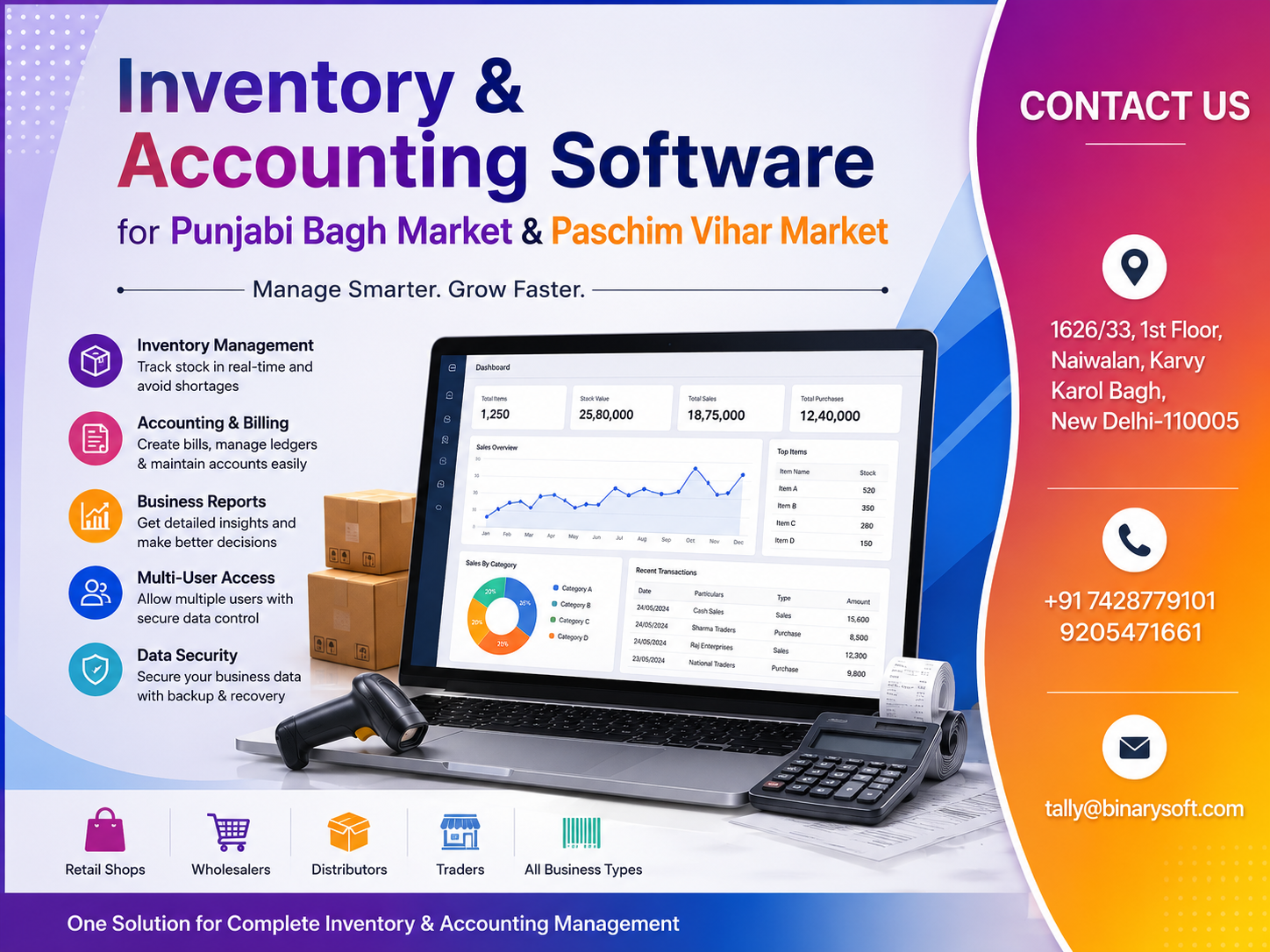
In 2026, businesses in Punjabi Bagh Market and Paschim Vihar Market are operating in an environment where fast billing alone is no longer enough. Customers expect quick service, owners need real-time visibility of stock, GST compliance requires accurate records, and even a small inventory mismatch can affect margins. Recent months have also increased the pressure on retailers, wholesalers, distributors and service businesses to keep accounting and inventory information organized instead of depending on separate spreadsheets, handwritten registers and disconnected billing systems. The benefit of moving to integrated inventory and accounting software is straightforward: sales, purchases, stock, outstanding payments, GST and business reports can be managed from one system. For growing businesses in West Delhi, solutions such as TallyPrime can help reduce repetitive work, improve stock visibility and give owners a clearer picture of their finances before making important purchasing or pricing decisions.
Why Punjabi Bagh and Paschim Vihar Businesses Need Better Business Management
Punjabi Bagh and Paschim Vihar are important commercial and residential areas of West Delhi, with businesses serving both local consumers and customers from surrounding areas.
From retail stores and wholesalers to distributors, restaurants, professional offices, electronics businesses, garment stores and service providers, every business has its own operational challenges. However, several requirements remain common:
- Accurate sales and purchase records
- Faster billing
- GST-ready accounting
- Inventory tracking
- Outstanding payment management
- Supplier management
- Bank reconciliation
- Profit and loss visibility
- Business reports
- Data security and backup
- Multi-user access for growing teams
When these activities are handled using different applications, spreadsheets and manual records, owners may spend significant time matching information.
Integrated inventory and accounting software helps bring these activities together.
A Punjabi Bagh Business Owner Who Discovered the Real Cost of Stock Confusion
Consider the example of a fictional retail business owner in Punjabi Bagh.
His store had been growing steadily. Customers were increasing, suppliers were offering more product varieties, and sales looked healthy. Yet at the end of every month, he faced the same uncomfortable question:
"If sales are good, why is available cash lower than expected?"
His accountant maintained financial records, employees prepared bills, and stock quantities were partly maintained through spreadsheets. The problem was not one major loss. It was dozens of small gaps.
Some products were being reordered even though stock was already available. A few fast-moving products went out of stock because nobody noticed their quantity falling. Supplier payments were recorded separately, and outstanding customer amounts required manual checking.
During one particularly busy week, a regular customer requested several items in quantity. Employees initially believed the products were unavailable. Later, they discovered that part of the required stock was sitting in storage.
The order had already gone elsewhere.
That moment changed the owner's approach. He realized that inventory information was not merely an accounting requirement. It directly affected customer service, working capital and sales opportunities.
After shifting toward integrated accounting and inventory management, the business could review stock, purchases, sales and outstanding balances from a more centralized system.
The emotional relief came not from having "new software," but from finally having greater confidence in the numbers used to run the business.
What Is Inventory and Accounting Software?
Inventory and accounting software combines financial accounting with stock management.
Instead of maintaining one application for billing, another spreadsheet for inventory and separate records for accounting, businesses can maintain connected transactions.
For example, when a sales transaction is recorded correctly, the system can simultaneously contribute to:
- Sales accounting
- Customer ledger
- Inventory movement
- Tax calculation
- Receivables
- Financial reporting
Similarly, a purchase can affect supplier accounts, inventory quantities, taxation and payables.
This connected approach can significantly reduce duplicate data entry.
TallyPrime for Businesses in Punjabi Bagh and Paschim Vihar
TallyPrime is widely used by Indian businesses for accounting, inventory, taxation and business management requirements.
Depending on business configuration and applicable features, it can support functions such as accounting, inventory management, invoicing, GST-related workflows, receivables and payables, banking and management reports.
For a business in Punjabi Bagh Market or Paschim Vihar Market, the objective is not simply to install accounting software. The important part is configuring it according to actual business operations.
A garment retailer, electronics distributor and hardware wholesaler may all use accounting software, but their stock structures can be very different.
Proper implementation therefore matters.
Smart Billing for Busy Retail Counters
During peak business hours, customers do not want to wait while employees struggle with billing calculations.
An organized billing system can help businesses prepare invoices faster while maintaining transaction records.
Depending on the business setup, invoices may include:
- Customer details
- Item descriptions
- Quantity
- Rate
- Discount
- GST details
- Payment information
- Other applicable transaction details
A properly structured billing process can also reduce manual calculations and repetitive entry.
For Punjabi Bagh and Paschim Vihar retailers handling numerous daily transactions, even a small reduction in time per invoice can improve counter efficiency.
Real-Time Inventory Visibility
One of the biggest advantages of integrated inventory software is improved visibility.
A business owner should ideally be able to answer important questions such as:
Which products are available?
Which items are selling quickly?
Which products need replenishment?
Which items have remained unsold?
How much stock is held in a particular location?
What is the value of available inventory?
Without structured inventory records, these questions can require physical counting or spreadsheet reconciliation.
Better inventory visibility helps management make faster purchasing decisions.
Manage Multiple Stock Groups and Categories
Businesses often deal with hundreds or thousands of items.
A clothing business may maintain stock according to brand, category, size or other attributes. An electronics dealer may track different product categories and models. A distributor may maintain products by manufacturer, category or location.
Creating a logical stock structure can make inventory reports more useful.
Businesses can organize stock using appropriate groups, categories, units and locations based on their requirements.
The goal is to make information easy to understand, not merely to create a large database.
Godown and Location-Based Inventory Management
Businesses with more than one stock location face another challenge: knowing where the inventory actually exists.
Stock may be divided among:
- Main shop
- Warehouse
- Secondary storage location
- Branch
- Dispatch location
Location-wise inventory management can help businesses identify stock at different locations and record transfers appropriately.
This can be especially useful for distributors and wholesalers serving customers throughout West Delhi and nearby business areas.
GST Accounting and Compliance Support
GST compliance is an important part of business accounting in India.
Incorrect tax classification, GSTIN details, transaction treatment or invoice information can create additional reconciliation work.
An accounting system configured according to the business's applicable GST requirements can help maintain organized transaction records.
Businesses can maintain relevant information for sales, purchases and taxation while generating reports required for review and compliance workflows.
However, software should complement professional tax advice rather than replace it. Businesses should consult their accountant or tax professional regarding their specific compliance obligations.
Accounts Receivable Management
Sales do not always mean immediate cash.
Many wholesalers, distributors and B2B businesses provide credit to regular customers. Over time, outstanding amounts can become difficult to track without proper records.
Accounting software can help businesses monitor:
- Customer outstanding balances
- Invoice-wise receivables
- Due amounts
- Payment entries
- Ageing information
This gives owners a clearer view of money that has been billed but not yet collected.
Better receivables visibility can support healthier cash-flow management.
Supplier and Accounts Payable Management
Businesses also need to know how much they owe suppliers.
Missing a payment can affect supplier relationships, while making an unnecessary duplicate payment creates its own problems.
Proper supplier ledger management provides visibility into purchases, payments and outstanding liabilities.
Owners can review payable information before planning cash requirements.
Purchase Management and Reordering Decisions
Inventory purchasing should ideally be based on demand rather than guesswork.
Suppose a retailer notices that a particular product sells consistently while another category has barely moved for several months.
Without sales and stock reports, the owner may continue purchasing both.
With better inventory information, purchasing decisions can be based on actual movement.
This can help reduce unnecessary stock accumulation and make working capital more productive.
Identify Fast-Moving and Slow-Moving Stock
Not every product deserves equal shelf or warehouse space.
Fast-moving products need sufficient availability because stock-outs can result in missed sales.
Slow-moving products need attention for the opposite reason: too much capital may be blocked in inventory that is not generating revenue.
Inventory reports can help management evaluate product movement and take appropriate commercial decisions.
For businesses operating with tight margins, this visibility can be extremely valuable.
Better Financial Visibility for Owners
A business owner should not have to wait until the end of the year to understand business performance.
Accounting reports can provide a structured view of financial activity.
Depending on the accounting setup, management can review reports such as:
- Profit and Loss
- Balance Sheet
- Trial Balance
- Cash and Bank position
- Receivables
- Payables
- Sales reports
- Purchase reports
- Stock reports
Regularly reviewing these reports helps transform accounting data into business information.
Bank Reconciliation
Matching bank transactions manually can consume considerable accounting time.
Bank reconciliation helps businesses compare accounting records with banking activity and identify differences that require attention.
For companies processing numerous payments and receipts, a disciplined reconciliation process improves the reliability of financial records.
Multi-User Accounting for Growing Businesses
A small business may initially have only one person managing accounts.
As the company expands, several employees may need to work with business data.
For example:
- Billing employee
- Accountant
- Purchase department
- Inventory staff
- Owner or management
A suitable multi-user setup can allow teams to work according to the organization's operational requirements.
Businesses considering TallyPrime should select the licensing and deployment arrangement that matches the number of users and their working environment.
User Access and Better Internal Control
Not every employee needs access to every financial record.
A cashier may require billing access, while management may require financial reports. An inventory employee may primarily work with stock-related transactions.
Setting appropriate user permissions can support stronger internal controls and reduce unnecessary access to sensitive business information.
Businesses should periodically review user access, especially when employees or responsibilities change.
Why Spreadsheets Alone Become Difficult as Businesses Grow
Spreadsheets remain useful business tools, but relying entirely on manually maintained spreadsheets for accounting and inventory can become difficult as transaction volumes increase.
Common challenges include:
- Duplicate entries
- Formula mistakes
- Multiple file versions
- Accidental deletion
- Difficulty tracing transactions
- Manual GST calculations
- Stock mismatch
- Limited transaction-level controls
- Time-consuming reconciliation
A growing business needs a structured system in which transactions are connected.
Inventory Software for Retailers
Retail businesses in Punjabi Bagh and Paschim Vihar may handle large numbers of products and daily customer transactions.
A properly configured inventory and accounting system can help retailers manage sales, purchases, stock quantities, customer accounts and business reporting.
Suitable businesses may include garment stores, footwear businesses, electronics retailers, mobile accessory shops, gift stores, home furnishing businesses and general retailers.
Accounting Software for Wholesalers
Wholesalers often face a different set of challenges.
They may deal with bulk quantities, credit customers, multiple suppliers, price variations and larger outstanding balances.
Their software requirements may therefore include detailed party ledgers, stock management, sales and purchase reporting, receivables and location-wise inventory.
Software for Distributors
Distributors need visibility across purchases, stock availability, sales and collections.
When product volumes increase, manual coordination between the warehouse and accounts department can become inefficient.
Integrated accounting and inventory information helps both teams work from consistent transaction data.
Software for Service Businesses
Inventory is not equally important for every organization.
Consultants, agencies and professional service providers may be more focused on accounting, invoicing, expense management, receivables, banking and taxation.
The software should therefore be configured around the business rather than forcing every organization to follow the same structure.
Benefits for Businesses in Punjabi Bagh Market
Businesses operating in Punjabi Bagh can benefit from organized accounting and inventory systems because commercial operations often involve frequent purchases, customer billing and stock movement.
The major business benefits can include:
- Faster access to financial information
- Improved stock visibility
- Better outstanding tracking
- Organized GST records
- Reduced duplicate entry
- Better purchase planning
- Improved management reporting
- More systematic accounting
The exact benefits depend on proper implementation and disciplined transaction entry.
Benefits for Businesses in Paschim Vihar Market
Paschim Vihar has a broad mix of retail stores, offices, service businesses and other commercial establishments.
For growing businesses, integrated software can provide a foundation for managing increasing transaction volumes.
Instead of adding more spreadsheets whenever the business grows, owners can develop a structured accounting and inventory workflow from the beginning.
How Better Inventory Control Can Improve Working Capital
Inventory represents money invested in products.
If ₹10 lakh worth of goods are sitting in a warehouse but a significant portion is not moving, the business may appear well stocked while still experiencing cash-flow pressure.
Inventory management helps owners understand where capital is tied up.
Better information can support decisions about:
- Future purchases
- Stock reduction
- Replenishment
- Product focus
- Supplier ordering
- Pricing and promotions
The software itself does not make these decisions, but it can provide the information required to make them intelligently.
Data Backup and Business Continuity
Business data is valuable.
Losing accounting records because of hardware failure, accidental deletion or another technical issue can disrupt operations.
Every business should therefore establish an appropriate backup policy.
Important considerations include regular backups, secure storage, controlled access and periodic verification that backups can actually be restored.
Businesses should not wait for a data-loss incident before creating a backup strategy.
Choosing the Right Accounting and Inventory Software
Before selecting software, businesses should identify their real requirements.
Important questions include:
How many users will operate the software?
How many products are maintained?
Is GST applicable?
Are multiple stock locations required?
Does the business sell on credit?
Are multiple branches involved?
Does management need remote or centralized access?
How frequently are reports required?
What level of user permissions is needed?
Is implementation or training required?
Answering these questions makes software selection easier and helps avoid purchasing a solution based only on price.
Why Implementation and Support Matter
Buying accounting software is only the beginning.
If ledgers, stock items, taxation settings and user permissions are configured incorrectly, the business may not receive the expected benefits.
Professional implementation can help structure the system around actual operational requirements.
Training is equally important because employees need to understand how transactions should be entered and reviewed.
Ongoing support can also help businesses address operational questions as their requirements evolve.
Binarysoft Technologies – Authorized Tally Partner
Binarysoft Technologies provides Tally-related solutions and assistance for businesses looking to improve accounting, inventory, billing and business management processes.
Businesses in Punjabi Bagh Market, Paschim Vihar Market and other parts of Delhi can discuss their requirements before deciding on an appropriate Tally setup.
The focus should be on understanding factors such as business type, number of users, inventory volume, GST requirements and working environment before implementation.
Powered by Binarysoft Technologies
Authorized Tally Partner
Location: 1626/33, 1st Floor, Naiwalan, Karol Bagh, New Delhi – 110005, INDIA
Contact Us: +91 7428779101, 9205471661
Email: tally@binarysoft.com
Business Hours: 10:00 AM – 6:00 PM, Monday to Friday
Conclusion
In 2026, inventory and accounting software is becoming increasingly important for businesses that want faster operations and better visibility over their finances. For retailers, wholesalers, distributors and service businesses in Punjabi Bagh Market and Paschim Vihar Market, managing sales, purchases, GST, inventory, receivables and financial reports through disconnected records can create unnecessary complexity.
An integrated solution such as TallyPrime can help businesses organize these activities within a more structured environment.
The greatest value, however, comes from accurate implementation and regular use. When transactions are recorded correctly, stock is monitored consistently, outstanding amounts are reviewed and management reports are used for decision-making, accounting software becomes more than a compliance tool.
It becomes an important source of business intelligence.
For companies looking to improve billing, GST accounting, stock management and financial visibility, Binarysoft Technologies can assist in evaluating and implementing an appropriate Tally solution based on actual business requirements.
Frequently Asked Questions
Which accounting software is suitable for businesses in Punjabi Bagh Market?
TallyPrime can be considered by retailers, wholesalers, distributors and other businesses that need accounting, invoicing, inventory and GST-related functionality. The appropriate setup depends on the company's size and requirements.
Can inventory and accounting be managed in the same software?
Yes. Integrated business software can connect accounting transactions with inventory movement, reducing the need to maintain separate stock and accounting records.
CA. Ankit Vardiya works closely with traders, wholesalers, and service businesses on accounting automation, GST reporting, and audit readiness. His professional exposure to day-to-day business operations allows him to translate complex accounting concepts into practical guidance for Indian business owners.