Call CA Tally HelpDesk
+91 9205471661,
7428779101
Manufacturing Businesses in 2026 Need More Than Basic Billing
In 2026, manufacturing-linked businesses serving Lajpat Nagar Central Market and Sarojini Nagar Market are dealing with tighter margins, faster replenishment cycles, greater product variety and growing pressure to know exactly what is available, what is being produced and what has already been committed to customers. In recent months, dependence on handwritten production registers, disconnected spreadsheets and separate billing systems has become increasingly difficult for businesses handling raw materials, finished goods, job work and GST transactions together. A delayed stock update can lead to unnecessary purchasing, while an incorrect invoice can affect dispatch, customer confidence and accounts. The practical benefit of integrated manufacturing business software is straightforward: connect billing, inventory, purchases, production and accounting so that management can make decisions from organised business data. For growing manufacturers and suppliers, better control can mean faster invoicing, fewer stock surprises and stronger visibility over daily operations.
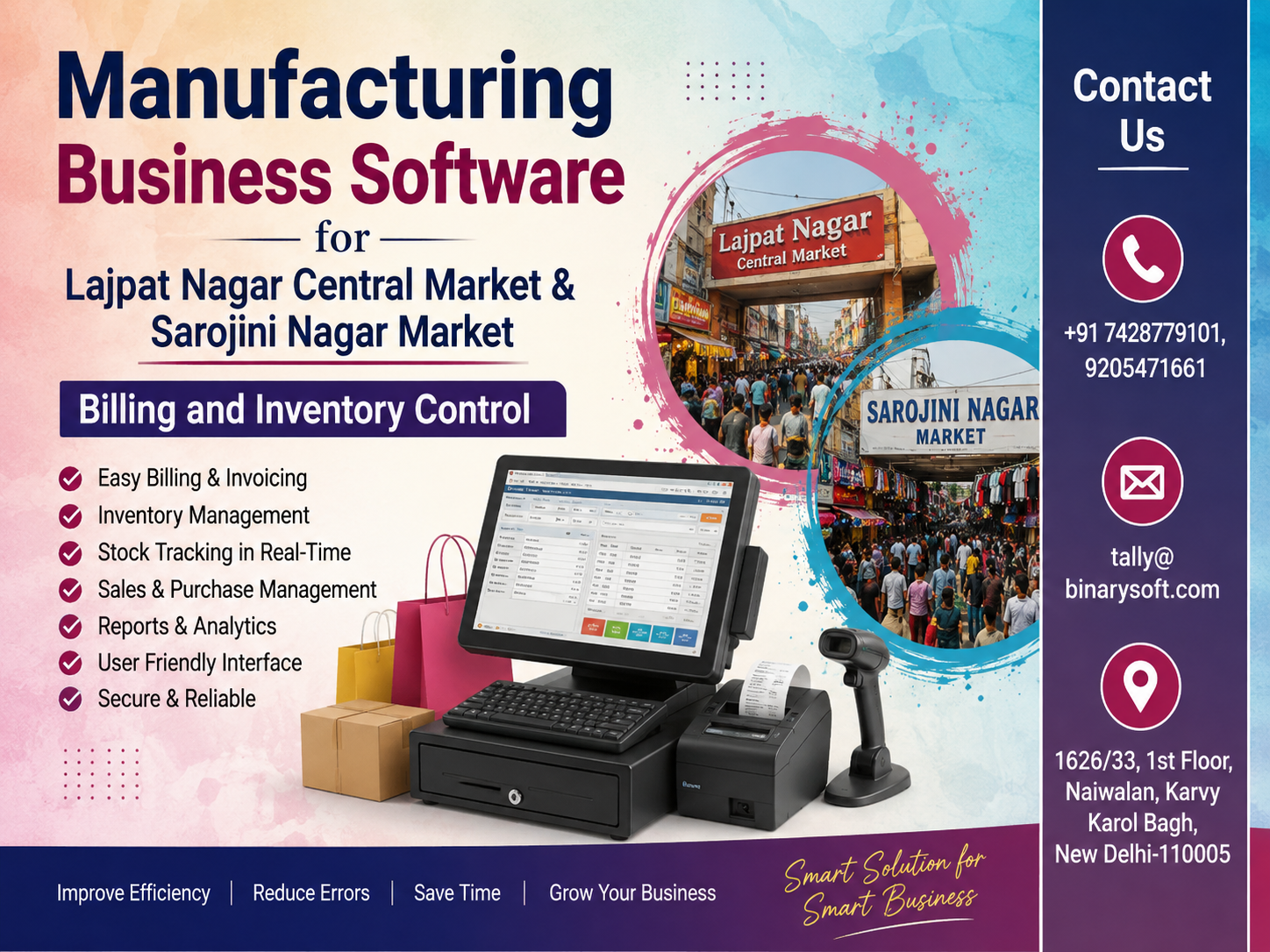
Manufacturing Business Software for Lajpat Nagar Central Market and Sarojini Nagar Market
Manufacturing is not simply about converting raw material into finished goods. Behind every finished product is a chain of purchases, material consumption, labour, processing, inventory movement, billing, taxation, payment collection and business reporting.
When these activities are managed through separate registers or files, owners can find themselves spending more time locating information than using it.
This is where an integrated manufacturing business software for Lajpat Nagar Central Market and Sarojini Nagar Market can make a meaningful difference.
Businesses can use a structured system to maintain inventory records, record purchases and sales, organise financial transactions, monitor receivables and payables and obtain reports that support day-to-day decision-making.
For businesses using TallyPrime, the system can be configured according to their accounting, inventory and operational requirements.
Why Manufacturing Businesses Need Better Inventory Control
Inventory is one of the most important assets of a manufacturing business.
Unlike a straightforward trading operation, a manufacturer may have several types of stock simultaneously:
- Raw materials
- Components
- Consumables
- Semi-finished goods
- Work-in-progress
- Finished products
- Packaging materials
- Rejected or damaged stock
- Goods sent for job work
- Goods received after processing
Without proper inventory control, management may know the total amount spent on purchases but still struggle to determine what is actually available for production.
An organised inventory system helps bring greater visibility to material movement and stock balances.
From Raw Material to Finished Goods
A manufacturer needs to understand the journey of inventory.
Suppose a business manufactures garments for retailers around Lajpat Nagar and Sarojini Nagar.
The business purchases fabric, buttons, zippers, labels, thread and packaging material. These items are consumed to manufacture finished garments.
If the business only records the purchase of fabric and the eventual sale of garments, an important part of the process remains invisible.
How much material was consumed?
How many finished units were produced?
Was there unusual wastage?
Which materials need to be reordered?
How much finished stock is currently ready for sale?
Structured inventory and manufacturing records can make these questions easier to answer.
The Story of One Missing Order
A small manufacturing unit supplying garments to several retailers had built its reputation over many years.
Its owner knew the business personally. He remembered which supplier gave the best fabric rates, which customer usually ordered in bulk and which designs moved fastest during the season.
For years, a combination of notebooks, spreadsheets and personal experience was enough.
Then the business started growing.
One afternoon, an important customer called with an urgent requirement for 600 pieces. The sales employee checked a spreadsheet and confirmed the order.
The customer arranged transportation and promised his own buyers that the goods would arrive the next morning.
But when the warehouse team started packing, only 410 finished pieces were available.
The spreadsheet showed more because some goods had already been dispatched against another order, but the entry had not yet been updated.
The owner stood in the warehouse that evening, surrounded by half-packed cartons, trying to arrange emergency production.
The biggest concern was not the missing 190 pieces.
It was the possibility of losing a customer who had trusted him for years.
That evening changed the way he looked at business software.
He realised that inventory management was not simply an accounting requirement. Accurate stock information protected commitments.
For a growing manufacturing business, knowing the correct quantity before saying "yes" to a customer can be as valuable as making the sale itself.
Fast Billing for Busy Market Operations
Lajpat Nagar Central Market and Sarojini Nagar Market are associated with fast-moving commercial activity.
Businesses supplying products into such environments need billing processes that can keep pace with customer demand.
Repeatedly entering customer names, product descriptions, tax information and rates manually consumes time and increases the possibility of errors.
A structured billing system can maintain relevant masters and transaction information so invoices can be generated more efficiently.
When billing is connected with inventory and accounting, the transaction can become part of the overall business record instead of remaining an isolated invoice.
TallyPrime for Manufacturing Businesses
TallyPrime can be considered by manufacturing businesses looking for an integrated environment for accounting, inventory, billing and related business processes.
Depending on the organisation's configuration and requirements, businesses may use TallyPrime for areas such as:
- Sales invoicing
- Purchase accounting
- Inventory management
- Raw material records
- Finished goods records
- Bill of Materials
- Manufacturing-related stock entries
- Godown management
- Receivables and payables
- GST-related accounting
- Banking
- Cost-related reporting
- Financial reports
- Business analysis
The exact implementation should be designed around the actual workflow of the organisation.
Binarysoft Technologies, an Authorized Tally Partner, can assist businesses in evaluating TallyPrime licensing, configuration, implementation and support requirements.
Bill of Materials for Better Production Planning
For manufacturers, knowing what goes into a finished product is essential.
A Bill of Materials, commonly known as BOM, represents the components or materials required to produce a particular finished item.
For example, a garment manufacturer may require fabric, buttons, thread, labels and packaging material for a finished garment.
A structured BOM can help create greater consistency in material planning and manufacturing records.
When product structures are properly configured, businesses can better understand expected material requirements and consumption.
This is particularly useful for organisations producing repeat products in standard quantities.
Raw Material Inventory Management
Running out of an important raw material can stop production.
At the same time, purchasing excessive quantities can lock working capital into inventory.
The objective is therefore not simply to keep more stock.
The objective is to keep appropriate stock.
Accurate raw material records can help management examine available quantities before placing new purchase orders or planning production.
Historical consumption and purchase information can also support better procurement decisions.
Finished Goods Stock Control
Once production is complete, finished products become available for sale.
But management needs to know which products are actually ready, how many units are available and whether those units have already been committed.
Maintaining structured finished-goods inventory can help sales teams provide more reliable availability information to customers.
This becomes particularly important during seasonal demand periods when popular products move quickly.
Better Purchase Management
Manufacturing businesses purchase materials from multiple suppliers, often at changing rates.
Organised purchase records can help management review supplier transactions, purchase values and outstanding balances.
Businesses can also use historical information to understand their procurement patterns.
Instead of relying entirely on memory or scattered files, management can refer to recorded transactions when evaluating future purchases.
Sales Management and Customer Records
Sales information is equally important.
Manufacturers supplying retailers, wholesalers and distributors need organised customer ledgers and sales records.
A connected business system can help management examine customer transactions, invoice history and outstanding amounts.
This creates a more complete picture of the customer relationship.
The sales team can focus on fulfilling orders while management retains visibility over the financial side of those transactions.
GST Billing for Manufacturing Businesses
Manufacturing businesses may handle transactions involving different products, tax classifications, customers and locations.
Accurate GST-related configuration is therefore important.
A properly configured accounting system can help businesses maintain GST-related transaction information in an organised manner and support relevant reporting and reconciliation workflows.
Businesses should ensure that GST classifications, tax rates and transaction treatment are maintained according to applicable requirements and reviewed by the appropriate professional where necessary.
The value of an integrated system is that GST-related information originates from the underlying purchase and sales transactions.
Receivables Management
A profitable sale does not immediately become available cash when the customer purchases on credit.
This distinction is particularly important for manufacturing businesses because money may already have been spent on raw material, labour and production before the customer pays.
Businesses therefore need visibility over receivables.
Structured accounting records can help management identify outstanding customer balances and follow up on pending payments.
Better receivable visibility can support healthier cash-flow management.
Supplier Payables Management
Manufacturers also need to know what they owe.
Supplier payment obligations can include raw material vendors, packaging suppliers and other business partners.
Keeping purchase and payment information together helps management understand upcoming liabilities.
This is important when planning cash flow because customer collections and supplier payments often occur on different schedules.
Multiple Godown and Storage Location Management
A manufacturing business may maintain inventory at several locations.
Raw material may be stored at one location.
Production may happen at another.
Finished goods may be maintained in a separate warehouse or dispatch area.
When inventory is physically distributed, location-wise records become increasingly valuable.
Appropriate godown configuration can help businesses maintain better visibility over where stock is recorded.
This can reduce unnecessary searching and improve coordination between production, warehouse, billing and management teams.
Managing Stock Transfers
Materials frequently move internally.
Raw material may move from storage to production. Finished goods may move from production to the warehouse. Goods may also be transferred between storage locations.
If these movements are not recorded consistently, system stock and physical stock can gradually become different.
Maintaining appropriate stock-transfer records helps preserve inventory accuracy.
Regular physical verification remains important, but software gives the business a structured record against which physical quantities can be compared.
Job Work and Outsourced Manufacturing
Not every manufacturing activity happens inside the business premises.
Some businesses send materials to external processors for cutting, stitching, finishing, printing, polishing, assembly or other specialised work.
This creates additional inventory-control requirements.
Management needs to know what material was sent, what was received back and what remains with the external party.
Depending on the business process and software configuration, job-work-related records can be structured to improve visibility over these movements.
Businesses with complex job-work requirements should have their workflow studied carefully before implementation.
Track Production More Systematically
Production management is most useful when records reflect what actually happens on the shop floor.
If production is completed but the transaction is not entered until several days later, software reports may not show the actual operational position.
For this reason, implementation should define who records production transactions and when.
A good system is not simply software.
It is software combined with a consistent process.
Reduce Inventory Leakage and Unexplained Differences
Stock differences can arise for many reasons.
They may result from incorrect entries, damaged goods, unrecorded consumption, incorrect units, missing stock transfers or physical handling issues.
When inventory records are structured, management has a better foundation for investigating differences.
Regular reconciliation between physical inventory and system inventory can highlight areas requiring attention.
The purpose is not merely to find mistakes after they occur but to create processes that reduce repeated errors.
Better Control Over Slow-Moving Stock
Manufacturers can accumulate inventory that does not move as expected.
Perhaps customer preferences changed.
Perhaps too much material was purchased.
Perhaps a finished product did not sell at the anticipated rate.
Whatever the reason, slow-moving stock represents money that remains tied up.
Inventory reports and transaction history can help management identify items that deserve closer review.
Management can then consider reducing future purchases, adjusting production or developing an appropriate sales strategy.
Cost Visibility for Manufacturing Decisions
Manufacturing profitability depends on more than the final selling price.
Businesses must consider material costs and other expenses associated with operations.
A business management and accounting system can provide structured financial information that supports management analysis.
However, accurate cost analysis depends heavily on proper configuration and disciplined transaction recording.
Businesses requiring detailed costing should define their reporting requirements before implementation so the system can be structured appropriately.
Avoid Overproduction
Producing more than customers require can create another form of inventory problem.
Finished goods occupy space and tie up capital.
For products affected by changing fashion or seasonal demand, excess production can be particularly risky.
This is relevant for businesses connected with markets such as Lajpat Nagar Central Market and Sarojini Nagar Market, where consumer preferences and product movement can change quickly.
Better sales and inventory information can help manufacturers make more informed production decisions.
Seasonal Demand and Manufacturing Planning
Retail-linked manufacturing businesses often experience significant seasonal changes.
Festivals, wedding seasons, school cycles, weather changes and fashion trends can influence demand.
Historical transaction information does not guarantee future sales, but it can provide useful context.
Management can examine previous periods and compare them with current stock levels before deciding how aggressively to purchase or manufacture.
This is far more structured than relying exclusively on memory.
Faster Information for Business Owners
One of the biggest advantages of integrated business software is access to organised information.
A business owner should not have to ask five different employees to understand today's position.
With properly maintained records, management can review relevant reports to understand sales, purchases, stock, outstanding balances and other business information.
This can reduce dependence on informal communication and make the organisation more scalable.
Role-Based Business Management
As a manufacturing business grows, responsibilities become distributed among employees.
One person may handle billing.
Another may handle purchases.
Warehouse employees may manage inventory.
An accountant may handle financial records.
Management may require broader visibility.
Appropriate security and access configuration can help ensure users work with the information required for their responsibilities.
This becomes increasingly important as the number of users grows.
Reduce Dependence on Spreadsheets
Spreadsheets remain useful tools, but they can become difficult to manage when many people repeatedly update operational information.
Different versions can circulate.
Formulas can be changed accidentally.
Transactions can be omitted.
Stock may be updated in one sheet but not another.
An integrated business application provides a more structured transaction environment.
For manufacturers handling regular purchases, production, inventory movements and sales, this can reduce duplication and improve consistency.
Why Local Implementation and Support Matter
Buying software is relatively easy.
Making software work correctly for a specific business requires more thought.
Two manufacturing businesses operating in the same market may have completely different requirements.
One may manufacture garments.
Another may assemble electrical products.
Another may produce packaging material.
Their inventory structure, units, manufacturing processes and reporting requirements will differ.
Implementation should therefore begin with understanding the business workflow.
Binarysoft Technologies can assist businesses with Tally-related implementation and support based on their specific operational requirements.
Manufacturing Software for Garment and Fashion Businesses
Businesses supplying Lajpat Nagar and Sarojini Nagar may include manufacturers and suppliers connected with garments, accessories, fashion products and related merchandise.
Such businesses can have large numbers of designs, variants and rapidly changing stock.
Accurate item creation and inventory organisation become important.
A suitable stock structure can help employees distinguish between products and maintain more useful inventory reports.
The structure should remain practical, however. Excessive complexity can make everyday data entry difficult.
Manufacturing Software for Other Industries
The same basic principles can apply across many manufacturing categories.
Businesses producing or assembling electrical items, hardware products, packaging material, furniture components, household products, promotional goods, accessories or industrial products may also require connected inventory and accounting.
The details change from industry to industry, but the central requirement remains similar:
Know what came in.
Know what was consumed.
Know what was produced.
Know what was sold.
Know what remains.
Know what money is receivable and payable.
Moving from Manual Manufacturing Records to TallyPrime
Migration should be planned rather than rushed.
Businesses can begin by reviewing existing records and deciding which information needs to be carried into the new system.
Important information may include:
- Customer masters
- Supplier masters
- Item masters
- Raw material lists
- Finished product lists
- Units of measurement
- Opening stock quantities
- Opening balances
- Outstanding receivables
- Outstanding payables
- Godown information
- GST-related details
Existing information should be cleaned before migration wherever possible.
Duplicated product names and inconsistent units should be corrected because poor master data can continue creating problems after implementation.
Employee Training Is Essential
Even well-configured software cannot produce reliable reports when transactions are recorded incorrectly.
Employees should therefore understand the correct procedures for sales, purchases, inventory movements, production-related entries and payment transactions relevant to their responsibilities.
Training also helps reduce resistance to a new system.
Employees who understand how the software makes their own work easier are more likely to use it consistently.
Why Growing Manufacturers Should Act Before Problems Become Bigger
A common mistake is waiting until existing systems completely fail.
A manufacturer may continue with spreadsheets because they still work "most of the time."
But growth gradually increases complexity.
Twenty products become two hundred.
Ten customers become five hundred.
One employee becomes a team.
One warehouse becomes multiple locations.
At that point, changing systems becomes harder because the business has accumulated even more data.
Building structured processes while the business is growing can make future expansion easier.
Key Benefits of Manufacturing Business Software
A properly configured solution can help manufacturing businesses achieve:
- Faster and more organised invoicing
- Better raw material visibility
- Better finished goods control
- Structured purchase records
- Structured sales records
- Customer outstanding visibility
- Supplier payable visibility
- Godown-wise inventory control
- More systematic manufacturing records
- Reduced duplicate data entry
- Better GST-related record management
- Improved management reporting
- Greater operational visibility
- Better support for business decision-making
The actual benefits depend on configuration, employee usage and the quality of data entered.
TallyPrime Support Near Lajpat Nagar and Sarojini Nagar
Businesses searching for manufacturing software in Lajpat Nagar, billing software for Lajpat Nagar Central Market, inventory software for Sarojini Nagar Market, TallyPrime for manufacturers in Delhi, or manufacturing accounting software in Delhi can discuss their requirements with Binarysoft Technologies.
Rather than focusing only on software installation, businesses should consider the complete implementation process: licensing, configuration, data preparation, training and ongoing support.
Powered by Binarysoft Technologies
Authorized Tally Partner
Location:
1626/33, 1st Floor, Naiwalan, Karol Bagh, New Delhi – 110005, INDIA
Contact Us:
+91 7428779101, 9205471661
Email:
tally@binarysoft.com
Business Hours:
10:00 AM – 6:00 PM, Monday to Friday
Conclusion
Manufacturing businesses connected with Lajpat Nagar Central Market and Sarojini Nagar Market operate in a demanding commercial environment where customers expect quick availability confirmation, accurate invoices and reliable delivery commitments.
As the business grows, manual registers and disconnected spreadsheets can make it increasingly difficult to maintain accurate information across raw materials, production, finished goods, purchases, sales, customer balances and supplier payments.
An integrated manufacturing business software for billing and inventory control can provide a more structured approach.
TallyPrime can be considered by manufacturers looking to connect accounting, inventory, billing and manufacturing-related records according to their business requirements.
The real objective is not simply digitisation. It is control.
When owners can see accurate stock information, understand outstanding balances, review purchases and sales and obtain useful reports, they can spend less time searching for information and more time making business decisions.
For TallyPrime licensing, implementation, configuration, training and support, businesses can contact Binarysoft Technologies, an Authorized Tally Partner in New Delhi.
Frequently Asked Questions
What is manufacturing business software?
Manufacturing business software helps organisations maintain structured records for activities such as purchases, inventory, production-related stock movement, sales, billing, accounting and financial reporting.
Is TallyPrime suitable for manufacturing businesses?
TallyPrime can be considered by manufacturing businesses requiring integrated accounting, inventory, billing and related functionality. The appropriate setup depends on the manufacturer's workflow and reporting requirements.
Can TallyPrime manage raw materials and finished goods?
TallyPrime provides inventory functionality that can be configured to maintain different stock items, including raw materials and finished goods.
Can manufacturers use a Bill of Materials in TallyPrime?
Manufacturing businesses can use appropriate inventory and manufacturing configurations, including Bill of Materials functionality, where suitable for their production process.
CA. Lakshy Vermaa advises small and mid-sized businesses on accounting discipline, tax compliance, and process improvement. With exposure to retail and trading environments, he writes practical articles aimed at helping business owners gain better financial visibility and control.