Call CA Tally HelpDesk
+91 9205471661,
7428779101
Manufacturing Businesses Are Changing Fast in 2026
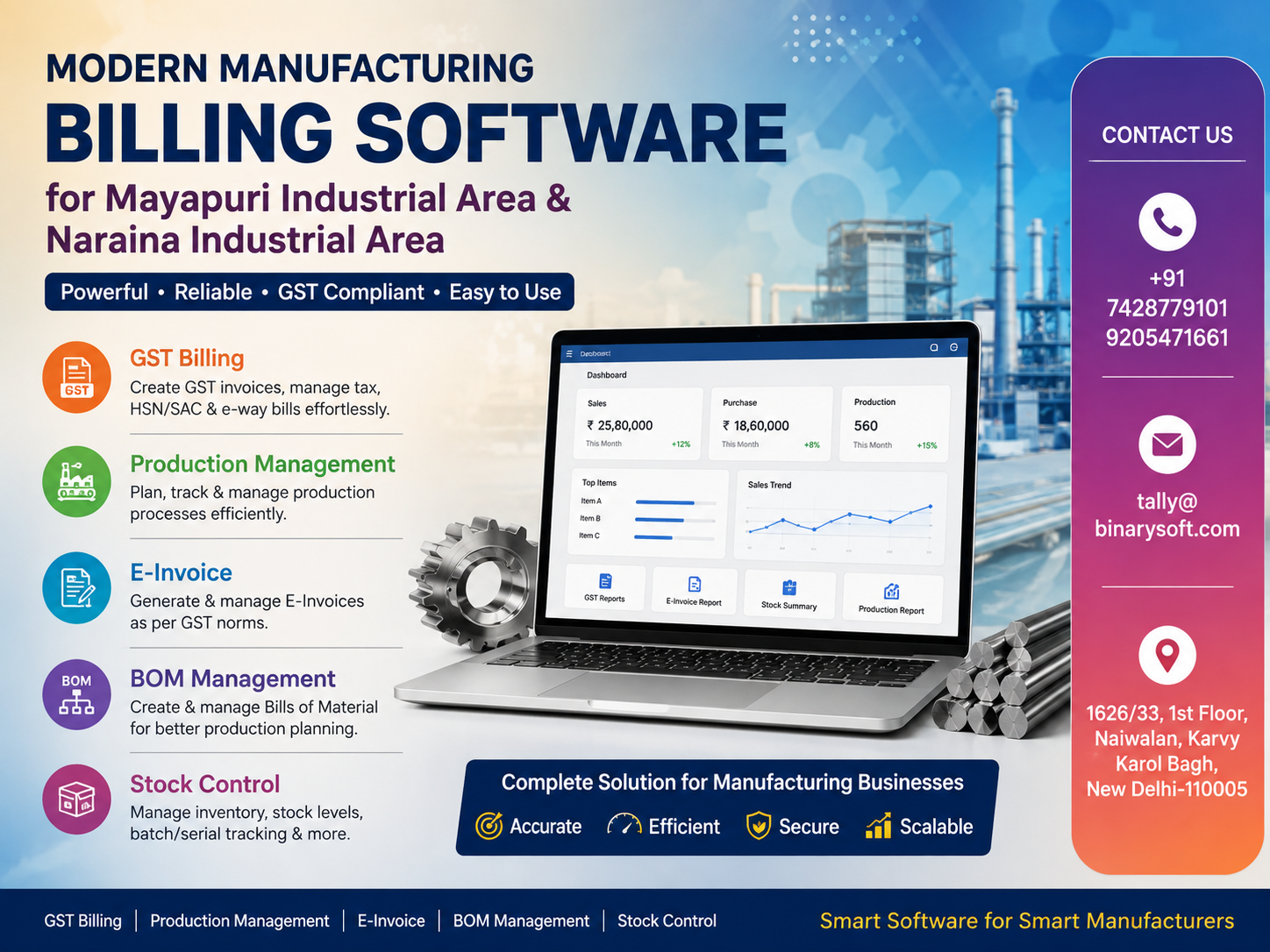
In 2026, manufacturers can no longer afford to treat billing, production, inventory and accounting as separate activities. Businesses operating in busy industrial hubs such as Mayapuri Industrial Area and Naraina Industrial Area face growing pressure to deliver orders faster, maintain accurate stock, control raw-material consumption, manage GST documentation and keep production costs visible in real time. A small mismatch between purchase records, BOM consumption, finished goods and invoices can affect margins and delay customer deliveries. Modern manufacturing billing software changes this by connecting GST billing, production management, Bill of Materials, inventory, purchase, sales, E-Invoice processes and financial accounting in one structured system. Instead of waiting until month-end to discover stock shortages or costing errors, manufacturers can obtain timely business information and make faster decisions. For growing factories, workshops, fabricators, assemblers and distributors, integrated software is increasingly becoming the foundation for better operational control.
Why Manufacturers in Mayapuri and Naraina Need More Than Basic Billing Software
Mayapuri Industrial Area and Naraina Industrial Area are important commercial and industrial locations in Delhi. Businesses operating in and around these areas may deal with manufacturing, fabrication, engineering components, automobile parts, machinery, electrical products, packaging materials, metal products, industrial supplies and numerous other product categories.
The accounting requirements of a manufacturing company are very different from those of a simple retail shop.
A retailer may primarily need to purchase products, maintain stock and sell them. A manufacturer, however, may purchase several raw materials, consume them through multiple production stages, produce semi-finished or finished goods, generate scrap or by-products and finally sell the manufactured item.
This creates an important question:
How much did it actually cost to manufacture each finished product?
If the business cannot answer this question accurately, pricing and profitability decisions become difficult.
Modern manufacturing billing software helps connect the complete process:
Purchase → Raw Material Inventory → BOM → Production → Finished Goods → Sales → GST Invoice → Accounting → Outstanding → Profitability
When these operations are managed through an integrated system, management gets a much clearer picture of the business.
What Is Manufacturing Billing Software?
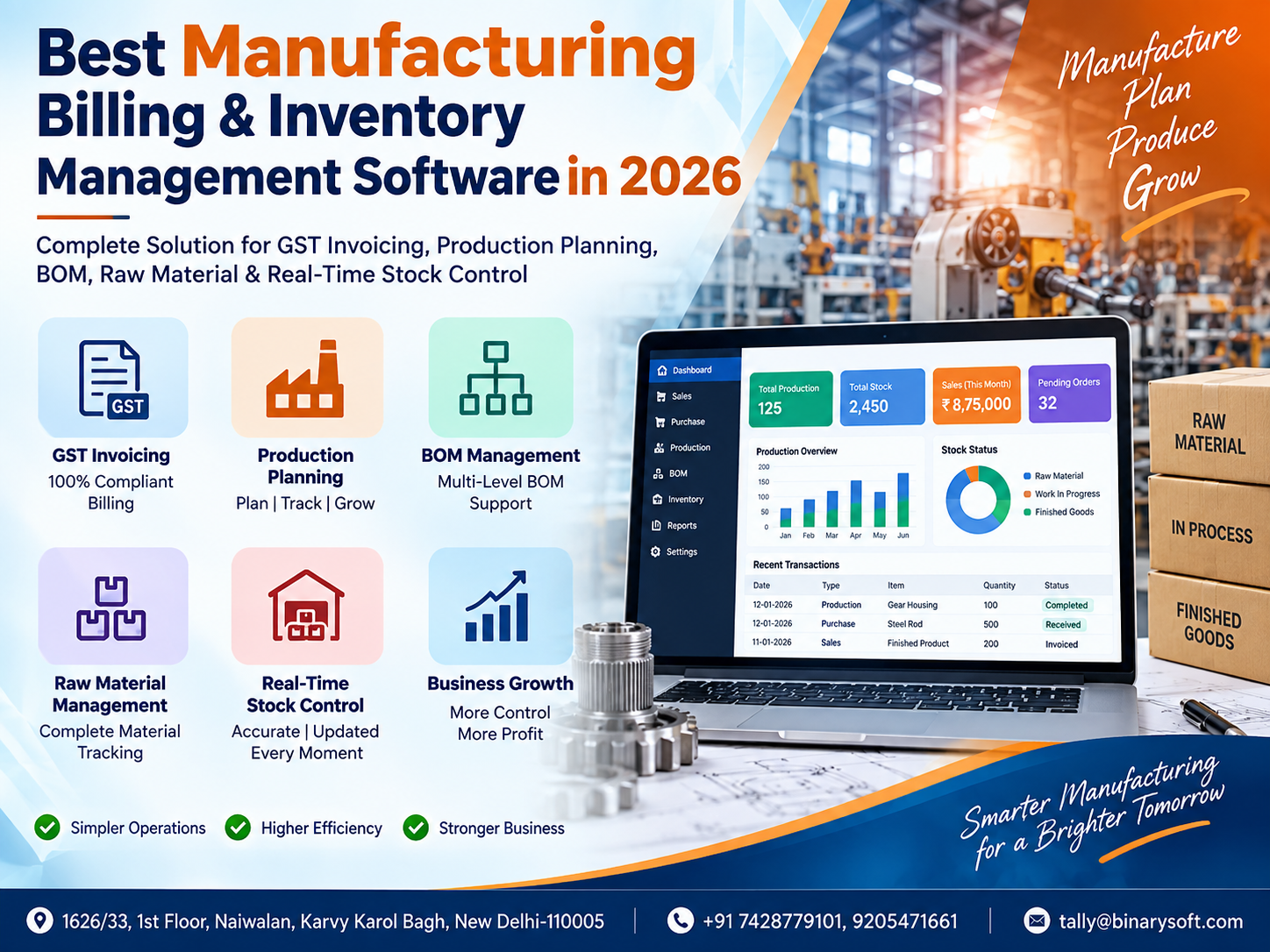
Manufacturing billing software is a business management solution designed to handle much more than invoice generation.
It can help manufacturers manage:
- GST-compliant sales and purchase transactions
- Raw-material inventory
- Finished goods inventory
- Bill of Materials
- Manufacturing and production entries
- Material consumption
- Stock transfers
- Multiple godowns or locations
- Purchase management
- Sales order processing
- E-Invoice-related workflows where applicable
- E-Way Bill-related processes where applicable
- Receivables and payables
- Financial accounting
- Cost centres
- Job or project-related tracking
- Business reports
- Profitability analysis
For a growing manufacturing business, this means fewer disconnected spreadsheets and better visibility across departments.
A Mayapuri Manufacturer's Story: When a Profitable Order Started Looking Like a Loss
Consider the example of a fictional engineering components manufacturer operating from Mayapuri Industrial Area.
The company had grown steadily. Orders were coming from Delhi-NCR as well as customers in other states. From the outside, everything looked positive.
Sales were increasing.
Workers were busy.
Machines were running.
Dispatches were happening every day.
But the owner, Rajesh, had a problem.
Despite increasing turnover, the bank balance did not seem to reflect the growth.
Every month his accountant reported good sales, while his production supervisor frequently requested urgent purchases of materials that were supposedly already available according to the stock records.
One afternoon, an important customer called asking why a large order had not been dispatched.
The production team said one critical component was unavailable.
The accounting records, however, showed sufficient stock.
Rajesh was frustrated.
He opened several spreadsheets, checked handwritten production registers and called the store supervisor. After almost two hours, the reason became clear: raw materials had been issued to production, but the consumption had not been recorded correctly.
The inventory was available on paper, not on the factory floor.
The delayed order was eventually completed, but Rajesh realised something more worrying: if raw-material consumption was inaccurate, how could he know the true manufacturing cost of his products?
That evening became a turning point.
The company started moving toward an integrated manufacturing system where purchases, BOM, material consumption, production, finished goods and sales could be tracked in a structured manner.
A few weeks later, Rajesh was no longer asking only:
"How much did we sell?"
He had started asking the far more valuable question:
"What did we earn from what we produced?"
That difference is exactly why manufacturing businesses need more than ordinary billing software.
1. GST Billing for Manufacturing Businesses
Billing is the final commercial stage of many manufacturing transactions, but it is connected to everything that happens before the invoice.
A modern system should allow businesses to prepare sales invoices while maintaining the corresponding accounting and inventory impact.
Depending on business requirements, invoices may contain details such as:
- Customer information
- GSTIN
- Invoice number and date
- Product description
- HSN/SAC details as relevant
- Quantity
- Rate
- Discount
- Taxable value
- GST details
- Transportation-related information
- Payment terms
- Additional charges
- Order or reference details
Instead of repeatedly entering the same transaction into separate billing, stock and accounting systems, integrated software can reduce duplicate work.
2. Production Management: Know What Is Being Manufactured
Production is the heart of a manufacturing business.
Yet many small and mid-sized manufacturers still rely heavily on manual registers or spreadsheets to record production.
This creates problems when management wants answers to questions such as:
- How much was manufactured today?
- Which raw materials were consumed?
- How much finished stock is available?
- Which production order is pending?
- Was excess material consumed?
- Which items are below minimum stock?
- What was the approximate production cost?
- Is production matching sales demand?
Production management software can create a structured flow between materials and finished goods.
When production information is updated regularly, management gets better operational visibility.
3. Bill of Materials (BOM): The Foundation of Manufacturing Control
A Bill of Materials or BOM defines the materials or components normally required to manufacture a product.
For example, suppose an industrial assembly requires:
- Component A – 2 units
- Component B – 4 units
- Metal Sheet – 1 unit
- Packaging Material – 1 set
This combination can be defined as the BOM for the finished product.
When production is recorded, the appropriate raw materials can be consumed and the finished product added to inventory according to the configured workflow.
Why BOM Is Important
Without proper BOM management, manufacturers may struggle with:
- Incorrect material consumption
- Unexplained inventory shortages
- Excessive wastage
- Incorrect product costing
- Production delays
- Manual calculation errors
- Difficulty planning future purchases
A properly configured BOM helps create a standard production structure.
4. Raw Material Inventory Management
Inventory is often one of the largest working-capital investments for a manufacturing company.
Too little stock can stop production.
Too much stock can block money.
The objective is therefore not simply to keep "more stock." The objective is to maintain the right stock at the right time.
Manufacturing inventory software can help track:
- Raw materials
- Components
- Consumables
- Packing materials
- Semi-finished goods
- Finished goods
- Scrap and by-products, depending on configuration
- Location-wise stock
- Batch-wise stock where applicable
Management can use inventory reports to identify shortages before they begin affecting production schedules.
5. Finished Goods Stock Control
Producing goods without knowing the actual available finished inventory can create unnecessary production or missed sales.
Suppose the sales team receives an urgent order for 500 units.
Before committing to the customer, the team should ideally know:
- Current finished stock
- Stock already committed to other orders
- Material available for additional production
- Pending purchase orders
- Production requirements
- Expected dispatch capability
An integrated system creates better coordination between sales, stores and production.
6. E-Invoice Management for Eligible Businesses
E-Invoicing has made structured digital invoicing an important part of GST compliance for businesses to which the requirements apply.
Manufacturers dealing with significant B2B transaction volumes need their billing processes to be organised so that invoice information remains accurate and consistent.
A suitable software setup can help streamline the E-Invoice workflow and reduce repeated data entry.
Businesses should ensure that their E-Invoice configuration reflects the GST requirements applicable to their turnover, transaction type and current regulatory position.
The major benefit is operational efficiency.
Instead of preparing an invoice in one system and repeatedly recreating the same information elsewhere, an integrated workflow can make compliance processes easier to manage.
7. E-Way Bill Workflow
Manufacturers frequently move goods between factories, warehouses, customers and other business locations.
Where E-Way Bill requirements apply, accurate invoice and transportation information becomes important.
An integrated billing system can help maintain consistency between:
- Invoice information
- Customer details
- Product details
- Taxable value
- HSN information
- Transportation details
- Dispatch documentation
This can be especially useful for companies handling frequent interstate or local dispatches.
8. Purchase Management
Manufacturing efficiency begins long before production starts.
It begins with purchasing.
Poor purchase planning can result in either shortages or unnecessary stock accumulation.
A manufacturing business should be able to monitor:
- Purchase orders
- Supplier details
- Material rates
- Purchase invoices
- Pending orders
- Supplier outstanding
- Material receipts
- Stock availability
- Purchase history
Historical purchase information can also help management compare supplier rates and make better procurement decisions.
9. Sales Order Management
A customer order should ideally not disappear into a WhatsApp message, email inbox or handwritten notebook.
Sales orders can be recorded systematically so that the organisation knows what needs to be produced and dispatched.
This can help answer:
Which customer orders are still pending?
How much material will be required?
Do we already have finished stock?
What quantity needs to be manufactured?
What has already been invoiced?
Order visibility is particularly valuable for manufacturers handling multiple customers and product variations.
10. Multiple Godown and Warehouse Management
Manufacturers in Mayapuri Industrial Area and Naraina Industrial Area may operate from more than one location.
For example:
- Raw-material godown
- Factory floor
- Finished goods warehouse
- Dispatch location
- Branch
- Job-work location
Without location-wise tracking, total inventory figures can be misleading.
A business may have 1,000 units in total but only 50 units at the location where they are immediately required.
Godown-wise stock reports provide a more practical view.
11. Material Movement and Stock Transfers
Stock regularly moves between locations during manufacturing.
Every movement should ideally leave a record.
This makes it easier to identify:
- Where material came from
- Where it went
- Which location currently holds it
- Whether stock was transferred internally
- Whether stock balances match physical inventory
Better stock movement records improve internal accountability.
12. Manufacturing Cost Control
Sales growth does not automatically mean profit growth.
This is one of the most important lessons for manufacturers.
A company might increase revenue while simultaneously experiencing increases in:
- Raw-material prices
- Labour expenses
- Electricity costs
- Transportation costs
- Packaging expenses
- Wastage
- Rework
- Machine costs
- Administrative overheads
If selling prices are not adjusted appropriately, margins can shrink silently.
Manufacturing and accounting software provides the data foundation required to analyse costs more effectively.
13. Track Material Wastage and Scrap
Scrap is not always avoidable.
Unrecorded scrap, however, creates a serious inventory-control problem.
Depending on the manufacturing process and configuration, businesses may need to account for:
- Expected wastage
- Unexpected wastage
- Rejected material
- Scrap generated
- Reusable material
- By-products
Tracking these elements helps management compare actual consumption with expected consumption.
Large differences can indicate process inefficiencies that require investigation.
14. Barcode Management for Faster Inventory Operations
Manufacturers handling hundreds or thousands of SKUs can benefit from barcode-based processes.
Barcode integration may help with:
- Item identification
- Billing
- Stock entry
- Warehouse operations
- Finished goods tracking
- Faster item selection
- Reduced manual typing
The exact barcode workflow should be designed according to the nature of the products and business operations.
15. Batch-Wise and Lot-Wise Tracking
Some manufacturing businesses need to know exactly which batch of goods was produced or purchased.
Batch or lot tracking may be useful in industries dealing with products that require traceability.
It can help maintain information such as:
- Batch number
- Production batch
- Quantity
- Purchase batch
- Stock availability
- Dispatch information
- Expiry-related information where relevant
Traceability becomes increasingly important as manufacturing operations scale.
16. Financial Accounting Integrated With Manufacturing
A manufacturing system becomes significantly more useful when operational information is connected with financial accounting.
Management should not need completely separate systems to understand sales and accounts.
Integrated accounting can help manage:
- Sales
- Purchases
- Receipts
- Payments
- Expenses
- Journal transactions
- Customer outstanding
- Supplier outstanding
- Cash
- Bank
- Profit and loss
- Balance sheet
- Ledgers
- Tax-related records
This provides management with both operational and financial visibility.
17. Receivable Management
A company can report excellent sales and still experience cash-flow problems.
Why?
Because invoiced sales are not the same as collected money.
Manufacturers often extend credit to dealers, distributors and corporate customers.
Management therefore needs to monitor:
- Total receivables
- Customer-wise outstanding
- Invoice-wise outstanding
- Ageing
- Overdue invoices
- Credit periods
- Collection status
Timely follow-up can improve cash-flow discipline.
18. Supplier Payable Management
Supplier relationships are equally important.
Delayed payments can affect:
- Material availability
- Supplier confidence
- Credit limits
- Purchase terms
- Production continuity
A structured accounting system provides visibility into bills payable and their due dates.
Businesses should also maintain appropriate processes for payment obligations applicable to eligible Micro and Small Enterprise suppliers under prevailing law.
19. Cost Centre and Department-Wise Analysis
A manufacturer may operate multiple:
- Departments
- Production units
- Projects
- Product categories
- Sales teams
- Locations
Cost-centre-based accounting can help allocate income and expenses to relevant business segments.
Instead of seeing only total company expenditure, management can analyse where costs are arising.
20. Job Work Management
Many manufacturing businesses outsource specific processes.
For example:
Cutting → External Processing → Finishing → Return to Factory
Materials sent outside for processing need proper tracking.
Depending on the software configuration and operational requirements, job-work records can help businesses maintain better control over material issued and received.
This reduces the risk of materials remaining unaccounted for outside the factory.
21. Why Excel Alone Becomes Difficult as Manufacturing Grows
Excel remains useful for analysis and many business tasks.
The problem arises when multiple spreadsheets become the primary operational database.
A company might maintain separate sheets for:
- Purchases
- Sales
- Raw materials
- Production
- Finished goods
- Customer outstanding
- Supplier payments
Soon, different employees may be working with different versions.
A purchase entry may be updated in one sheet but not another.
Production may be completed without updating raw-material consumption.
An invoice may be changed without correcting a related report.
Integrated software reduces dependence on disconnected records.
22. Real-Time Reports for Better Decisions
A business management system should not merely store transactions.
It should transform transactions into useful information.
Manufacturers can benefit from reports such as:
- Stock summary
- Raw-material stock
- Finished goods stock
- Item-wise movement
- Purchase analysis
- Sales analysis
- Outstanding receivables
- Outstanding payables
- Profit and loss
- Balance sheet
- Cash and bank position
- Order status
- Godown-wise inventory
- Cost-centre reports
When management has timely information, decision-making becomes faster.
23. How Software Can Help Avoid Production Delays
Production delays often begin with small information gaps.
The sales team promises delivery without checking inventory.
The production department assumes material is available.
The store discovers a shortage.
Purchasing places an urgent order.
The supplier cannot deliver immediately.
The customer's order gets delayed.
Better information flow can interrupt this chain.
When stock, purchases, sales and production information are connected, departments can coordinate more effectively.
24. Better Control Over Slow-Moving Inventory
Not every inventory problem is a shortage.
Sometimes the bigger problem is stock that is not moving.
Slow-moving raw materials and finished products occupy storage space and block working capital.
Inventory reports can help identify items that have had limited movement.
Management can then investigate whether to:
- Reduce future purchasing
- Use material in alternative production
- Clear finished stock
- Review minimum stock levels
- Change procurement quantities
This converts inventory information into working-capital decisions.
25. Data Security and User Access Control
As a manufacturing business grows, more employees require software access.
However, every employee should not necessarily have access to every function.
Businesses may require role-based controls for:
- Billing staff
- Accounts department
- Purchase department
- Stores
- Production team
- Management
Appropriate user controls can help protect sensitive business information while allowing employees to perform their responsibilities.
26. Software for Different Types of Manufacturers
Manufacturing billing and inventory solutions can be configured for many industries, depending on their operational complexity.
Examples may include:
- Automobile parts manufacturers
- Engineering component manufacturers
- Electrical equipment businesses
- Machinery manufacturers
- Fabrication units
- Packaging businesses
- Furniture manufacturers
- Plastic product manufacturers
- Metal component manufacturers
- Industrial equipment suppliers
- Assembly businesses
- Consumer goods manufacturers
- Printing and packaging units
- Hardware manufacturers
- General manufacturing SMEs
The most important factor is not simply the industry name.
It is how the business actually purchases, produces, stores, sells and accounts for goods.
27. Why Mayapuri Industrial Area Businesses Need Integrated Management
Manufacturing businesses operating in competitive industrial markets frequently handle urgent orders and tight delivery schedules.
When billing, accounting and inventory are disconnected, owners spend too much time verifying basic information.
An integrated system can reduce this dependency.
Instead of asking several people for separate reports, management can access structured business information from the accounting and inventory system.
This becomes increasingly valuable as transaction volumes increase.
28. Manufacturing Software for Naraina Industrial Area
Naraina Industrial Area is also home to diverse commercial and industrial operations.
Growing manufacturers need systems capable of supporting increasing:
- Customers
- Suppliers
- SKUs
- Purchase transactions
- Production activity
- GST invoices
- Inventory locations
- Employees
- Financial transactions
The software selected today should therefore not solve only today's billing problem.
It should provide a foundation that can support future operational growth.
29. From Raw Material Purchase to Final GST Invoice
Consider a simplified manufacturing workflow.
Step 1: Purchase Raw Materials
The company buys required materials from suppliers.
Step 2: Receive and Record Inventory
Material quantities are recorded in the appropriate stock location.
Step 3: Create or Use BOM
The standard components required for the finished product are defined.
Step 4: Issue Materials for Production
Raw materials move into the production process.
Step 5: Record Manufacturing
Materials are consumed and finished goods are produced according to the configured process.
Step 6: Update Finished Goods Inventory
Completed products become available for sale or dispatch.
Step 7: Process Customer Order
The sales team checks availability and prepares the order.
Step 8: Generate GST Invoice
The final invoice is generated with the required transaction details.
Step 9: Complete Applicable Compliance Workflow
E-Invoice and E-Way Bill requirements can be handled where applicable to the business and transaction.
Step 10: Track Customer Payment
The invoice remains in receivables until payment is received and accounted for.
This is the advantage of integration: one transaction flows logically into the next.
30. Benefits of Modern Manufacturing Billing Software
The biggest benefits can include:
- Better inventory accuracy
- Faster GST billing
- Improved raw-material visibility
- Structured production recording
- BOM-based material planning
- Better finished goods control
- Reduced duplicate data entry
- Easier purchase monitoring
- Better customer outstanding tracking
- Improved supplier payable visibility
- Better financial accounting
- Faster management reporting
- Improved coordination between departments
- Greater control over business operations
The actual benefits depend heavily on proper configuration and disciplined data entry.
31. What to Check Before Selecting Manufacturing Software
Do not choose software based only on the number of features advertised.
First understand your own workflow.
Ask:
- How many products do we manufacture?
- How many raw materials are involved?
- Do products require BOMs?
- Do BOMs vary?
- Do we maintain multiple warehouses?
- Do we undertake job work?
- Do we require barcode management?
- Do we need batch tracking?
- How many people will use the software?
- What accounting reports are required?
- What GST-related workflows apply to us?
- Do we require E-Invoice integration?
- Do we need E-Way Bill processes?
- How are production entries currently recorded?
- Which reports does management need every day?
Once these questions are answered, software configuration becomes much more meaningful.
32. Implementation Is as Important as Software Selection
Buying software does not automatically improve a business.
Implementation matters.
A proper implementation should consider:
- Company configuration
- GST settings
- Ledger structure
- Stock groups
- Stock items
- Units of measurement
- Godowns
- BOM structure
- Opening balances
- User permissions
- Invoice formats
- Production workflow
- Reporting requirements
- Backup practices
- Staff training
A poorly configured system can recreate the same problems businesses were trying to eliminate.
33. Employee Training Is Essential
Employees need to understand not only how to enter a transaction but also why accurate entry matters.
For example, if production staff do not record material consumption correctly, stock reports become unreliable.
If purchase entries are delayed, available inventory may appear lower than reality.
If customer receipts are not entered promptly, outstanding reports become inaccurate.
Good software plus disciplined processes produces better information.
34. Why Tally-Based Business Management Can Help Manufacturers
Many Indian businesses use Tally for accounting, taxation, inventory and business management.
Depending on the requirements and configuration, manufacturers can use Tally-based solutions and associated workflows for areas such as:
- Accounting
- GST invoicing
- Inventory
- Manufacturing entries
- BOM
- Godowns
- Cost centres
- Orders
- Receivables
- Payables
- Financial reporting
- Applicable connected compliance processes
The final configuration should always be based on the manufacturer's actual operational requirements.
35. Why Work With an Authorized Tally Partner?
Manufacturing implementation often requires more than installing software.
Businesses may need assistance with:
- Understanding existing processes
- Software selection
- Tally configuration
- Inventory setup
- BOM configuration
- Manufacturing workflows
- GST billing
- Invoice formats
- Data migration planning
- User training
- Support
- Business-specific requirements
Working with an experienced Tally partner can help align the system more closely with day-to-day operations.
Powered by Binarysoft Technologies
Binarysoft Technologies provides Tally-related business solutions and support for manufacturers, wholesalers, distributors, retailers and other businesses.
Authorized Tally Partner
Businesses in Mayapuri Industrial Area, Naraina Industrial Area, Karol Bagh and other locations across Delhi-NCR can discuss their requirements for GST billing, manufacturing, inventory, BOM, accounting and related business processes.
Before implementation, the business workflow can be evaluated to determine which features and configurations are actually required.
Conclusion
Manufacturing in 2026 is becoming increasingly dependent on accurate, timely and connected business information. For companies operating in Mayapuri Industrial Area and Naraina Industrial Area, managing GST billing in one place, raw materials in another spreadsheet, production in a register and accounts in a separate system can create avoidable information gaps.
Modern manufacturing billing software provides a more integrated approach.
By connecting GST billing, production management, Bill of Materials, raw-material inventory, finished goods, purchases, sales, E-Invoice workflows, stock control and financial accounting, manufacturers can gain better visibility over the complete business cycle.
The real advantage is not simply faster invoice generation.
It is knowing what material is available, what has been consumed, what has been manufactured, what remains to be dispatched, how much customers owe, how much suppliers need to be paid and how the business is performing financially.
For a growing manufacturer, that visibility can turn everyday transaction data into better business decisions.
Frequently Asked Questions
What is manufacturing billing software?
Manufacturing billing software combines billing with inventory, production and accounting processes. Depending on the solution and configuration, it can help manage raw materials, BOMs, production entries, finished goods, purchases, GST invoices, customer outstanding and financial reports.
Is manufacturing software suitable for small factories in Mayapuri Industrial Area?
Yes. Small and growing manufacturing businesses can benefit from structured inventory, billing and production records. The appropriate configuration depends on transaction volume, product complexity and the manufacturing process.
CA. Pankaj Bhadoria brings practical experience in GST, accounting, and business process consulting. He works closely with MSMEs to resolve compliance challenges and improve operational transparency. His articles aim to simplify complex regulations for everyday business use.