Call CA Tally HelpDesk
+91 9205471661,
7428779101
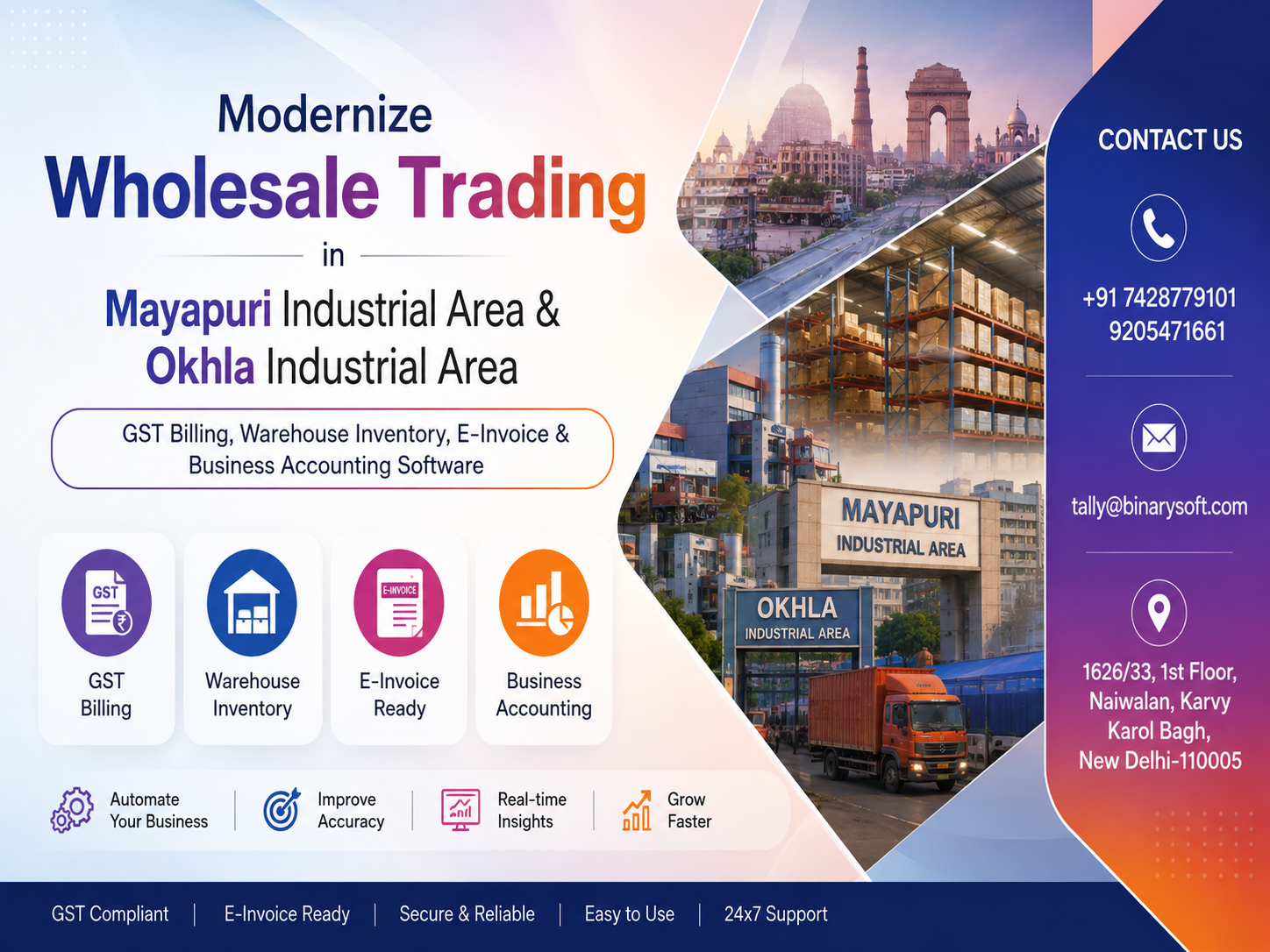
Wholesale Trading Is Changing in 2026: Are Your Business Systems Ready?
In 2026, wholesale businesses operating in Mayapuri Industrial Area and Okhla Industrial Area, Delhi are facing a faster, more compliance-driven business environment. GST billing, inventory accuracy, e-invoicing, e-way bill requirements, receivable management and real-time financial reporting are no longer isolated accounting activities—they increasingly need to work together. A wholesaler handling hundreds or thousands of products cannot afford to depend on scattered spreadsheets, handwritten stock registers and disconnected billing processes. One incorrect stock figure can delay an order, while a billing or GST data error can create additional reconciliation work. The benefit of modern business accounting software is straightforward: faster billing, better warehouse visibility, improved GST compliance and stronger control over cash flow from one connected system. For growing wholesalers, distributors, stockists and industrial suppliers, modernization is becoming an operational necessity rather than simply an IT upgrade.
Why Wholesale Businesses in Mayapuri and Okhla Need Modern Business Software
Mayapuri Industrial Area and Okhla Industrial Area are important commercial and industrial locations in Delhi. Businesses operating in these areas may deal with automotive components, machinery, industrial products, electrical goods, electronics, packaging materials, hardware, engineering products, spare parts, raw materials, consumer goods and numerous other product categories.
Wholesale trading is fundamentally different from simple counter-based retail.
A wholesaler may have to manage:
- Large quantities of inventory
- Multiple warehouses or godowns
- Hundreds or thousands of SKUs
- Different purchase and selling rates
- Dealer-specific pricing
- Credit sales
- Outstanding payments
- GST invoices
- Purchase orders
- Sales orders
- Delivery documentation
- E-invoices, where applicable
- E-way bills, where applicable
- Batch, serial number or item-wise tracking
- Business accounting
- Profitability and cash-flow monitoring
When these activities are managed separately, management can struggle to get a reliable picture of the business.
An integrated GST billing, inventory and accounting system helps bring these operations together.
A Story from the Wholesale Counter: When One Missing Stock Update Nearly Cost a Customer
Imagine a wholesale industrial parts supplier operating from Mayapuri.
It is 11:15 in the morning, and the sales counter is already busy. A long-term customer calls with an urgent requirement for 120 units of a particular component. The spreadsheet used by the sales team shows 146 units available.
The salesperson immediately confirms the order.
The customer arranges transportation and promises the material to his own client the same afternoon.
But when the warehouse team starts picking the order, only 83 units can be found.
The remaining quantity had already been dispatched against another invoice, but the spreadsheet had not been updated.
Suddenly, a normal working day becomes stressful.
The salesperson calls the customer.
The warehouse team checks old dispatch papers.
The accountant searches invoices.
The owner starts calling suppliers for emergency stock.
The customer is frustrated because his own delivery commitment is now at risk.
The real problem was not simply "missing stock."
It was missing real-time visibility.
Now imagine the same business with integrated inventory and billing software. Once goods are purchased, sold, transferred or adjusted, inventory records are updated systematically. Before promising 120 units, the salesperson can check available stock and relevant inventory information.
That difference can protect more than one order.
It can protect a business relationship.
What Is Wholesale Business Management Software?
Wholesale business management software is a centralized solution designed to help businesses manage financial and operational activities such as billing, accounting, purchases, sales, inventory, warehouses, taxation and receivables.
Instead of maintaining separate systems for accounting, stock and invoicing, businesses can work with connected information.
For example:
Purchase → Inventory → Sales Order → Invoice → GST → Outstanding → Payment → Accounting Reports
When these processes are connected, management can obtain a clearer view of what is happening across the business.
For wholesalers in Mayapuri Industrial Area and Okhla Industrial Area, this can be especially valuable because transaction volumes, inventory quantities and credit sales can become difficult to control manually as the business grows.
1. GST Billing Software for Faster Wholesale Invoicing
Billing is one of the most frequent activities in a wholesale operation.
A good GST billing solution should make invoice creation faster while reducing repetitive manual work.
Businesses can maintain customer, item, tax and pricing information so that billing teams do not need to re-enter the same information for every transaction.
Depending on the software and configuration, billing processes can support:
- GST-compliant invoices
- CGST, SGST and IGST calculations
- HSN/SAC details
- Customer GSTIN records
- Item-wise taxation
- Discounts
- Multiple units of measurement
- Credit and cash invoices
- Debit and credit notes
- Sales returns
- Purchase returns
- Delivery documentation
- Outstanding tracking
- Invoice printing and sharing
For busy wholesale counters, saving even a small amount of time on every invoice can produce significant efficiency gains over hundreds of transactions.
2. Warehouse Inventory Management for Better Stock Control
Inventory is often one of the largest working-capital investments for a wholesaler.
That makes stock visibility extremely important.
Without reliable inventory records, businesses can face two opposite problems.
Overstocking locks money into slow-moving products.
Understocking can cause missed orders and unhappy customers.
Warehouse inventory software can help businesses track stock movement systematically.
Depending on the solution, businesses may monitor:
- Opening stock
- Purchases
- Sales
- Stock transfers
- Returns
- Adjustments
- Closing stock
- Item-wise quantity
- Godown-wise inventory
- Reorder requirements
- Fast-moving products
- Slow-moving products
- Non-moving stock
The objective is not simply knowing how much stock exists.
The objective is knowing what stock exists, where it is located and how quickly it is moving.
3. Multiple Godown and Warehouse Management
A growing wholesale business may maintain stock across a main warehouse, shop, secondary godown or other storage locations.
Without centralized records, warehouse transfers can become difficult to reconcile.
Modern inventory software can allow businesses to maintain multiple inventory locations and record transfers between them.
For example:
Mayapuri Main Warehouse → Secondary Godown → Sales/Dispatch
or
Okhla Warehouse A → Okhla Warehouse B → Customer Delivery
This can help management understand the quantity available at individual locations rather than relying only on a combined stock figure.
It also supports better purchasing and dispatch decisions.
4. E-Invoice Integration for Eligible Businesses
E-invoicing has become an important part of India's GST compliance framework for businesses that fall within the applicable requirements.
Where e-invoicing applies, businesses need a process that can connect invoice creation with the required e-invoice workflow.
A properly configured business system can help reduce duplicate data entry and make compliance processes more manageable.
Businesses should ensure that their software and internal processes are configured according to the currently applicable GST rules, turnover criteria and notified requirements, as government requirements can change.
This is particularly important for growing wholesalers whose turnover may cross applicable compliance thresholds.
5. E-Way Bill Management for Goods Movement
Wholesale businesses regularly move goods from warehouses to customers, branches or other business locations.
Depending on the nature and value of the transaction and applicable GST rules, an e-way bill may be required.
Integrated business software can help businesses use invoice information for the e-way bill process rather than repeatedly entering transaction data into separate systems.
This can reduce:
- Duplicate entry
- Typing mistakes
- Incorrect item information
- GSTIN mismatches
- Document inconsistencies
- Dispatch delays
The exact applicability of e-way bill requirements should always be checked against current GST rules and transaction circumstances.
6. Complete Purchase Management
Wholesale profitability begins with purchasing.
A business may sell large quantities every month but still face margin pressure if purchases are poorly controlled.
Modern business software can help maintain supplier-wise purchase records and provide information for better buying decisions.
Businesses can track:
- Supplier details
- Purchase invoices
- Purchase orders
- Item quantities
- Purchase rates
- Taxes
- Purchase returns
- Supplier outstanding amounts
- Payment history
- Stock received
Historical purchase information can also help management compare buying patterns and identify products where procurement costs are increasing.
7. Sales Order to Invoice Management
A common wholesale workflow begins before the invoice.
A customer places an order.
The sales team confirms quantity and price.
The warehouse prepares material.
Goods are dispatched.
The invoice is generated.
Payment becomes due.
If these stages are handled separately, information can be missed.
An integrated system can provide a more organized flow:
Sales Order → Stock Allocation → Dispatch → Invoice → Receivable → Payment
This becomes increasingly useful as transaction volume grows.
8. Customer-Wise Pricing and Discount Management
Not every wholesale customer purchases at the same price.
A distributor buying 1,000 units may receive different pricing from a dealer purchasing 50 units.
Businesses may also offer:
- Dealer discounts
- Quantity-based discounts
- Promotional pricing
- Special negotiated rates
- Customer-specific prices
- Cash discounts
- Seasonal schemes
Business software can help maintain structured pricing information, depending on the selected solution and configuration.
This reduces dependence on memory or handwritten price lists.
It can also help prevent accidental underbilling.
9. Receivables and Outstanding Payment Management
Credit is a major part of many wholesale businesses.
Sales growth looks positive on paper, but cash flow can become difficult if customers do not pay on time.
A business therefore needs visibility into both sales and collections.
Accounting software can provide information such as:
- Customer outstanding
- Invoice-wise outstanding
- Ageing reports
- Due dates
- Overdue invoices
- Credit balances
- Receipts
- Adjustments
Consider a wholesaler with ₹80 lakh in monthly sales.
If a large portion remains outstanding beyond expected credit periods, the business may struggle to pay suppliers even though its sales reports appear strong.
This is why receivable management is as important as sales reporting.
10. Payables and Supplier Management
The same principle applies to suppliers.
Businesses need to know:
- How much is payable
- To whom it is payable
- Which invoice is due
- When payment is due
- Which payments have already been made
- Whether any debit or credit adjustments remain pending
A clear payable system can help businesses plan cash requirements and maintain better relationships with suppliers.
11. Integrated Business Accounting
Wholesale management software becomes considerably more powerful when inventory and billing are connected with accounting.
Instead of preparing financial information separately, transactions can flow into the accounting system according to the business setup.
Management can then review important reports such as:
- Profit & Loss Account
- Balance Sheet
- Trial Balance
- Cash Book
- Bank Book
- Ledger reports
- Sales Register
- Purchase Register
- Receivables
- Payables
- Inventory reports
This provides a broader financial view of the organization.
12. Know Which Products Are Actually Making Money
High sales do not automatically mean high profits.
Suppose Product A generates ₹20 lakh in sales while Product B generates only ₹12 lakh.
At first glance, Product A looks more valuable.
But if Product A has a very thin margin and Product B has a stronger margin, the second product may contribute more meaningfully to profitability.
This is why businesses need more than turnover figures.
They need useful management information.
Product and transaction analysis can help business owners understand:
- Sales performance
- Purchase costs
- Inventory movement
- Gross margins
- Customer performance
- Product performance
Better visibility can support better commercial decisions.
13. Identify Slow-Moving and Non-Moving Inventory
A warehouse may look full while working capital is actually stuck.
Imagine that a Mayapuri wholesaler has ₹1 crore worth of inventory.
If ₹20 lakh of that inventory has barely moved for several months, a significant amount of capital is tied up in stock.
Management needs to identify such situations early.
Inventory reports can help highlight products requiring attention.
The business can then consider appropriate actions such as reviewing future purchases, adjusting pricing, promoting inventory or discussing alternative strategies with the sales team.
14. Better Reorder Planning
Running out of a fast-selling item can be expensive.
The immediate loss is one sale.
The larger risk is that the customer begins purchasing the product from a competitor.
Inventory management software can support reorder planning by giving businesses visibility into current stock and consumption patterns.
Instead of ordering based entirely on assumptions, management can use actual transaction information.
This can help balance two goals:
Keep enough stock to serve customers while avoiding unnecessary overstocking.
15. Barcode-Based Inventory Management
For wholesalers handling large product ranges, barcode-based workflows can improve speed and accuracy.
Depending on business requirements and the selected solution, barcode processes can be used for:
- Item identification
- Billing
- Stock verification
- Picking
- Packing
- Inventory counting
- Product lookup
Barcode usage is especially valuable where products look similar but have different sizes, specifications, models or SKUs.
16. Batch and Serial Number Tracking
Some wholesale businesses need more detailed product tracking.
For example, electronics, equipment, components or other serialized products may require serial-number-level identification.
Other products may need batch tracking.
Appropriate inventory software can help businesses maintain such information according to their operational requirements.
This can be useful for:
- Warranty-related identification
- Product traceability
- Returns
- Batch monitoring
- Stock verification
- Customer service
17. GST Reporting and Reconciliation Support
GST compliance involves more than simply adding tax to an invoice.
Businesses also need organized records for sales, purchases, returns and reconciliations.
A properly maintained accounting system can help organize GST-related transaction data and support accountants or tax professionals during compliance work.
Accurate records are especially important for high-volume wholesalers because small errors repeated across hundreds of transactions can become a significant reconciliation problem.
18. Reduce Dependence on Excel and Manual Registers
Excel remains useful for many business tasks, but it can become difficult to manage as the primary operational system for a growing wholesale business.
Typical problems include:
- Duplicate files
- Different versions of the same sheet
- Accidental formula changes
- Manual stock updates
- Limited transaction control
- Difficulty tracking user activity
- Delayed reporting
- Repetitive data entry
A structured business application provides a more controlled environment for day-to-day operations.
This does not necessarily mean eliminating spreadsheets completely.
It means using the right system for core transactions and using spreadsheets where they genuinely add value.
19. Multi-User Operations for Growing Wholesale Teams
A growing wholesale business usually has several people working simultaneously.
For example:
Sales Team: Creates orders and invoices.
Warehouse Team: Handles stock and dispatch.
Purchase Team: Records procurement.
Accounts Team: Manages payments, receipts and taxation.
Management: Reviews reports.
A suitable multi-user business solution can help these teams work on connected business information while maintaining appropriate user controls.
20. User-Level Security and Access Control
Every employee does not necessarily need access to every financial report.
For example, a billing operator may need access to invoice creation but not sensitive financial reports.
A warehouse employee may need inventory information without access to banking records.
Depending on the software, businesses can configure users, roles and permissions to improve internal control.
This becomes increasingly important as organizations expand.
21. Real-Time Reports for Business Owners
One of the biggest advantages of computerized business management is faster access to information.
A business owner should ideally be able to answer questions such as:
- What are today's sales?
- Which customers owe us money?
- Which suppliers need payment?
- What stock is available?
- Which items are selling quickly?
- Which products are not moving?
- What are our current bank and cash positions?
- How is the business performing?
When information is available quickly, decisions can be made earlier.
22. Business Software for Mayapuri Industrial Area
Businesses in Mayapuri Industrial Area often operate in environments where inventory, industrial supply, spare parts, machinery and distribution activities require strong stock and transaction control.
For such businesses, an appropriate software system can bring together:
GST Billing + Inventory + Purchases + Sales + Warehouses + Receivables + Accounting + Reporting
This can help reduce operational fragmentation.
23. Business Software for Okhla Industrial Area
Businesses operating in Okhla Industrial Area may have diverse requirements depending on their industry, transaction volume, warehouse structure and customer base.
Growing organizations may require better control over:
- Inventory
- Orders
- Billing
- Customer credit
- Procurement
- Warehouses
- GST
- Financial accounts
- Business reports
A scalable system allows processes to become more structured as transaction volumes increase.
24. Why TallyPrime Can Be Considered for Wholesale Businesses
Tally Solutions's TallyPrime is widely used for business accounting, inventory and taxation-related processes in India.
For wholesale businesses, a properly configured TallyPrime environment can support areas such as:
- Accounting
- GST
- Sales
- Purchases
- Inventory
- Multiple godowns
- Receivables
- Payables
- Banking
- Cost tracking
- Financial reporting
- Business reports
The exact features available and the best configuration depend on the edition, version, business requirements and applicable integrations.
25. Why Proper Software Implementation Matters
Buying software is only the beginning.
Implementation determines whether the business actually receives value from it.
A wholesale business may need proper setup for:
- Company configuration
- GST details
- Ledger creation
- Stock groups
- Stock items
- Units
- Warehouses/godowns
- Opening balances
- Opening inventory
- Customer masters
- Supplier masters
- Tax configuration
- Invoice formats
- User permissions
- Backup procedures
- Staff training
Incorrect initial configuration can create reporting problems later.
Businesses should therefore focus not only on software selection but also on implementation, migration, training and ongoing support.
26. Moving from Manual Accounting to Digital Business Management
Digital transformation does not have to happen in one day.
A wholesaler can move through structured stages.
Stage 1: Understand Current Processes
Identify how billing, purchasing, stock, GST, payments and reporting are currently handled.
Stage 2: Identify Problems
Look for repeated data entry, delayed reports, inventory differences, outstanding payment issues and compliance difficulties.
Stage 3: Clean Existing Data
Customer, supplier and inventory masters should be reviewed before migration.
Stage 4: Configure the Software
Set up accounting, taxation, inventory and operational requirements.
Stage 5: Train Users
Employees should understand the workflows relevant to their responsibilities.
Stage 6: Review Reports
Management should periodically check whether the system's reports match actual business operations.
27. How Automation Can Improve Day-to-Day Wholesale Operations
Consider the difference between two businesses.
Business A: Disconnected Process
Order received → Salesperson writes details → Warehouse checks register → Accountant creates invoice → Stock sheet updated later → Outstanding tracked separately.
Every additional handoff creates another opportunity for delay or error.
Business B: Integrated Process
Order received → Stock checked → Invoice created → Inventory updated → Accounting recorded → Outstanding reflected → Management reports updated.
The second model creates a stronger information flow.
This is the real purpose of business automation.
It is not simply replacing paper with a computer.
It is connecting business activities so that information moves with the transaction.
28. Benefits for Wholesale Business Owners
A well-implemented business management system can help wholesalers achieve several practical improvements:
- Faster GST billing
- Better inventory visibility
- Improved warehouse control
- More organized purchasing
- Better customer outstanding tracking
- Improved supplier payable management
- Reduced repetitive data entry
- Faster access to financial reports
- More systematic GST records
- Improved management visibility
- Better control as transaction volumes increase
The actual benefit depends on software selection, implementation quality, data accuracy and staff usage.
29. Choosing the Right Wholesale Business Software in 2026
Before selecting software, business owners should evaluate their actual requirements rather than simply choosing the cheapest package.
Important questions include:
How many users will operate the system?
How many warehouses or godowns do we have?
How many invoices do we generate every month?
Do we require GST and e-invoice workflows?
Do we need e-way bill support?
Do we maintain customer-specific pricing?
Do we sell on credit?
Do we need batch or serial number tracking?
How large is our inventory?
Do we require multiple companies or branches?
Which reports does management need?
Who will provide implementation and technical support?
The answers help determine the right configuration.
30. The Cost of Delaying Digital Transformation
Businesses sometimes postpone software modernization because the existing process appears to be "working."
But inefficiency has a cost.
Ten minutes wasted here, a stock mismatch there, an overdue customer invoice that nobody followed up, an unnecessary purchase because actual stock was unknown—each incident appears small individually.
Across hundreds of transactions and an entire financial year, those inefficiencies can become substantial.
Modernization should therefore be evaluated not only by asking:
"How much will the software cost?"
Businesses should also ask:
"How much is our current process costing us?"
That includes time, errors, delayed collections, unnecessary inventory, missed sales and management effort.
Future of Wholesale Trading in Delhi
The wholesale market is becoming increasingly digital.
Customers expect faster quotations, accurate stock information and professional invoices.
Management expects timely reports.
Tax compliance requires structured transaction records.
Employees need systems that can handle higher transaction volumes without creating unnecessary manual work.
For businesses in Mayapuri Industrial Area and Okhla Industrial Area, the ability to combine billing, inventory, GST and accounting can therefore become a competitive advantage.
Businesses that establish strong digital processes today can be better positioned to handle future growth.
Conclusion
Wholesale trading in Mayapuri Industrial Area and Okhla Industrial Area is no longer only about buying goods at the right price and selling them at a margin. Modern wholesale management requires control over billing, inventory, warehouses, purchases, receivables, payables, taxation and financial reporting.
An integrated GST billing, warehouse inventory, e-invoice and business accounting software solution can help businesses replace fragmented processes with a more structured workflow.
The biggest advantage is visibility.
When owners know what is selling, what is available in stock, which customers owe money, what suppliers need to be paid and how the business is performing financially, they can make decisions with greater confidence.
The objective of digital transformation is therefore not merely computerization.
It is to create a wholesale operation that is faster, more organized, compliant, measurable and ready to scale.
Frequently Asked Questions
What is the best software for wholesale businesses in Mayapuri Industrial Area?
The best software depends on transaction volume, number of users, warehouses, inventory complexity and accounting requirements. TallyPrime can be considered by businesses looking for integrated accounting, GST, inventory and business reporting capabilities.
Can wholesale software manage GST billing?
Yes. Appropriate GST-enabled accounting software can support GST invoice creation, tax calculations and GST-related transaction records, subject to correct configuration and applicable regulations.
CA. Harshit Gaurwaadi is a practicing Chartered Accountant with hands-on experience in accounting systems, GST compliance, and MSME advisory. He regularly works with small and mid-sized businesses to streamline inventory, billing, and statutory processes using modern accounting software. His articles focus on practical, ground-level challenges faced by Indian traders and professionals.